memodb-io/memobase
Memory that reads like a dossier, not a search index
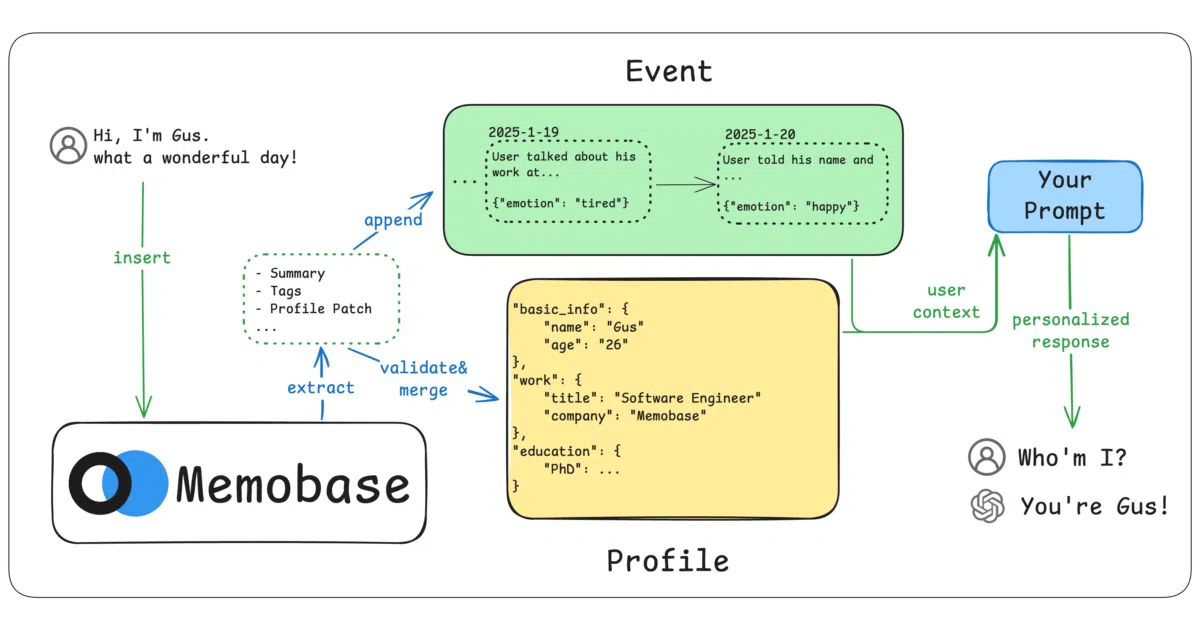
Memobase distills each user's chats into a structured, always-current profile, so remembering a person costs a few SQL queries instead of a vector search over their whole history.
Velocity · 7d
+0.7
★ / day
Trend
→steady
star history
What it does
Memobase is a long-term memory backend for LLM applications, organized around users rather than sessions or agents. You push each user’s chats in as blobs; a background pipeline extracts structured profile fields — name, interests, work, education, even psychological notes — and keeps an event timeline alongside. When you need memory, a context API packs the profile and recent events into a prompt-ready string. Python, Node, and Go SDKs, an HTTP API, and an MCP server are all available.
The interesting bit
The architectural bet: memory is materialized, not retrieved. Profile and timeline are always current, so recall is a handful of SQL operations — the README claims under 100ms — rather than embedding search over raw transcripts. The expensive part (LLM extraction) happens off the hot path, in per-user buffers that flush at roughly 1024 tokens or an hour of idle; since 0.0.40 each run makes a fixed 3 LLM calls, which the authors say cut token costs 40–50%. The searchable context path is the exception, at 500–1000ms depending on your embedding API.
Key highlights
- You design the profile schema — pick which topics and subtopics your product actually cares about, instead of hoarding every fact.
- Time-aware: an event timeline sits next to the profile, so “what did we talk about last week” is answerable.
- Raw blobs are deleted after processing by default; only the distilled memory sticks around (persistence is configurable).
- Self-hostable on FastAPI, Postgres, and Redis, fully dockerized — or use the hosted cloud’s free tier.
- Benchmarked on LOCOMO against mem0, langmem, and zep, with results published in the repo.
Caveats
- It’s a service, not a library — you’re running (or renting) a Postgres/Redis-backed server, real weight for a weekend project.
- Explicitly user memory, not agent memory: no task scratchpads or working memory for autonomous agents.
- The SOTA claims come from the project’s own benchmark runs; treat the numbers as self-reported.
Verdict If your product is “remember me” — companions, tutors, personalized assistants — this is a well-reasoned take on the problem. If you need agent working memory or zero infrastructure, look elsewhere.
Frequently asked
- What is memodb-io/memobase?
- Memobase distills each user's chats into a structured, always-current profile, so remembering a person costs a few SQL queries instead of a vector search over their whole history.
- Is memobase open source?
- Yes — memodb-io/memobase is open source, released under the Apache-2.0 license.
- What language is memobase written in?
- memodb-io/memobase is primarily written in Python.
- How popular is memobase?
- memodb-io/memobase has 2.9k stars on GitHub and is currently holding steady.
- Where can I find memobase?
- memodb-io/memobase is on GitHub at https://github.com/memodb-io/memobase.