mattzh72/articraft
LLMs write Python to build 3D desk lamps with working joints
Articraft turns articulated 3D asset creation into a code-generation pipeline, skipping manual CAD tools for LLM-written Python scripts.
Not currently ranked — collecting fresh signals.
star history
What it does
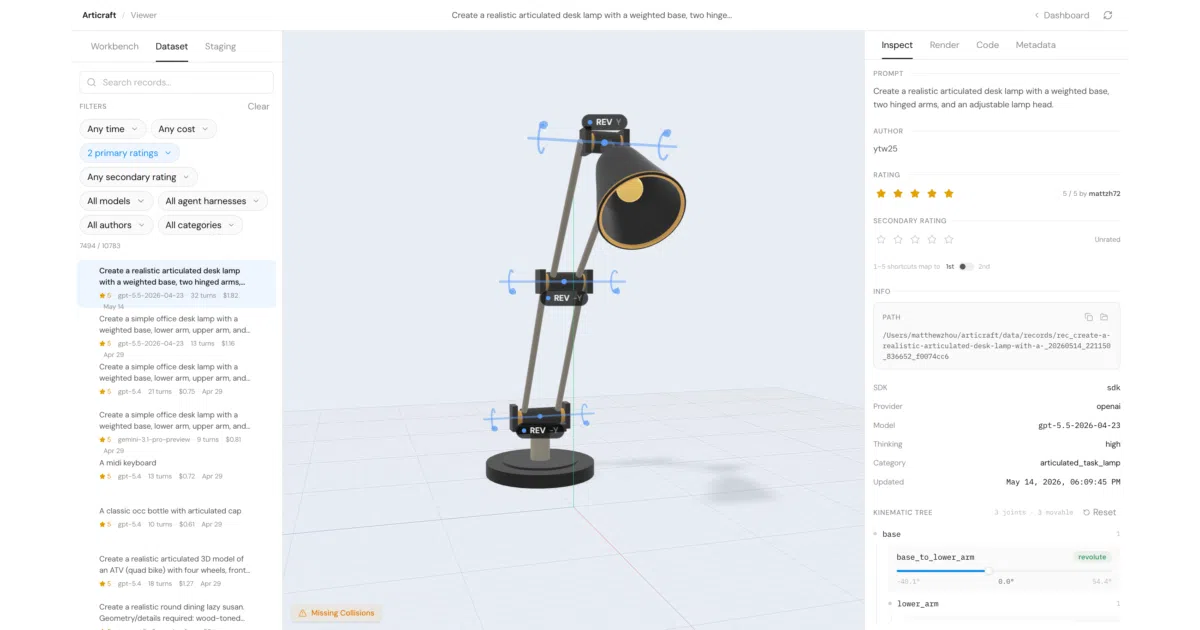
Articraft generates articulated 3D objects—think desk lamps with hinged arms, fans with tilting heads—by having LLMs write Python code instead of manipulating polygons by hand. You prompt it, the system produces a model.py file, and you get geometry with semantic parts and physical joints. A local React viewer lets you browse, search, and inspect results.
The interesting bit
The project treats 3D generation as a software engineering problem: versioned records, forking existing assets with natural language edits ("make the handle longer"), and Git LFS for lazy-loading heavy payloads. It also explicitly supports external agents—Claude Code, Codex, Cursor—as first-class citizens, not just API fallbacks.
Key highlights
- CLI-driven workflow:
articraft generate,articraft fork,articraft data hydrate - Multiple LLM backends: OpenAI, Gemini, Anthropic, DashScope/Qwen
- Image-conditioned generation from reference photos
- Dataset contributions released under CC-BY 4.0 for ML training
- Apache-2.0 licensed; Python 3.11/3.12, uses
uvandjust
Caveats
- Generated
model.pyfiles are executed as Python code; the README warns to only run trusted sources - Python 3.13+ not supported
- Requires
uv,just, Git LFS, and optionallynpmfor the viewer—no lightweight pip install
Verdict
Worth a look if you’re building 3D datasets for robotics, simulation, or generative ML and want programmatic, versioned assets. Skip it if you need polished, production-ready models out of the box; this is a research pipeline with rough edges.
Frequently asked
- What is mattzh72/articraft?
- Articraft turns articulated 3D asset creation into a code-generation pipeline, skipping manual CAD tools for LLM-written Python scripts.
- Is articraft open source?
- Yes — mattzh72/articraft is open source, released under the Apache-2.0 license.
- What language is articraft written in?
- mattzh72/articraft is primarily written in Python.
- How popular is articraft?
- mattzh72/articraft has 1.4k stars on GitHub.
- Where can I find articraft?
- mattzh72/articraft is on GitHub at https://github.com/mattzh72/articraft.