matrixorigin/matrixone
A database that commits, branches, and rolls back like Git
MatrixOne fuses HTAP, vector search, and version control into one MySQL-compatible engine so you can stop duct-taping four databases together.
Not currently ranked — collecting fresh signals.
star history
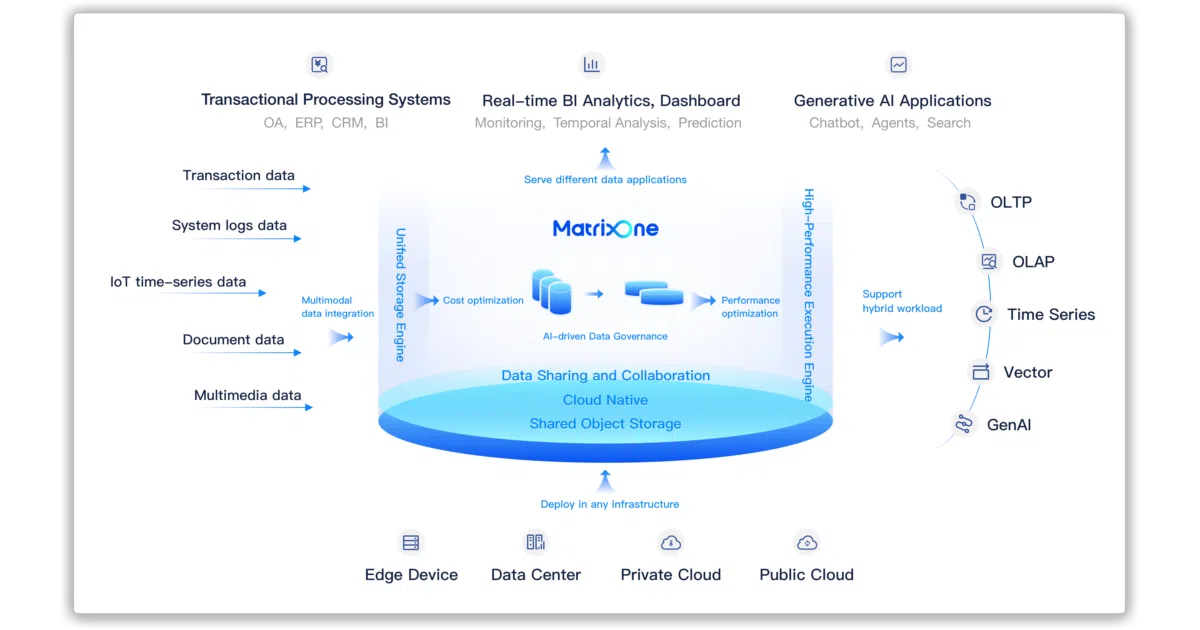
What it does MatrixOne is a single Go-based database that runs OLTP, OLAP, full-text search, and vector search under one roof. It speaks MySQL wire protocol, so existing ORMs and tools plug in without rewrites. The pitch is simple: one system instead of the usual MySQL → ClickHouse → Elasticsearch → Pinecone pipeline, with no ETL jobs or data lag.
The interesting bit The standout feature is “Git for Data” — zero-copy snapshots, time-travel queries, branching, and instant rollback built into the storage engine. The design is backed by an arXiv paper, and in practice it means you can snapshot a database in milliseconds, test a migration on a branch, and merge or discard it. For AI workloads, vector indexes (IVF and HNSW) and full-text search are native, not bolted-on sidecars.
Key highlights
- MySQL-compatible wire protocol; drop-in replacement for existing apps
- Built-in vector search with IVF and HNSW indexes, plus boolean/natural full-text search
- Git-style versioning: snapshots, branches, time travel, and rollback
- Cloud-native architecture with storage-compute separation and Kubernetes support
- Python SDK with SQLAlchemy-style ORM for vector and fulltext operations
Caveats
- The README claims “zero storage explosion” for snapshots, but doesn’t quantify deduplication ratios or branch limits
- “Production-ready” is stated, yet the project carries a modest ~1,800 stars; enterprise battle scars aren’t documented in the sources
Verdict Worth a look if you’re building RAG or agent apps and tired of syncing data across a half-dozen stores. Skip it if you need a battle-tested, narrowly specialized OLAP or vector database with deep ecosystem maturity.
Frequently asked
- What is matrixorigin/matrixone?
- MatrixOne fuses HTAP, vector search, and version control into one MySQL-compatible engine so you can stop duct-taping four databases together.
- Is matrixone open source?
- Yes — matrixorigin/matrixone is open source, released under the Apache-2.0 license.
- What language is matrixone written in?
- matrixorigin/matrixone is primarily written in Go.
- How popular is matrixone?
- matrixorigin/matrixone has 2.1k stars on GitHub.
- Where can I find matrixone?
- matrixorigin/matrixone is on GitHub at https://github.com/matrixorigin/matrixone.