madalinabuzau/tensorflow-eager-tutorials
TensorFlow Eager tutorials from the brief era when eager was new
A collection of Jupyter notebooks teaching deep learning with TensorFlow's imperative mode, frozen in time at version 1.7.
Not currently ranked — collecting fresh signals.
star history
What it does
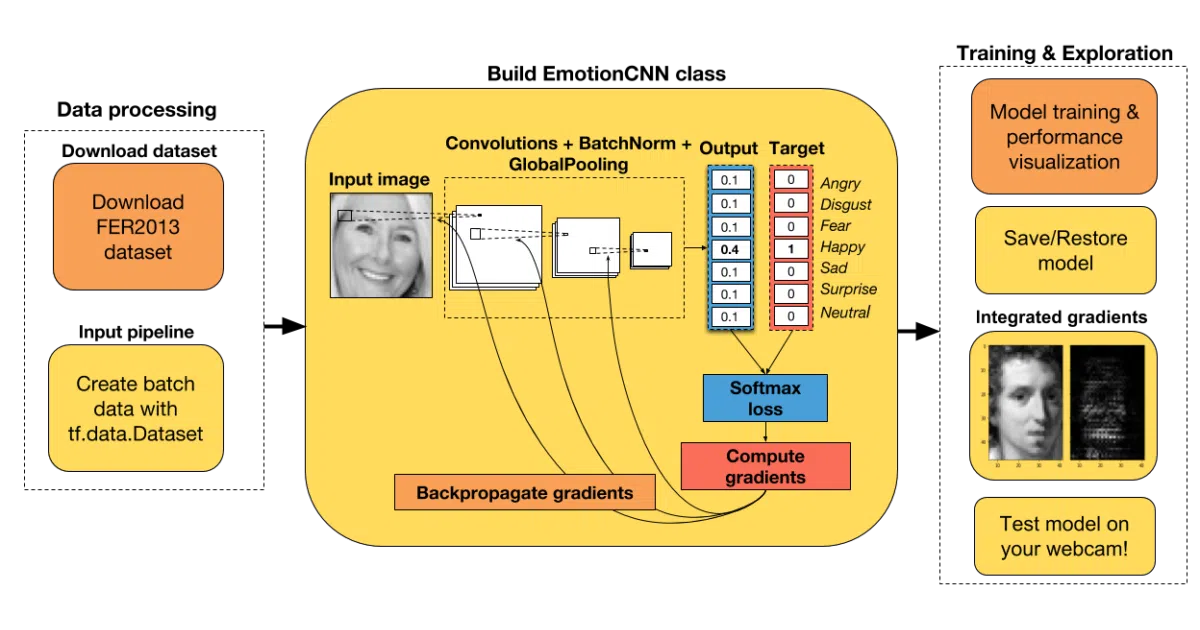
Nine Jupyter notebooks walk through neural network basics with TensorFlow Eager mode: simple feedforward nets, metrics, model save/restore, TFRecords for text and images, CNNs for emotion recognition, and RNNs for sequence classification and time series. The pitch is that Eager lets you write neural network code that looks like NumPy, but with automatic differentiation and GPU support.
The interesting bit
These tutorials date from the awkward adolescence of TensorFlow, after Eager execution arrived in 1.5 but before it became the default in TensorFlow 2.0. The author deliberately chose problems that run on CPU, which was genuinely useful in 2018 when GPU access was harder to come by. The webcam demo for emotion recognition is a nice touch of interactivity in an otherwise standard curriculum.
Key highlights
- Covers practical pipeline skills (TFRecords, batching, save/restore) that many tutorials skip
- Includes three distinct problem types: classification, regression, and sequence modeling
- Explicitly targets beginners with synthetic or small real datasets
- Webcam-based CNN demo for live emotion recognition
- Author actively solicited tutorial requests and feedback
Caveats
- Pinned to TensorFlow 1.7, which is several major versions behind current releases
- Eager mode is now the default behavior in TensorFlow 2.x, making these tutorials partly historical
- “transfew” typo in the image-to-TFRecords description suggests limited maintenance
Verdict
Worth a look if you’re maintaining legacy TensorFlow 1.x code or curious about the pre-2.0 transition. Skip it if you need current TensorFlow patterns — the modern equivalent would use tf.keras by default and handle Eager execution without ceremony.
Frequently asked
- What is madalinabuzau/tensorflow-eager-tutorials?
- A collection of Jupyter notebooks teaching deep learning with TensorFlow's imperative mode, frozen in time at version 1.7.
- Is tensorflow-eager-tutorials open source?
- Yes — madalinabuzau/tensorflow-eager-tutorials is an open-source project tracked on heatdrop.
- What language is tensorflow-eager-tutorials written in?
- madalinabuzau/tensorflow-eager-tutorials is primarily written in Jupyter Notebook.
- How popular is tensorflow-eager-tutorials?
- madalinabuzau/tensorflow-eager-tutorials has 509 stars on GitHub.
- Where can I find tensorflow-eager-tutorials?
- madalinabuzau/tensorflow-eager-tutorials is on GitHub at https://github.com/madalinabuzau/tensorflow-eager-tutorials.