lucidrains/titans-pytorch
A transformer memory module that updates itself during inference
It ports the Titans architecture to PyTorch so transformers can memorize long context by learning at test time.
Not currently ranked — collecting fresh signals.
star history
What it does
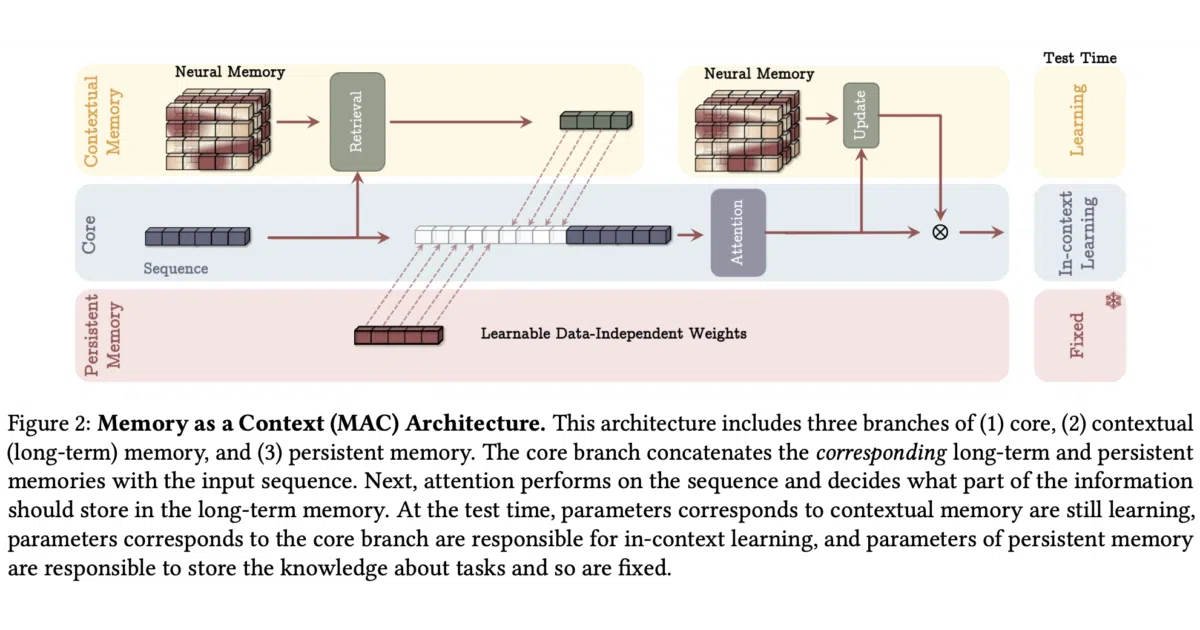
titans-pytorch is an unofficial reimplementation of the Titans paper, which bolts a learnable neural memory module onto standard transformers. The gist is test-time training: instead of freezing weights during inference, the model updates its memory to absorb long contexts on the fly. The repo provides a standalone NeuralMemory layer and a full MemoryAsContextTransformer that weaves memory tokens into a local-attention backbone. The author also plans to tinker with deeper memory architectures beyond the paper’s simple 1–4 layer MLP if early experiments continue to look promising.
The interesting bit
The MAC (Memory as Context) configuration mixes persistent memory tokens, long-term memory tokens, and a sliding local attention window, letting the model decide what to remember without ballooning the KV cache. A tunable chunk_size parameter hints that memory updates happen in chunks, offering a dial to trade memory pressure for sequence-level performance. The README is admirably candid about the whole thing being unofficial and exploratory.
Key highlights
- Standalone
NeuralMemorymodule plus a fullMemoryAsContextTransformerready for token-level training and sampling. - Configurable
segment_lenfor local attention, plus separate slots for persistent and long-term memory tokens. - Ships with a
train_mac.pyexperiment script and a linked Colab for quick smoke tests. - Author is already eyeing architectural variants beyond the paper’s shallow MLP memory design.
Caveats
- The README offers no training curves, benchmarks, or throughput numbers, so you are buying the architecture on spec.
- The author explicitly hedges that deeper memory explorations will only continue if the basic version works well, which it may not.
Verdict
Worth a look if you are researching long-context transformers or need a clean, hackable PyTorch sketch of test-time training. Move along if you require a production-hardened memory layer with proven performance data.
Frequently asked
- What is lucidrains/titans-pytorch?
- It ports the Titans architecture to PyTorch so transformers can memorize long context by learning at test time.
- Is titans-pytorch open source?
- Yes — lucidrains/titans-pytorch is open source, released under the MIT license.
- What language is titans-pytorch written in?
- lucidrains/titans-pytorch is primarily written in Python.
- How popular is titans-pytorch?
- lucidrains/titans-pytorch has 2k stars on GitHub.
- Where can I find titans-pytorch?
- lucidrains/titans-pytorch is on GitHub at https://github.com/lucidrains/titans-pytorch.