lsdefine/GenericAgent
A 3,000-line seed that grows its own skill tree
GenericAgent is a minimal framework that lets any LLM bootstrap itself into a full system operator by turning every solved task into a reusable skill.
Not currently ranked — collecting fresh signals.
star history
What it does
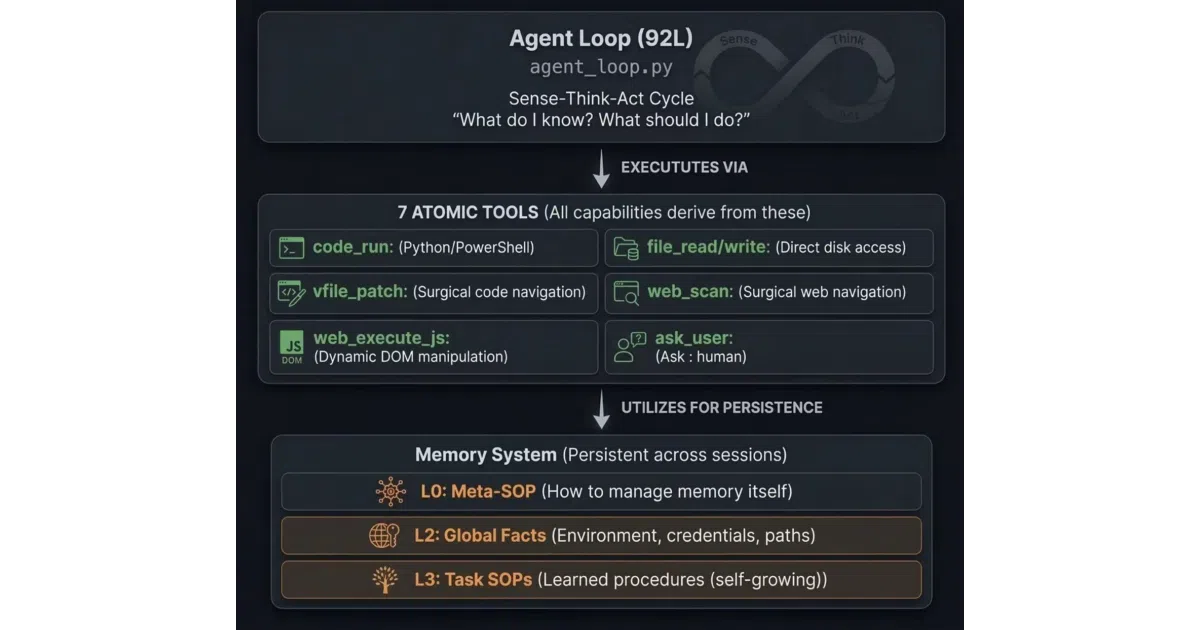
GenericAgent is a Python framework that gives supported LLMs direct control over a local computer—browser, terminal, filesystem, keyboard, mouse, screen vision, and mobile devices via ADB. Its core is roughly 3,000 lines of code built around nine atomic tools and a ~100-line execution loop. The agent handles tasks by perceiving the environment, reasoning, executing tools, and writing what it learned into memory.
The interesting bit
Rather than preloading capabilities, the framework “crystallizes” each completed task into a reusable Skill stored across a five-layer memory stack. The authors claim the repository itself serves as a self-bootstrap proof, asserting that every commit from git init onward was generated without the author opening a terminal. It also claims to operate on under a 30K token context window, which it says is a fraction of the 200K–1M windows other agents consume.
Key highlights
- Accumulates a personal skill tree over time; the longer it runs, the more capable it becomes without manual dependency hunting.
- Injects into a real browser with session persistence, not a headless sandbox, alongside OS-level input and screen access.
- Supports multiple LLM backends including Claude, Gemini, Kimi, and MiniMax.
- Ships with desktop, terminal, Streamlit, and instant-messenger frontends covering Telegram, WeChat, Lark, and others.
- Can dynamically extend its own toolset at runtime by writing and executing code, then promoting useful scripts into permanent skills.
Caveats
- Python 3.14 is explicitly incompatible due to
pywebviewdependency issues; the project targets Python 3.11 and 3.12. - The Textual-based terminal UI can render poorly on Windows depending on the terminal emulator and font.
- The comparison table in the README is truncated, so several claimed distinctions against other tools are incomplete in the provided source.
Verdict
Worth exploring if you want an agent that accumulates bespoke competence over time rather than starting from scratch each session. Less appealing if you prefer exhaustive human-readable documentation over a tool that literally expects you to ask it for help with its own configuration.
Frequently asked
- What is lsdefine/GenericAgent?
- GenericAgent is a minimal framework that lets any LLM bootstrap itself into a full system operator by turning every solved task into a reusable skill.
- Is GenericAgent open source?
- Yes — lsdefine/GenericAgent is open source, released under the MIT license.
- What language is GenericAgent written in?
- lsdefine/GenericAgent is primarily written in Python.
- How popular is GenericAgent?
- lsdefine/GenericAgent has 14.3k stars on GitHub.
- Where can I find GenericAgent?
- lsdefine/GenericAgent is on GitHub at https://github.com/lsdefine/GenericAgent.