lmnr-ai/index
A reasoning browser agent that shows its work
Index autonomously navigates the web using vision-capable reasoning models, offering structured data extraction and full session replay through built-in observability.
Not currently ranked — collecting fresh signals.
star history
What it does
Index hands a web browser to a vision-capable reasoning LLM and lets it navigate, click, and extract data autonomously. It returns structured results through Pydantic schemas and can be driven from Python, an interactive terminal UI, or a hosted serverless API. Every run can be wired into the open-source Laminar platform to trace actions alongside a recorded browser session.
The interesting bit
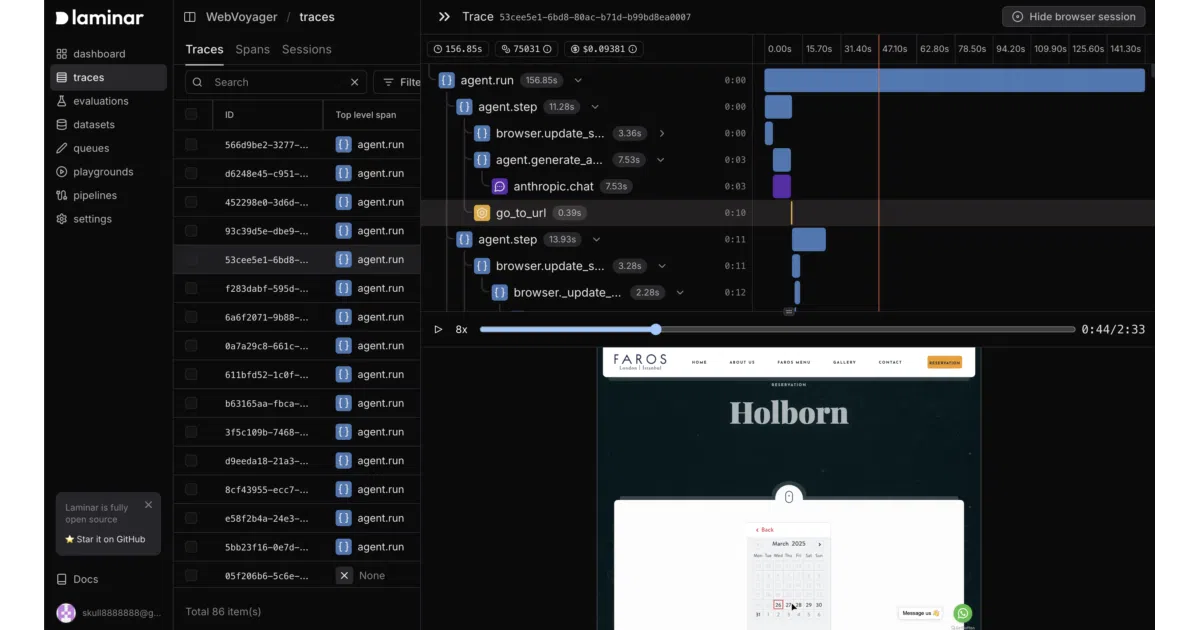
Unlike most headless agents, Index treats observability as a first-class feature: it syncs agent reasoning with browser session recordings so you can debug a failure without guessing. It also supports attaching to your personal Chrome instance, which means existing logins and cookies carry over instead of starting from a blank slate.
Key highlights
- Supports multiple reasoning models: Gemini 2.5 Pro/Flash, Claude 3.7 Sonnet, and OpenAI o4-mini.
- Enforces structured output via Pydantic schemas, turning messy web pages into typed data.
- Interactive CLI with browser state persistence across sessions and a “give human control” escape hatch.
- Optional integration with personal Chrome to reuse existing sessions and cookies.
- Deep observability integration with the open-source Laminar platform for tracing and session recording.
Caveats
- The README bills it as “state-of-the-art,” though it offers no benchmarks or comparison data to support the claim.
- Production use is steered toward the authors’ hosted serverless API and Laminar platform; self-hosting details are sparse.
- You will need API keys for at least one of the supported LLM providers to do anything useful.
Verdict
Worth a look if you need to extract structured data from sites that lack APIs and want visibility into what the agent actually clicked. Skip it if you were hoping for a fully offline, self-contained browser automation stack with no third-party dependencies.
Frequently asked
- What is lmnr-ai/index?
- Index autonomously navigates the web using vision-capable reasoning models, offering structured data extraction and full session replay through built-in observability.
- Is index open source?
- Yes — lmnr-ai/index is open source, released under the Apache-2.0 license.
- What language is index written in?
- lmnr-ai/index is primarily written in Python.
- How popular is index?
- lmnr-ai/index has 2.4k stars on GitHub.
- Where can I find index?
- lmnr-ai/index is on GitHub at https://github.com/lmnr-ai/index.