lasgroup/SDPO
Teaching LLMs to learn from their own mistakes
SDPO exists because scalar pass/fail rewards waste the rich textual feedback—error logs, judge evaluations—that verifiable domains already produce.
Not currently ranked — collecting fresh signals.
star history
What it does
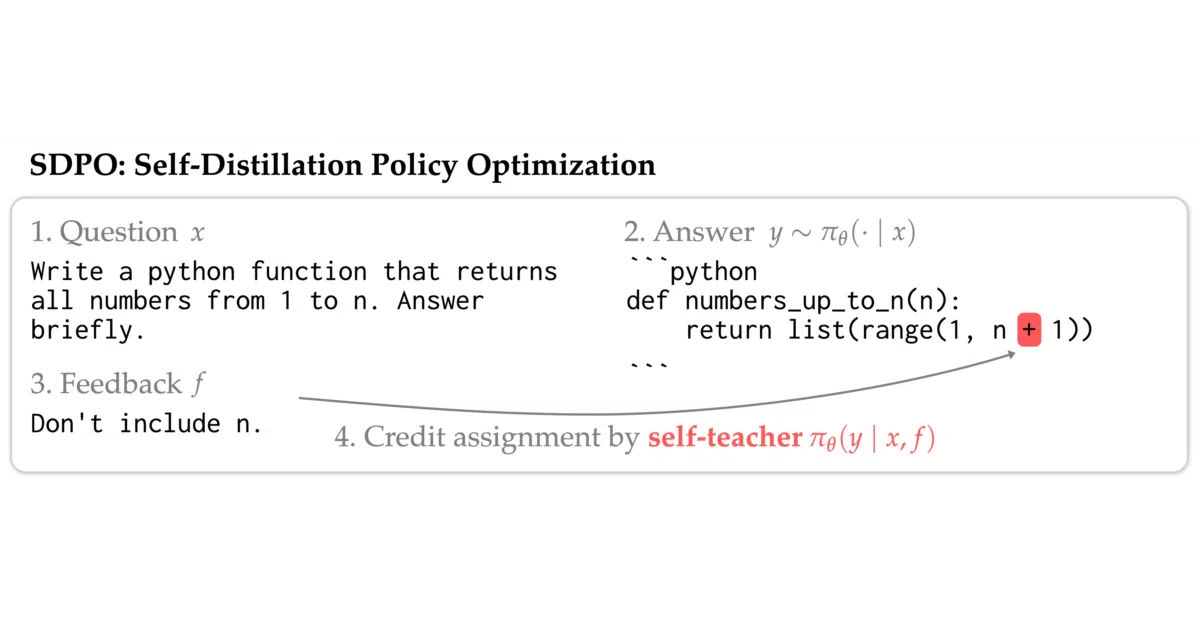
SDPO fine-tunes large language models with reinforcement learning in verifiable domains such as math and code. It augments standard on-policy optimization by distilling the model’s own high-reward trajectories—and any textual feedback from failures—back into the policy. The result is a denser training signal that uses error messages and judge evaluations without requiring an external teacher or explicit reward model.
The interesting bit
The policy acts as its own teacher: it conditions on feedback from failed attempts, predicts what it should have done, and distills those feedback-informed next-token probabilities back into itself. The same trick works at test time, where the model iteratively refines hard problems by treating its own best generations as in-context demonstrations.
Key highlights
- Converts rich textual feedback—runtime errors, judge evaluations, stack traces—into dense supervision.
- Outperforms GRPO on chemistry reasoning and LiveCodeBenchv6 when rich feedback is available, according to the README benchmarks.
- Falls back to implicit self-distillation from high-reward rollouts when environment feedback is sparse.
- Supports test-time self-distillation to bootstrap harder coding problems without additional training.
- Built as an extension to the
verlRL framework, with Docker images pre-configured for NVIDIA GH200 clusters.
Caveats
- Blackwell GPU support (RTX 50 series, B100/B200) is explicitly flagged as not fully tested.
- The README is dominated by cluster deployment, Docker builds, and reproduction scripts; this is an infrastructure-heavy research codebase, not a lightweight library.
- Results shown focus on specific models and benchmarks (Olmo3-7B-Instruct, chemistry, LiveCodeBench); broader generalization is not demonstrated.
Verdict
A solid bet if you are already running GPU clusters for LLM reinforcement learning and want to exploit detailed environment feedback instead of collapsing it to a scalar reward. Everyone else should admire the idea from a distance.
Frequently asked
- What is lasgroup/SDPO?
- SDPO exists because scalar pass/fail rewards waste the rich textual feedback—error logs, judge evaluations—that verifiable domains already produce.
- Is SDPO open source?
- Yes — lasgroup/SDPO is open source, released under the Apache-2.0 license.
- What language is SDPO written in?
- lasgroup/SDPO is primarily written in Python.
- How popular is SDPO?
- lasgroup/SDPO has 1k stars on GitHub.
- Where can I find SDPO?
- lasgroup/SDPO is on GitHub at https://github.com/lasgroup/SDPO.