kerpopule/hermes-jev-skills
Stop paying frontier prices for your agent's yes/no questions
Agents burn expensive tokens on choices that aren't thinking — which model, which skill, which passage — so this repo hands those calls to a decision-only model that answers in ~0.4 seconds for a fraction of a cent.
Collecting fresh signals — velocity needs a few days of history.
collecting data…
star history
What it does
Eleven skills, shipped as plain SKILL.md files, that delegate an agent’s small decisions to Jev — TypeSafe’s decision-only model. Jev never writes prose: you give it a state and typed questions (pick one, score this, yes/no) and it answers with a calibrated confidence in roughly 0.4 seconds. The calls it takes over include which model is good enough this turn, which of 377 installed skills to load, which search results and memory passages are worth opening, which turns survive compaction, and the next GUI or browser action. The same folder works in Hermes, Claude Code, and Codex — anything that reads a skill file — and the Hermes plugin sticks to public plugin seams, so core updates don’t break it.
The interesting bit
The results table measures everything, including its own failures. The handoffs skill originally had Jev build a keep/summarize/drop digest; the digest recalled less than the plain transcript, so what ships is the whole dialogue (58.7% recall alone, 75.0% with one search, versus 37.5% and 68.3% before) and Jev decides nothing there by default. Shadow mode is the other honest move: routing decides and logs without switching anything, so you can audit a day of decisions before committing a single one.
Key highlights
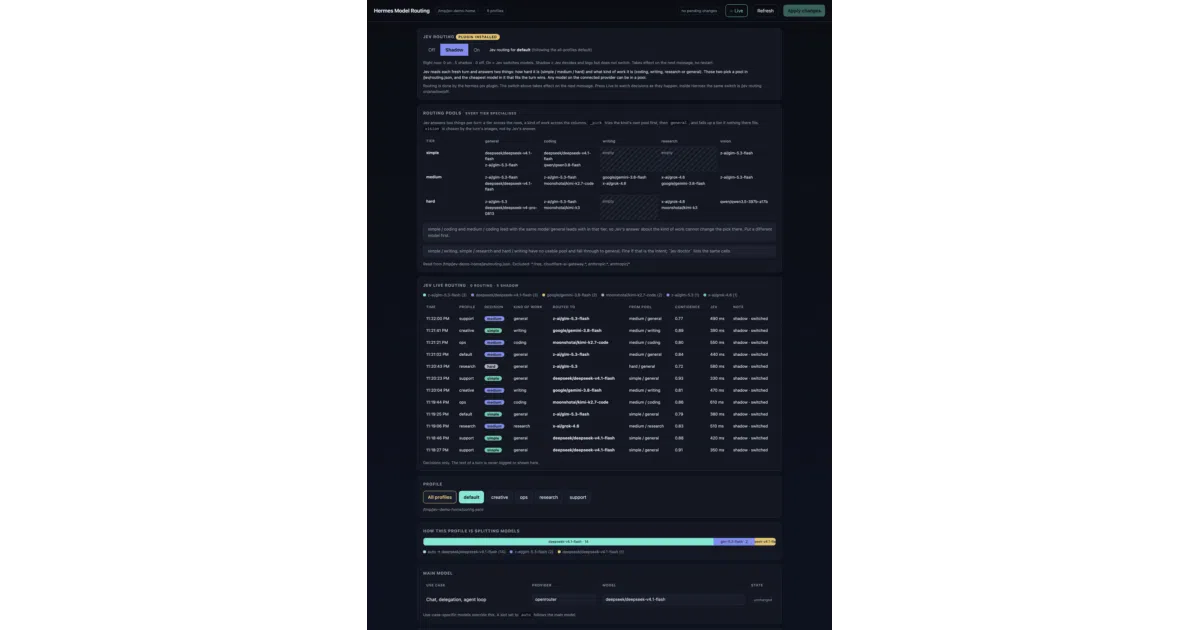
- Model routing picks the cheapest good-enough model per turn, from every model your keys can call, with a shadow mode that logs decisions without acting on them.
- Web screening caught 70 of 79 planted instruction-injection attacks in real web results (Hermes’s own pattern scan caught 11) and withheld 0 of 1,520 clean chunks, at ~0.2s per result.
- Skill selection covers 377 skills in ~2.8s; compaction chose 71 turns in 0.95s and beat recency-based selection 11 questions to 4.
- Computer and browser use constrain Jev to picking the next action from a table of actions you already judged safe — the action space is curated, not free-form.
- Privacy is spelled out per skill: redacted text, local ids replaced with
P0,P1…, sensitive-looking turns skipped or reduced to coarse features; the API key goes into the OS secret store via a one-time local page, and the agent never sees it.
Caveats
- Jev is a cloud API — content leaves the machine, however redacted and capped. If that’s a hard line for you, this isn’t your repo.
- The web-screening 70/79 is on in-distribution planted attacks; the README itself flags it as “not portable recall” and links held-out evidence.
- Social research has no benchmark of its own (it reuses the search numbers), and handoffs deliberately uses no Jev at all.
Verdict
If you run Hermes — or Claude Code or Codex — and your bill flinches every time the agent picks a model or rereads memory, the shadow mode alone is worth an afternoon. If one more cloud vendor between you and your agent is a dealbreaker, the scorecards still make this one of the more honest reads in the space.
Frequently asked
- What is kerpopule/hermes-jev-skills?
- Agents burn expensive tokens on choices that aren't thinking — which model, which skill, which passage — so this repo hands those calls to a decision-only model that answers in ~0.4 seconds for a fraction of a cent.
- Is hermes-jev-skills open source?
- Yes — kerpopule/hermes-jev-skills is open source, released under the MIT license.
- What language is hermes-jev-skills written in?
- kerpopule/hermes-jev-skills is primarily written in Python.
- How popular is hermes-jev-skills?
- kerpopule/hermes-jev-skills has 1k stars on GitHub.
- Where can I find hermes-jev-skills?
- kerpopule/hermes-jev-skills is on GitHub at https://github.com/kerpopule/hermes-jev-skills.