katanemo/plano
Stop Writing Intent Classifiers for Every New AI Agent
Plano is an AI-native proxy that centralizes routing, guardrails, and observability for multi-agent apps so you don't have to rebuild middleware in every codebase.
Not currently ranked — collecting fresh signals.
star history
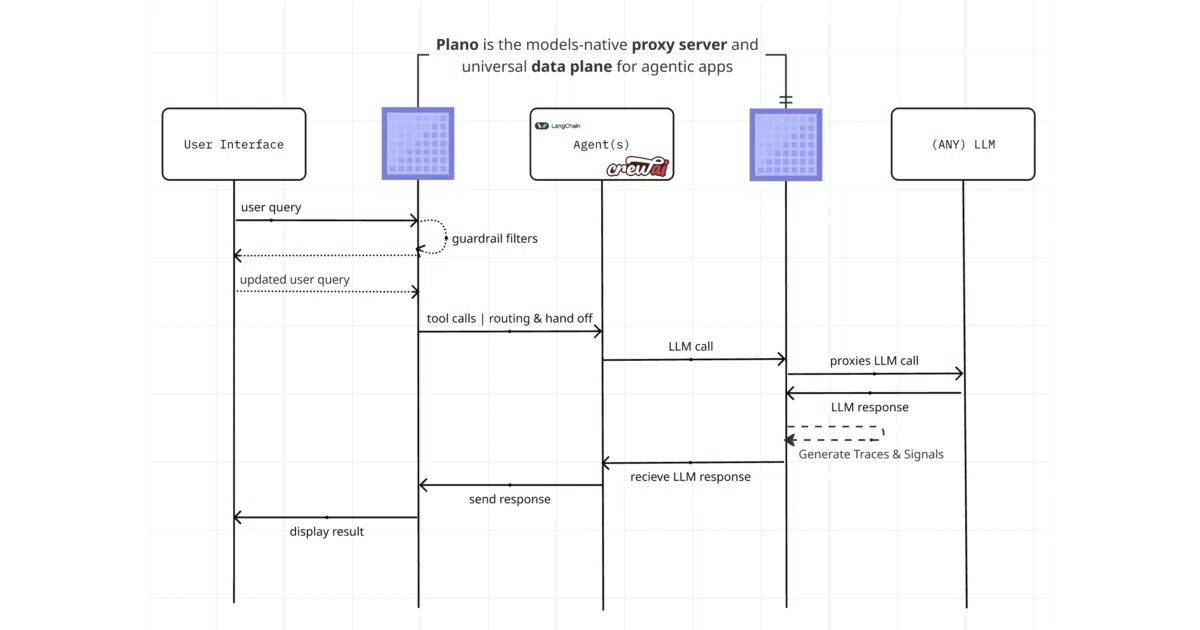
What it does Plano is a Rust-based proxy and data plane that sits between users and your AI agents. You declare agents and their capabilities in YAML, and it handles low-latency orchestration, LLM routing, safety guardrails, and OpenTelemetry tracing without touching your application code. Agents remain simple HTTP servers with an OpenAI-compatible chat endpoint; Plano takes care of the messy delivery infrastructure.
The interesting bit Instead of using heavy general-purpose models for routing, Plano uses its own lightweight LLMs—like a 4B-parameter orchestrator—to figure out which agent should handle a request. Because it is built on Envoy by the proxy’s core contributors, it treats agent traffic like modern service mesh traffic: filters, listeners, and declarative config rather than framework abstractions.
Key highlights
- Declare agents with natural-language descriptions in YAML; Plano routes requests automatically—no custom intent classifiers needed.
- Built-in filter chains for moderation, jailbreak protection, and memory hooks.
- Automatic OpenTelemetry traces and “Agentic Signals” for evaluation and continuous improvement.
- Model-agnostic LLM gateway that routes by name, alias, or preference, abstracting provider quirks.
- Runs as an out-of-process data plane, so agents can be written in any language or framework.
Caveats
- Free hosted routing LLMs (like the Plano-Orchestrator) run only from a US-central region; production scaling requires self-hosting or contacting the team for API keys.
- Some of the smarter routing features depend on Plano’s own model family, which is currently offered as a hosted service alongside the open-source proxy.
Verdict If you are shipping multi-agent systems to production and tired of reinventing routing, observability, and guardrails in Python middleware, Plano is worth a look. If you are still in the single-agent demo phase, it is probably overkill.
Frequently asked
- What is katanemo/plano?
- Plano is an AI-native proxy that centralizes routing, guardrails, and observability for multi-agent apps so you don't have to rebuild middleware in every codebase.
- Is plano open source?
- Yes — katanemo/plano is open source, released under the Apache-2.0 license.
- What language is plano written in?
- katanemo/plano is primarily written in Rust.
- How popular is plano?
- katanemo/plano has 7.1k stars on GitHub.
- Where can I find plano?
- katanemo/plano is on GitHub at https://github.com/katanemo/plano.