kamalkraj/BERT-NER
BERT NER: Python training, C++ inference, and a REST API
A PyTorch implementation of named entity recognition using BERT that ships with a C++ inference path and a lightweight REST API.
Not currently ranked — collecting fresh signals.
star history
What it does
This repo fine-tunes BERT (base and large) on the CoNLL-2003 NER dataset to label people, organizations, locations, and miscellaneous entities. It provides pretrained models, a Python inference wrapper, a C++ libtorch inference binary, and a small REST API served via api.py.
The interesting bit
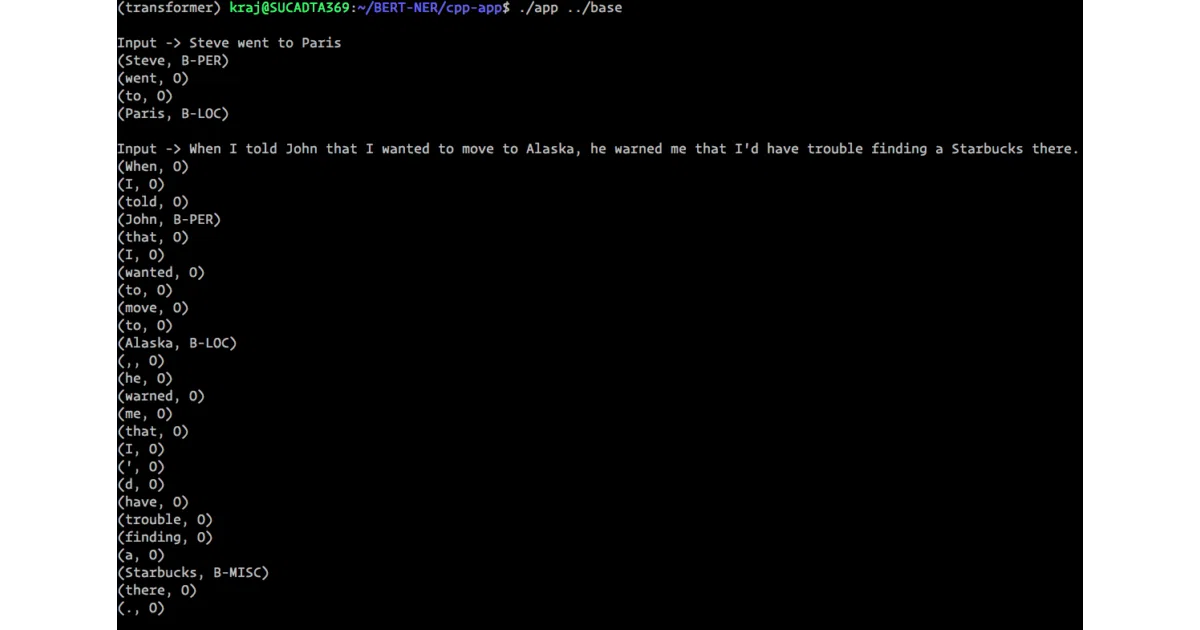
The C++ inference path is the unusual part. The author traced the model with PyTorch JIT, but had to split it into two pieces—feature extractor and classifier—because jit.trace chokes on input-dependent loops and conditionals inside forward(). It’s a pragmatic hack that gets you a compiled binary without dragging Python into production.
Key highlights
- Pretrained BERT-base and BERT-large models with reported F1 scores around 0.91–0.95 on CoNLL-2003 test/validation data
- Python one-liner inference via
bert.Ner.predict()with per-token confidence scores - C++ inference app using libtorch 1.2.0, with cmake build instructions and a split-model workaround
- REST API at
0.0.0.0:8000/predictwith cURL and Postman examples - Unicode support in C++ via the
ufal/uniliblibrary
Caveats
- The README is sparse on architecture details; it’s basically a runnable script collection with results pasted in
- C++ setup requires manual downloads of libtorch and a converted model from OneDrive links
- No training code explanation beyond a single command-line invocation
Verdict
Worth a look if you need a quick BERT-NER baseline with a C++ deployment path. Skip it if you want a maintained, well-documented library—this is more of a working recipe than a framework.
Frequently asked
- What is kamalkraj/BERT-NER?
- A PyTorch implementation of named entity recognition using BERT that ships with a C++ inference path and a lightweight REST API.
- Is BERT-NER open source?
- Yes — kamalkraj/BERT-NER is open source, released under the AGPL-3.0 license.
- What language is BERT-NER written in?
- kamalkraj/BERT-NER is primarily written in Python.
- How popular is BERT-NER?
- kamalkraj/BERT-NER has 1.2k stars on GitHub.
- Where can I find BERT-NER?
- kamalkraj/BERT-NER is on GitHub at https://github.com/kamalkraj/BERT-NER.