kakaobrain/fast-autoaugment
The 3.5-GPU-hour alternative to AutoAugment
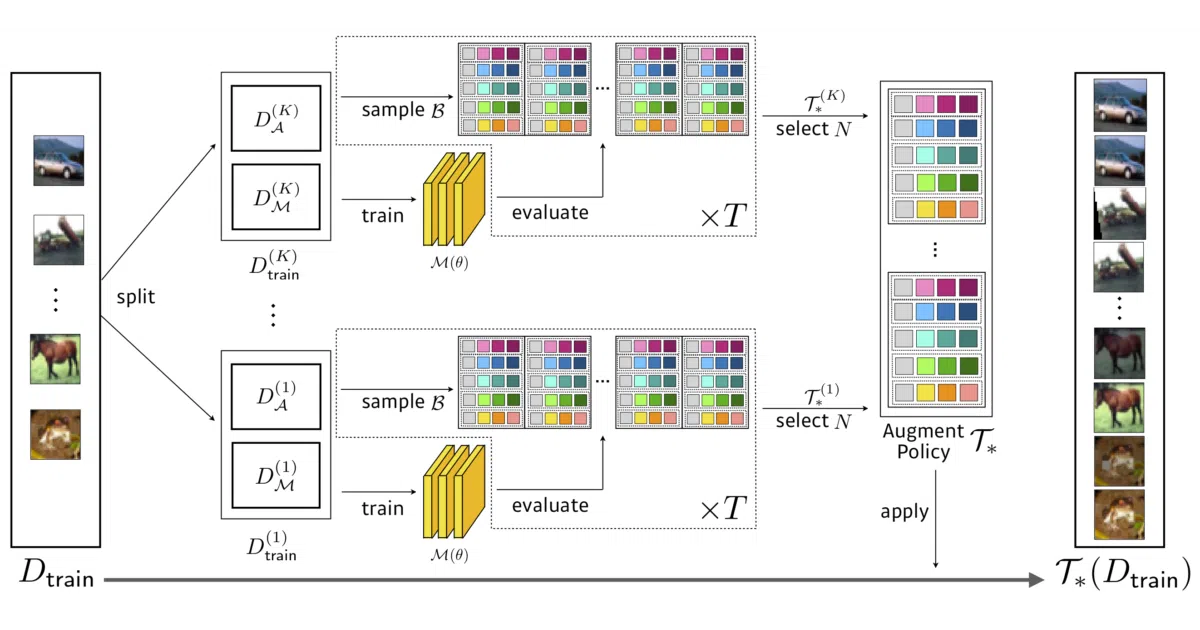
It implements a density-matching search that finds image augmentation policies in hours, claiming orders-of-magnitude speedups over the original AutoAugment.
Not currently ranked — collecting fresh signals.
star history
What it does Fast AutoAugment is the official PyTorch reproduction of a NeurIPS 2019 paper that automates the hunt for good image distortion policies. Instead of hand-tuning flips, crops, and color jitters, it searches for combinations that improve model accuracy, then hands you a fixed recipe you can reuse in standard training. The repo bundles the search algorithm, YAML configuration files, and a model zoo with pretrained weights for CIFAR-10/100, ImageNet, and SVHN.
The interesting bit The speedup comes from density matching, a search strategy that the authors claim explores the policy space far more efficiently than the original AutoAugment brute-force approach. On CIFAR-10, search finishes in 3.5 GPU hours—a 1,428× speedup—while ImageNet search drops to 450 GPU hours, or 33× faster, with comparable final accuracy.
Key highlights
- CIFAR-10 policy search finishes in 3.5 GPU hours; ImageNet in 450 GPU hours, with speedups of 1,428× and 33× over the original AutoAugment method.
- Pretrained models are provided for Wide-ResNet, Shake-Shake, PyramidNet, ResNet, and EfficientNet-B0.
- Distributed search relies on Ray, and multi-node training is supported through PyTorch’s distributed launcher.
- The project is a full research artifact: search scripts, training pipelines, configs, and evaluation checkpoints included.
Caveats
- The documented environment is Python 3.6.9, PyTorch 1.2.0, and CUDA 10, so modern compatibility is unclear.
- Setting up the Ray cluster for the search phase is explicitly flagged as a prerequisite, not a built-in single-process fallback.
Verdict A solid stop for researchers reproducing 2019 AutoAugment baselines or anyone who needs a vetted augmentation policy for standard vision benchmarks. If you are looking for a modern, drop-in augmentation library with current dependencies, this is not it.
Frequently asked
- What is kakaobrain/fast-autoaugment?
- It implements a density-matching search that finds image augmentation policies in hours, claiming orders-of-magnitude speedups over the original AutoAugment.
- Is fast-autoaugment open source?
- Yes — kakaobrain/fast-autoaugment is open source, released under the MIT license.
- What language is fast-autoaugment written in?
- kakaobrain/fast-autoaugment is primarily written in Python.
- How popular is fast-autoaugment?
- kakaobrain/fast-autoaugment has 1.6k stars on GitHub.
- Where can I find fast-autoaugment?
- kakaobrain/fast-autoaugment is on GitHub at https://github.com/kakaobrain/fast-autoaugment.