kaixindelele/ChatPaper
ChatGPT as your postdoc: reading papers so you don't have to
A Chinese PhD student built a pipeline to crawl arXiv, summarize papers, translate them, and even draft peer reviews—all via OpenAI's API.
Not currently ranked — collecting fresh signals.
star history
What it does ChatPaper is a Python toolkit that automates the most tedious parts of academic reading. Feed it an arXiv keyword and it downloads recent papers, pipes them through the ChatGPT API, and spits back structured summaries in Chinese. It also handles local PDFs, full-text translation, paper polishing, and—controversially—automated peer-review generation and rebuttal drafting. The author, a USTC reinforcement-learning PhD, built it to “use magic against magic” in the face of AI’s rapid progress.
The interesting bit The project isn’t just a wrapper—it’s grown into a whole ecosystem. Spinoffs include ChatReviewer (critiques papers), ChatResponse (drafts rebuttals to reviewers), and even ChatGenTitle, which fine-tuned a model on 2.2 million arXiv abstracts to generate titles from abstracts. The main repo has pre-summarized 30,000+ CCF-A conference papers to cut wait times.
Key highlights
- Crawls arXiv by keyword, date range, and paper count; fixes the “inaccurate search” of the standard arxiv package
- Outputs fixed-format summaries designed for rapid triage: decide what to actually read in depth
- Full local PDF translation pipeline added mid-2023
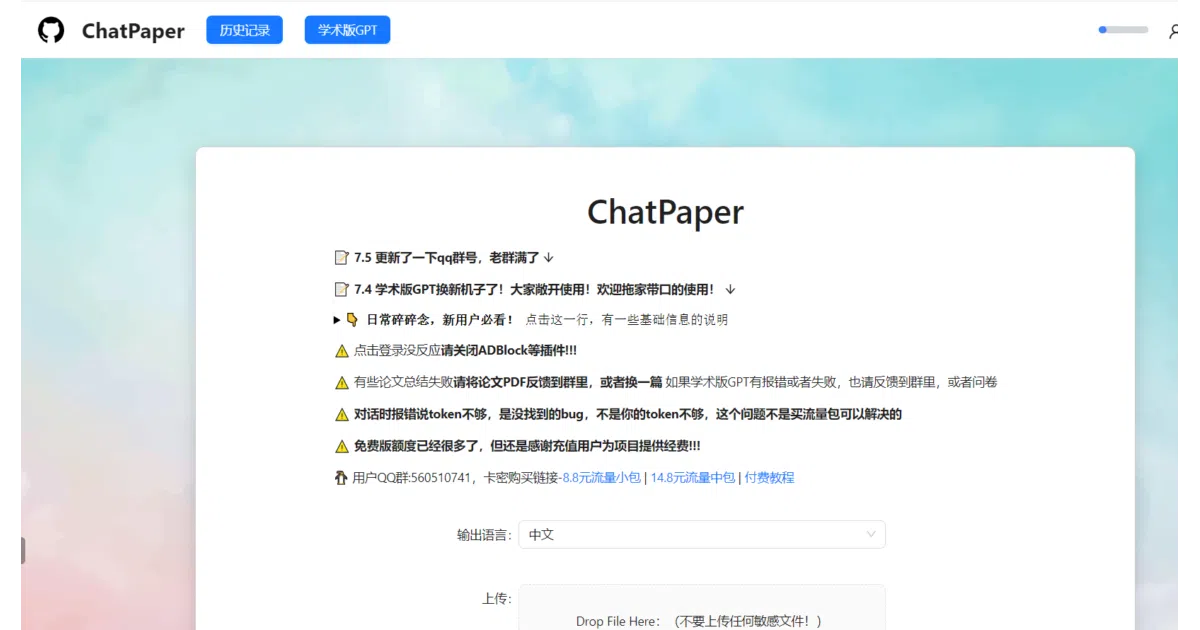
- Web UI at chatpaper.org; HuggingFace spaces for reviewer/response tools
- Explicit (if imperfect) guardrails: ChatReviewer injects “complex text” to flag AI-generated reviews and warns against academic-ethics abuse
Caveats
- Requires an unblocked ChatGPT account and API key; Chinese users face access friction
- The README admits a July 2023 file reorganization introduced “some path issues and bugs, currently being fixed”
- Review and rebuttal features walk an obvious ethical tightrope; the author asks for help preventing misuse but offers no technical enforcement beyond watermarking
Verdict Grad students drowning in literature reviews—especially Chinese-speaking ones—will find this a pragmatic time-saver. If you already have Zotero, Semantic Scholar, and a working ChatGPT tab, it’s mostly glue. The translation and batch-summarization are the solid bits; the peer-review automation is a loaded gun with a warning label.
Frequently asked
- What is kaixindelele/ChatPaper?
- A Chinese PhD student built a pipeline to crawl arXiv, summarize papers, translate them, and even draft peer reviews—all via OpenAI's API.
- Is ChatPaper open source?
- Yes — kaixindelele/ChatPaper is an open-source project tracked on heatdrop.
- What language is ChatPaper written in?
- kaixindelele/ChatPaper is primarily written in Python.
- How popular is ChatPaper?
- kaixindelele/ChatPaper has 19.6k stars on GitHub.
- Where can I find ChatPaper?
- kaixindelele/ChatPaper is on GitHub at https://github.com/kaixindelele/ChatPaper.