justlovemaki/AIClient2API
Turn free AI clients into a unified OpenAI-compatible API
A Node.js proxy that lets you call Gemini CLI, Codex, Grok, and others through a standard OpenAI interface.
Velocity · 7d
+8.1
★ / day
Trend
↗accelerating
star history
What it does
AIClient2API is a self-hosted proxy that simulates requests to client-only AI services—Gemini CLI, Antigravity, Codex, Grok, Kiro—and wraps them in a local OpenAI-compatible API. You point your existing tools (Cherry Studio, NextChat, Cline, etc.) at it and suddenly those “free with signup” models behave like standard API endpoints.
The interesting bit
The project doesn’t just forward requests; it reverse-engineers client protocols and handles protocol translation between OpenAI, Claude, and Gemini formats. It also manages account pools with polling, failover, and health checks—essentially treating free-tier accounts as a load-balanced cluster.
Key highlights
- Supports Gemini CLI, Antigravity, Codex, Grok, Kiro, and Gemini Preview protocols
- Built-in account pool management with “intelligent polling” and automatic failover
- Docker image with 100k+ downloads; Node.js ≥20 required
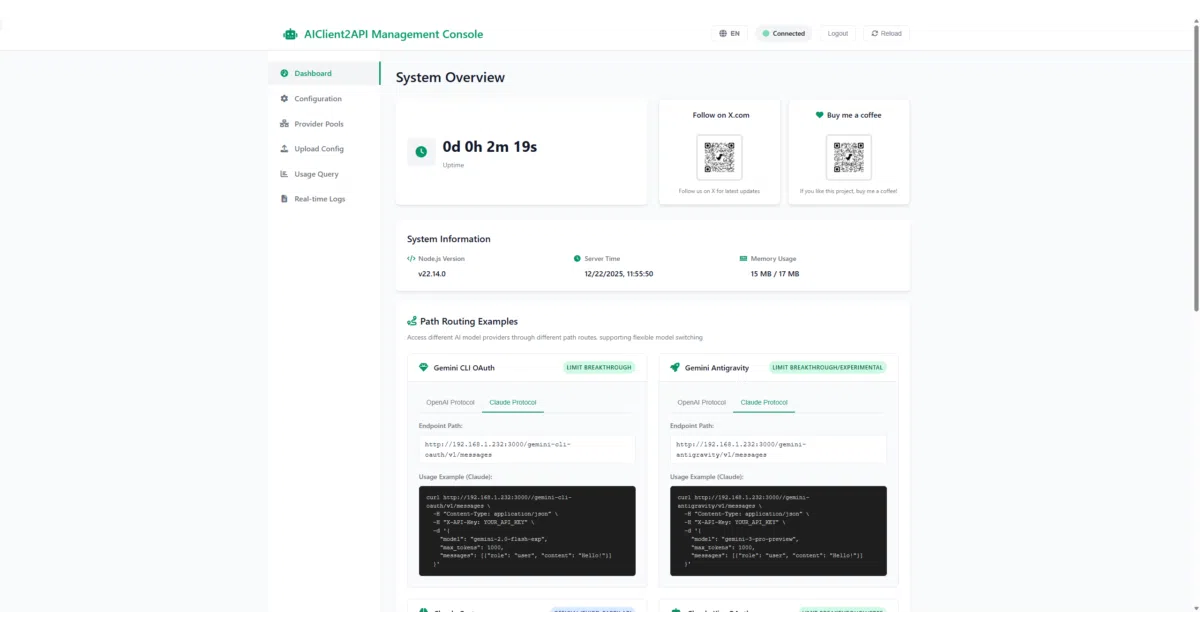
- Web UI for real-time config management and health monitoring (added v2025.11.11)
- Image generation and editing endpoints (
/v1/images/generations,/v1/images/edits) with model-specific protocol conversion - Self-discovery endpoints (
/api/help,/api/example) added in v3.0.0 for AI agent integration
Caveats
- Relies on client authentication methods (cookies, OAuth, SSO) that can break when vendors change their login flows
- The README’s “99.9% service availability” claim is stated but not substantiated with methodology
- Heavy sponsor presence; several listed sponsors appear to be competing API resellers
Verdict
Worth a look if you’re already juggling multiple free AI accounts and want to unify them behind one OpenAI-shaped endpoint. Skip it if you need guaranteed SLA-backed access or don’t want to maintain cookie-based authentication that could expire without warning.
Frequently asked
- What is justlovemaki/AIClient2API?
- A Node.js proxy that lets you call Gemini CLI, Codex, Grok, and others through a standard OpenAI interface.
- Is AIClient2API open source?
- Yes — justlovemaki/AIClient2API is open source, released under the GPL-3.0 license.
- What language is AIClient2API written in?
- justlovemaki/AIClient2API is primarily written in JavaScript.
- How popular is AIClient2API?
- justlovemaki/AIClient2API has 8.9k stars on GitHub and is currently accelerating.
- Where can I find AIClient2API?
- justlovemaki/AIClient2API is on GitHub at https://github.com/justlovemaki/AIClient2API.