juspay/xyne-spaces
An org OS that feeds agents context without handing them the keys
It centralizes your organization's scattered knowledge and serves it back to humans and agents through the same strict permission model.
Collecting fresh signals — velocity needs a few days of history.
collecting data…
star history
What it does
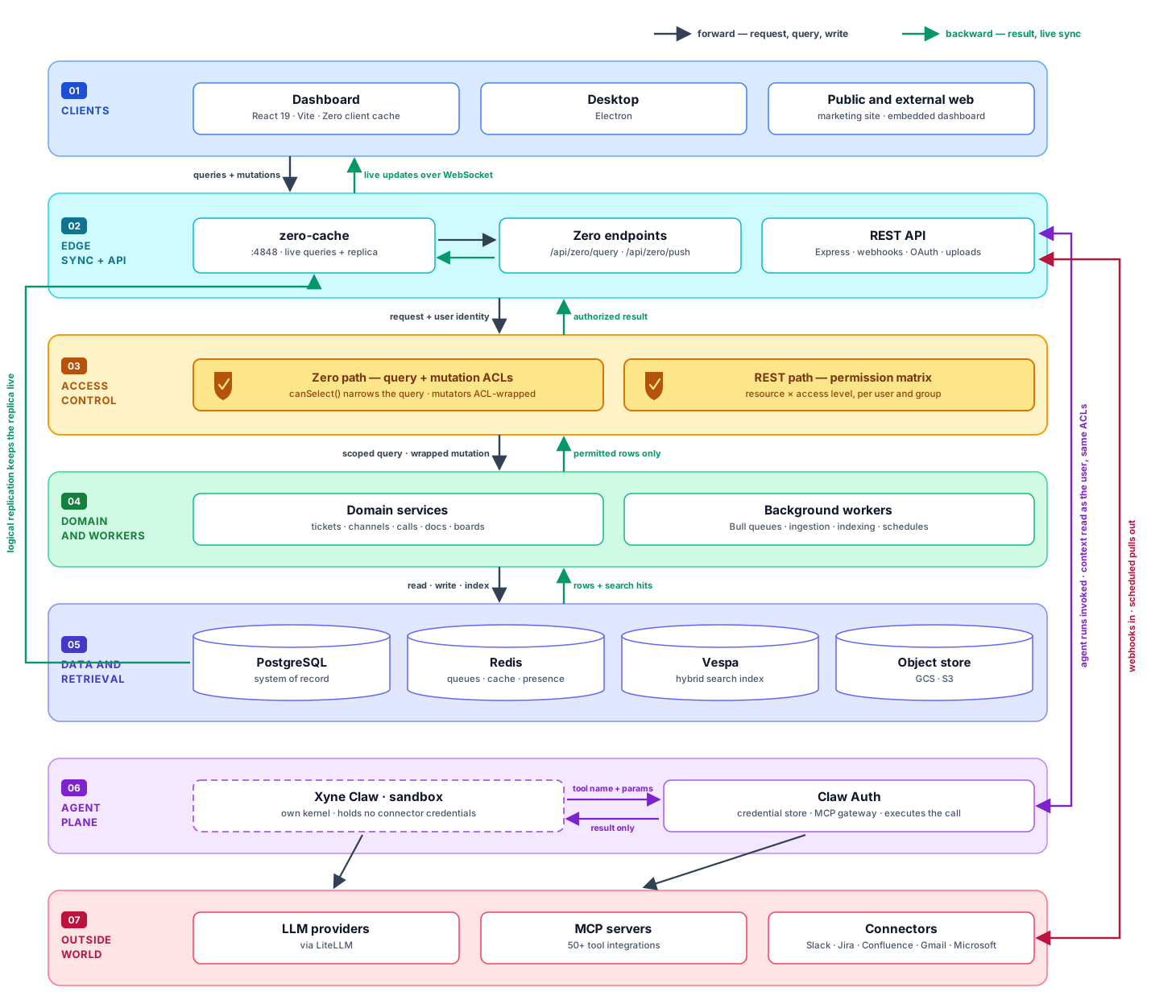
Xyne Spaces pulls in data from Slack, Gmail, Jira, and other tools, normalizes it into a central context store, and serves it back through built-in apps—chat, tickets, canvases, and automations—that all share the same permission-aware APIs. Every query is scoped to the caller, so an agent can only see what the user who invoked it can see.
The interesting bit
The agent security model is paranoid in a useful way: the runtime executing untrusted code has no secrets, no shell, and no network of its own, while a separate gateway tier handles every external tool call. Anything requiring a real shell runs inside a Kata Containers microVM with closed egress, so a compromised agent yields no reusable credentials because none were ever there.
Key highlights
- Connectors for Slack, Google Workspace, Microsoft 365, Jira, and Confluence, supporting both live sync and one-time bulk migration.
- Hybrid search across conversations, documents, tickets, and call transcripts, scoped to the asker’s permissions.
- Real-time collaborative apps that keep a live local replica instead of polling.
- A three-tier agent sandbox: the gateway holds credentials, the runtime holds none, and bash runs in an isolated VM.
- Human-in-the-loop approval for any agent write action; agents inherit the invoking user’s access controls with no privileged bypass.
Verdict
Worth evaluating if you run an organization that wants agents to work with real internal context without rewriting your access-control model. Give it a pass if you need a lightweight chatbot or a simple wiki—this is a full-stack, multi-service platform built to sit at the center of your tooling.
Frequently asked
- What is juspay/xyne-spaces?
- It centralizes your organization's scattered knowledge and serves it back to humans and agents through the same strict permission model.
- Is xyne-spaces open source?
- Yes — juspay/xyne-spaces is open source, released under the Apache-2.0 license.
- What language is xyne-spaces written in?
- juspay/xyne-spaces is primarily written in TypeScript.
- How popular is xyne-spaces?
- juspay/xyne-spaces has 684 stars on GitHub.
- Where can I find xyne-spaces?
- juspay/xyne-spaces is on GitHub at https://github.com/juspay/xyne-spaces.