jjang-ai/mlxstudio
A Mac-native AI workbench that skips the cloud entirely
MLX Studio wraps Apple's MLX framework into a SwiftUI desktop app for local LLMs, image generation, and coding agents—no API keys, no PyTorch in the hot path.
Not currently ranked — collecting fresh signals.
star history
What it does
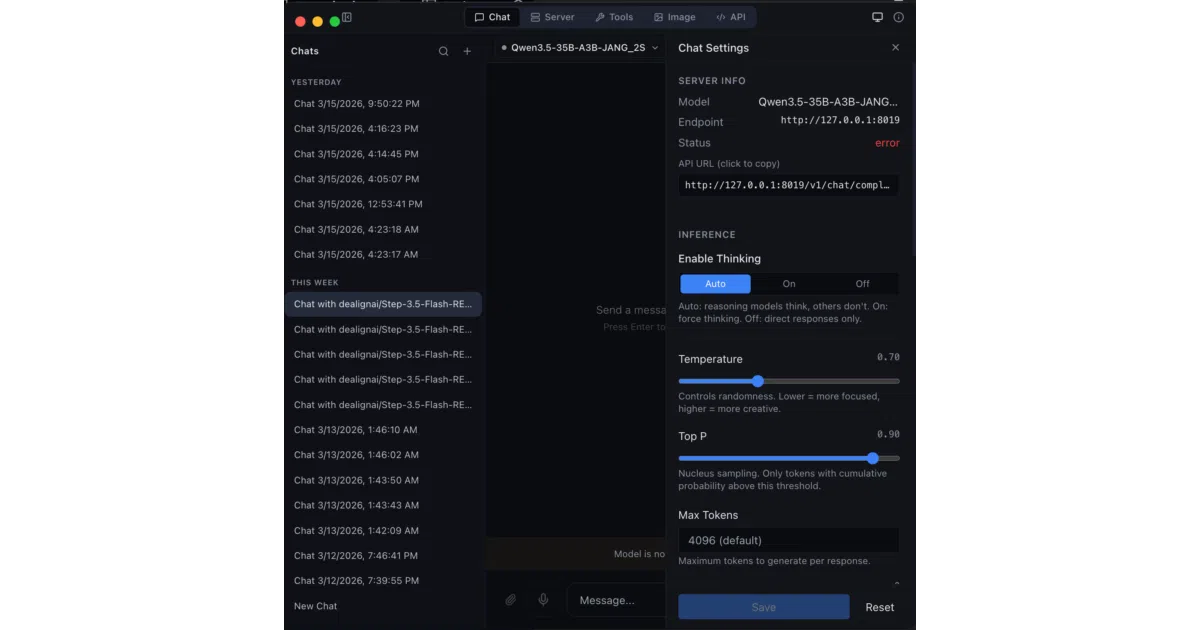
MLX Studio is a macOS desktop app for running large language models, vision models, image generators, and speech tools locally on Apple Silicon. It downloads models from HuggingFace’s mlx-community, launches an OpenAI-compatible API server, and provides chat, image editing, and agentic coding interfaces. A separate CLI engine (vmlx) is available via PyPI for terminal-first users.
The interesting bit
The project ships its own quantization scheme, JANG, which claims to beat standard MLX quantization at extreme compression—specifically 2-bit adaptive mixed-precision that reportedly outperforms MLX 4-bit on MiniMax M2.5. The app also implements Anthropic’s /v1/messages API format locally, so you can point the official Claude SDK at your own machine.
Key highlights
- Native Swift + Metal rewrite (vMLX v2) claims 50–95 tokens/second on M-series chips, with zero PyTorch in the inference path
- Supports 65+ model families including MoE architectures (DeepSeek, Qwen, Mixtral), vision-language models, and hybrid SSM models like Mamba variants
- Built-in tool calling with 26+ tools: file I/O, shell execution, web search, git operations, and MCP (Model Context Protocol) server connections
- Drag-and-drop model installation; code-signed and notarized DMG releases with no Homebrew or Xcode required
- OpenAI-compatible endpoints for chat, completions, images, embeddings, audio speech/transcription, plus Anthropic Messages API compatibility
Caveats
- macOS ARM64 only; no Intel Mac or Linux support mentioned
- The README’s performance claims for JANG quantization lack independent verification or methodology detail
- Some features (MCP, certain model families) appear to be recent additions with limited documentation depth
Verdict
Apple Silicon developers who want a self-contained local AI stack without wrangling Python environments should look here. If you’re on Linux, need cloud redundancy, or want battle-tested quantization with peer-reviewed benchmarks, this isn’t your tool.
Frequently asked
- What is jjang-ai/mlxstudio?
- MLX Studio wraps Apple's MLX framework into a SwiftUI desktop app for local LLMs, image generation, and coding agents—no API keys, no PyTorch in the hot path.
- Is mlxstudio open source?
- Yes — jjang-ai/mlxstudio is an open-source project tracked on heatdrop.
- How popular is mlxstudio?
- jjang-ai/mlxstudio has 988 stars on GitHub.
- Where can I find mlxstudio?
- jjang-ai/mlxstudio is on GitHub at https://github.com/jjang-ai/mlxstudio.