jaylfc/taOS
Your junk-drawer hardware, now a self-hosted AI datacenter
It turns your spare Raspberry Pi, old laptop, or gaming PC into a self-hosted, offline-first AI agent cluster wrapped in a full web desktop.
Not currently ranked — collecting fresh signals.
star history
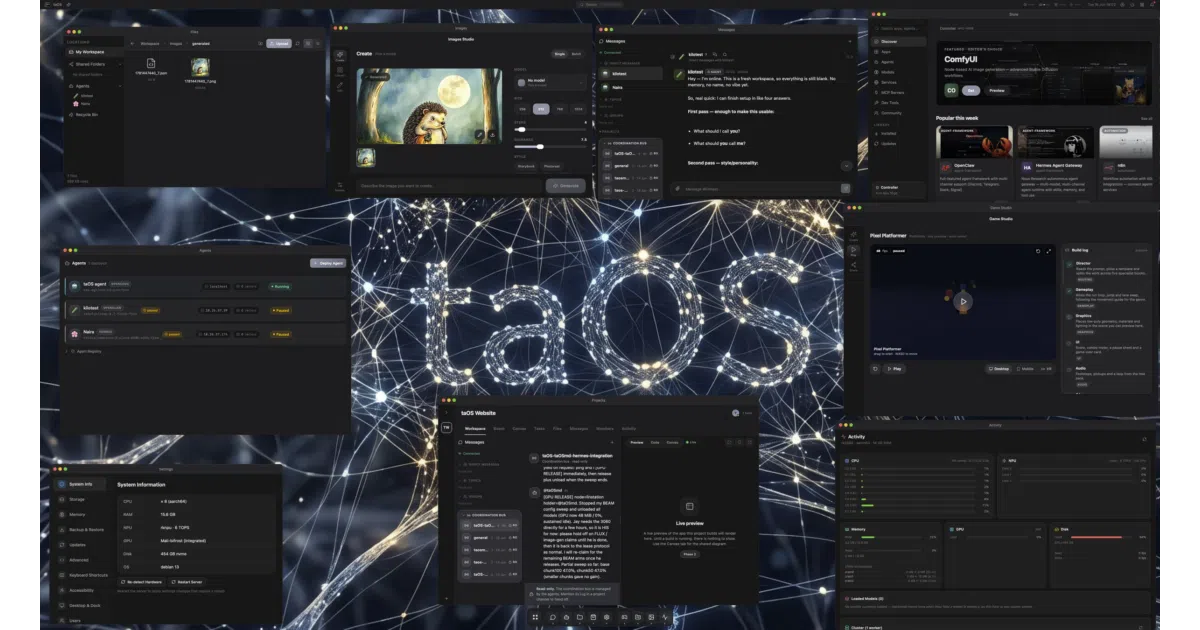
What it does taOS is a browser-based desktop environment that runs on your own hardware—think Orange Pi, Mac mini, or an old gaming PC—and clusters those machines into a distributed AI compute layer. It hosts long-running agents, a multi-framework chat system, a local model catalog, and your files, all reachable from a single web dashboard. The default stance is sovereignty: your agents’ memory, conversations, and data stay on your machines unless you explicitly opt into cloud models or services.
The interesting bit
The project treats agent frameworks as disposable execution engines rather than the center of gravity. taOS owns the full lifecycle—memory, files, API keys, chat channels, and LoRAs—so you can swap the underlying framework (say, SmolAgents for LangChain) without migrating data or re-wiring integrations. Its memory system, taOSmd, runs a temporal knowledge graph with contradiction detection and hybrid vector search entirely on a £170 Orange Pi; the authors claim a 97.0% end-to-end judge accuracy on LongMemEval-S, though they note this is not directly comparable to the retrieval-only Recall@5 scores published by comparators.
Key highlights
- Framework-agnostic agent lifecycle: switch frameworks without losing history, connections, or files.
taOSmdmemory system: temporal knowledge graph, hybrid semantic/keyword search, cross-encoder rerank, and LLM-assisted query expansion, exposed over an HTTP API.- Full web desktop shell with window manager, dock, launchpad, notifications, widgets, and bundled apps (mail, kanban, image studio, game maker), plus a store with over 100 catalog apps.
- Distributed compute that auto-clusters across consumer hardware, supporting Apple Silicon, NVIDIA, AMD, Rockchip NPU, and Raspberry Pi.
- Offline-first by design: local model catalog, air-gapped install path, and cloud models are strictly opt-in.
Caveats
- Explicitly beta with rough edges; the desktop GUI is usable day-to-day, but agent management, worker connections, and model routing flows are still being smoothed out.
- Many of the 100+ catalog apps, 16 frameworks, and 112 model manifests have not been tested on real hardware yet, so some installs will fail until the manifests are fixed.
- The 97.0% accuracy claim for
taOSmdis end-to-end (retrieve → generate → judge), which the README admits is not apples-to-apples against the retrieval-onlyRecall@5numbers cited from other systems.
Verdict Tinkerers with a drawer full of SBCs and a distrust of cloud AI lock-in should take a look. If you want a polished, zero-config consumer assistant or lack patience for beta bugs, this is not your OS yet.
Frequently asked
- What is jaylfc/taOS?
- It turns your spare Raspberry Pi, old laptop, or gaming PC into a self-hosted, offline-first AI agent cluster wrapped in a full web desktop.
- Is taOS open source?
- Yes — jaylfc/taOS is open source, released under the AGPL-3.0 license.
- What language is taOS written in?
- jaylfc/taOS is primarily written in Python.
- How popular is taOS?
- jaylfc/taOS has 556 stars on GitHub.
- Where can I find taOS?
- jaylfc/taOS is on GitHub at https://github.com/jaylfc/taOS.