ithtelab/workbuddy-manager
Turning a Tencent CodeBuddy CLI into a multi-tenant API shop
It gives the CLI-only `workbuddy2api` proxy a web face, letting you onboard Tencent CodeBuddy accounts by QR code, meter API keys, and audit credit spend down to the last token.
Collecting fresh signals — velocity needs a few days of history.
collecting data…
star history
What it does
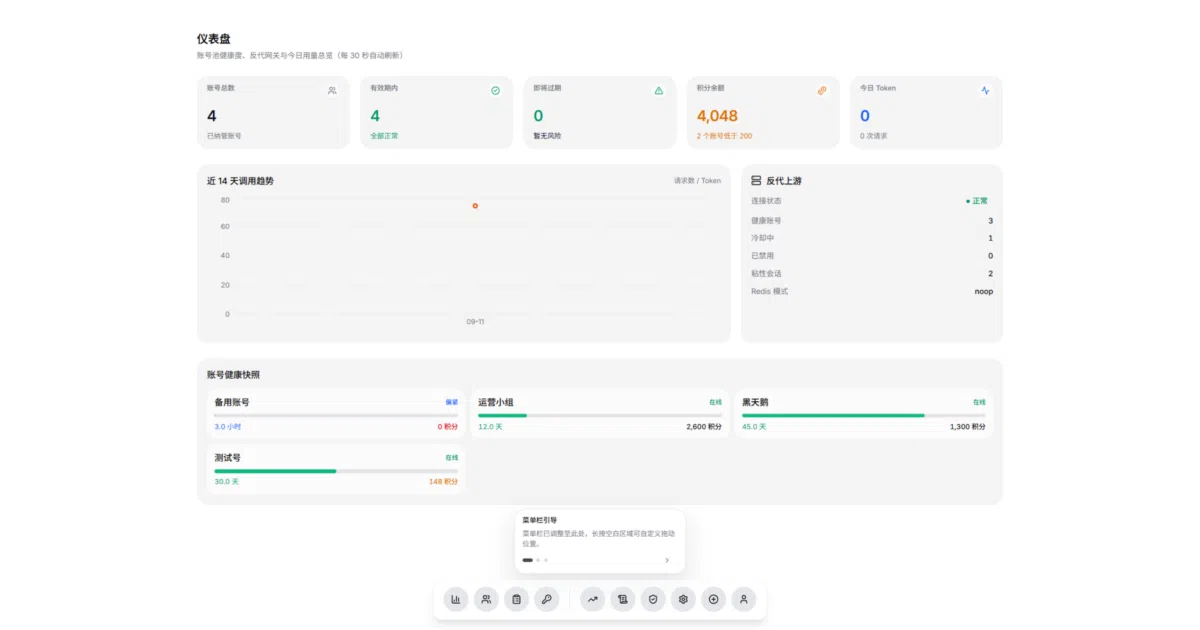
workbuddy-manager is the companion web console for workbuddy2api, the Go reverse proxy that exposes a pool of Tencent CodeBuddy accounts as an OpenAI-compatible API. While the upstream tool is strictly command-line, this project layers on a Next.js frontend and FastAPI backend so you can scan WeChat or QQ QR codes to enroll accounts, schedule auto-sign-in tasks, and manage multiple upstream pools from a single pane. It also serves as the public gateway, handling key distribution, IP allowlisting, model aliasing, and full request auditing.
The interesting bit The value hides in the unglamorous operational plumbing. The dashboard queries Tencent directly for real-time credit balances because the upstream cache lags by hours; it tracks per-package expiration countdowns so points don’t silently evaporate; and it persists auto-task logs that otherwise disappear when the upstream container restarts. It is essentially a billing and tenant-isolation layer built on top of someone else’s protocol adapter.
Key highlights
- OpenAI-compatible
/v1gateway with per-key quotas, IP limits, model whitelists, and SHA-256-hashed credentials. - Multi-upstream support that binds API keys to specific account pools, failing explicitly if a pool disappears rather than falling back silently.
- Real-time credit tracking with cache-age labels, plus a model browser listing reasoning tiers and credit multipliers sourced directly from Tencent’s API.
- Domestic and international version switching with fully separated keys, models, and audit trails.
- An admin playground that streams responses and displays the live credit cost of each turn.
Caveats
- The project is explicitly a visualization and operations wrapper; all core routing, token refresh, and circuit-breaking logic still lives in the unmodified upstream
workbuddy2apibinary. - International version accounts inherit upstream limitations: no daily sign-in, no cat-travel mini-game points, and credits come from a one-time trial only.
- Features like temporary account disable and granular task logging depend on upstream version compatibility, with graceful degradation noted in the UI when the upstream is older.
Verdict Anyone operating multiple Tencent CodeBuddy accounts as a shared API resource—especially those needing key rotation, tenant isolation, or spend tracking—should look here. If you only have one account and no need for metering, the upstream CLI is enough.
Frequently asked
- What is ithtelab/workbuddy-manager?
- It gives the CLI-only `workbuddy2api` proxy a web face, letting you onboard Tencent CodeBuddy accounts by QR code, meter API keys, and audit credit spend down to the last token.
- Is workbuddy-manager open source?
- Yes — ithtelab/workbuddy-manager is an open-source project tracked on heatdrop.
- What language is workbuddy-manager written in?
- ithtelab/workbuddy-manager is primarily written in Python.
- How popular is workbuddy-manager?
- ithtelab/workbuddy-manager has 501 stars on GitHub.
- Where can I find workbuddy-manager?
- ithtelab/workbuddy-manager is on GitHub at https://github.com/ithtelab/workbuddy-manager.