im4codes/imcodes
Cross-agent memory and supervision for Claude, Codex, and friends
IM.codes gives terminal-bound coding agents shared memory, cross-model audit, and a mobile lifeline so your work doesn't die when you leave your desk.
Not currently ranked — collecting fresh signals.
star history
What it does
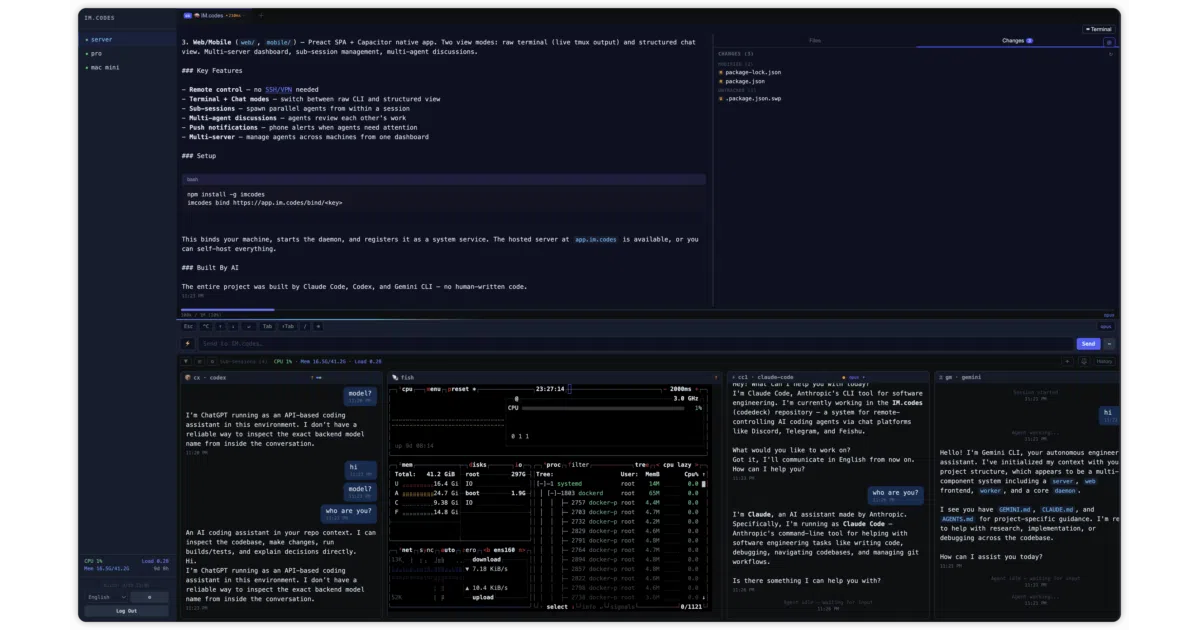
IM.codes is a messaging, memory, and review layer that wraps around terminal-based coding agents like Claude Code, OpenAI Codex, and Gemini CLI. It continuously turns completed agent work into reusable memory—stripping out streaming deltas and tool noise—and feeds that context back into future sessions across different providers. The project also ships native apps for iPhone, iPad, and Apple Watch, plus a web interface, letting you inspect terminals, browse files, review git changes, and preview localhost from a device that isn’t your laptop.
The interesting bit
The unusual angle is treating coding agents like participants in a persistent group chat that spans AI providers. IM.codes runs a daemon-managed MCP server so agents can search shared memory, message sibling sessions, and schedule cron jobs without holding raw auth tokens. It also supports “Team discussion,” where multiple models review and audit each other’s plans before code lands—essentially using model disagreement as a linting layer.
Key highlights
- Cross-provider memory: completed work is summarized and automatically injected into new sessions across Claude, Codex, Gemini, and others, with multilingual semantic search via pgvector.
- Mobile and watch apps: full terminal access, file browsing, git views, localhost preview, and push notifications on iPhone, iPad, and Apple Watch.
- Managed MCP tools: a runtime-bound stdio MCP server exposes
search_memory,send_message, and cron scheduling to agents, gated by session identity and kill switches. - Auto supervision: per-session modes can judge completed turns at the idle boundary, auto-continue work, or run an audit/rework loop before handing control back.
- Fail-closed automation: the supervisor returns control to the human on timeout, invalid output, or bad config rather than silently guessing.
Caveats
- The enterprise shared-context and team features are under active development and have not been fully production-tested yet.
- The author disclaims warranties, SLAs, and backward compatibility; breaking changes may arrive without notice.
- It is built almost entirely by other coding agents (Claude Code, Codex, Gemini CLI), which is either a selling point or a warning depending on your worldview.
Verdict
Worth a look if you run multiple terminal-based agents and need persistent context across providers, or if you want to babysit long-running agent jobs from your phone. Skip it if you want a polished, stable enterprise platform today—this is explicitly a personal project with sharp edges.
Frequently asked
- What is im4codes/imcodes?
- IM.codes gives terminal-bound coding agents shared memory, cross-model audit, and a mobile lifeline so your work doesn't die when you leave your desk.
- Is imcodes open source?
- Yes — im4codes/imcodes is open source, released under the MIT license.
- What language is imcodes written in?
- im4codes/imcodes is primarily written in TypeScript.
- How popular is imcodes?
- im4codes/imcodes has 971 stars on GitHub.
- Where can I find imcodes?
- im4codes/imcodes is on GitHub at https://github.com/im4codes/imcodes.