huangjia2019/rag-in-action
RAG from zero to Graph in eleven folders
It exists to teach RAG by isolating every pipeline stage—from chunking to Graph RAG—instead of treating retrieval as a black box.
Not currently ranked — collecting fresh signals.
star history
What it does
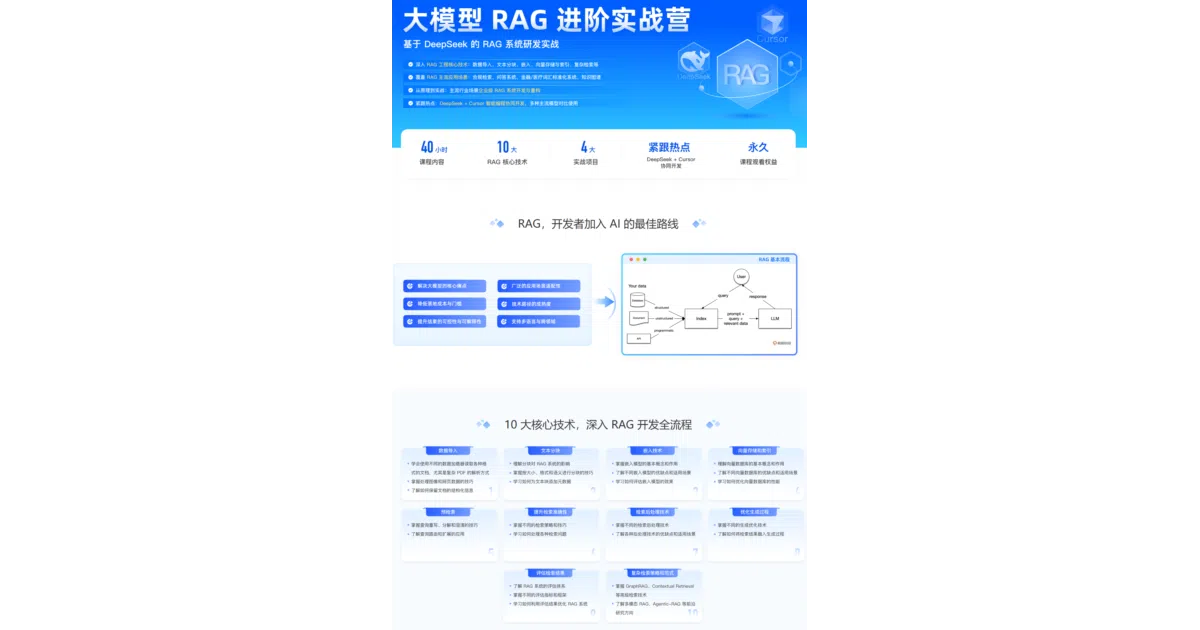
This is the companion code repository for a GeekTime course on building RAG systems with DeepSeek. It organizes the full retrieval pipeline into eleven sequential folders—starting with a bare-bones SimpleRAG and ending with AdvanceRAG (Graph RAG and multi-agent patterns). Each folder tackles one stage: document loading, chunking, embedding, vector storage, query expansion, indexing, reranking, generation, and evaluation. It is designed as narrative courseware, not a reusable library.
The interesting bit The repo treats RAG as a chain of tuning decisions rather than a single magic call. By giving each stage its own module—and providing parallel tracks for both LangChain and LlamaIndex—it forces you to confront the boring but decisive details: how you split documents, which reranker you use, and how you measure retrieval quality with RAGAS or TruLens instead of just eyeballing answers.
Key highlights
- Eleven modules covering the full lifecycle, from
00-简单RAGto10-高级RAGincluding Graph RAG and multi-agent setups. - Dual-framework coverage: the same pipeline concepts are implemented in both LangChain and LlamaIndex, with separate requirement files for each.
- Evaluation is a first-class module, using RAGAS and TruLens to score retrieval rather than relying on human vibe checks.
- Explicit hardware expectations: the GPU track targets ≥8GB VRAM, while a CPU-only track is provided for Mac and Windows users.
- Tied to a published book and video course, so the progression is intentional rather than an ad-hoc collection of notebooks.
Caveats
- The README is dominated by environment-setup instructions and course links; the actual depth of each notebook is not visible without opening the folders.
- It is course material first and open-source tooling second, so expect explanatory narrative and homework-style structure rather than drop-in packages.
- Module descriptions in the README are sometimes vague (e.g., “NLP tools” or “ML models”), so you will need to inspect the notebooks directly to see which specific algorithms are used.
Verdict Worth bookmarking if you want a structured, component-by-component map of a production RAG pipeline and prefer learning through annotated notebooks. Skip it if you need a turnkey API server or a pip-installable RAG framework.
Frequently asked
- What is huangjia2019/rag-in-action?
- It exists to teach RAG by isolating every pipeline stage—from chunking to Graph RAG—instead of treating retrieval as a black box.
- Is rag-in-action open source?
- Yes — huangjia2019/rag-in-action is an open-source project tracked on heatdrop.
- What language is rag-in-action written in?
- huangjia2019/rag-in-action is primarily written in Jupyter Notebook.
- How popular is rag-in-action?
- huangjia2019/rag-in-action has 854 stars on GitHub.
- Where can I find rag-in-action?
- huangjia2019/rag-in-action is on GitHub at https://github.com/huangjia2019/rag-in-action.