honeyandme/RAGQnASystem
Medical RAG that ditches vectors for a Neo4j graph
It forces a local Chinese LLM to cite a Neo4j medical graph instead of freelancing clinical advice.
Not currently ranked — collecting fresh signals.
star history
What it does
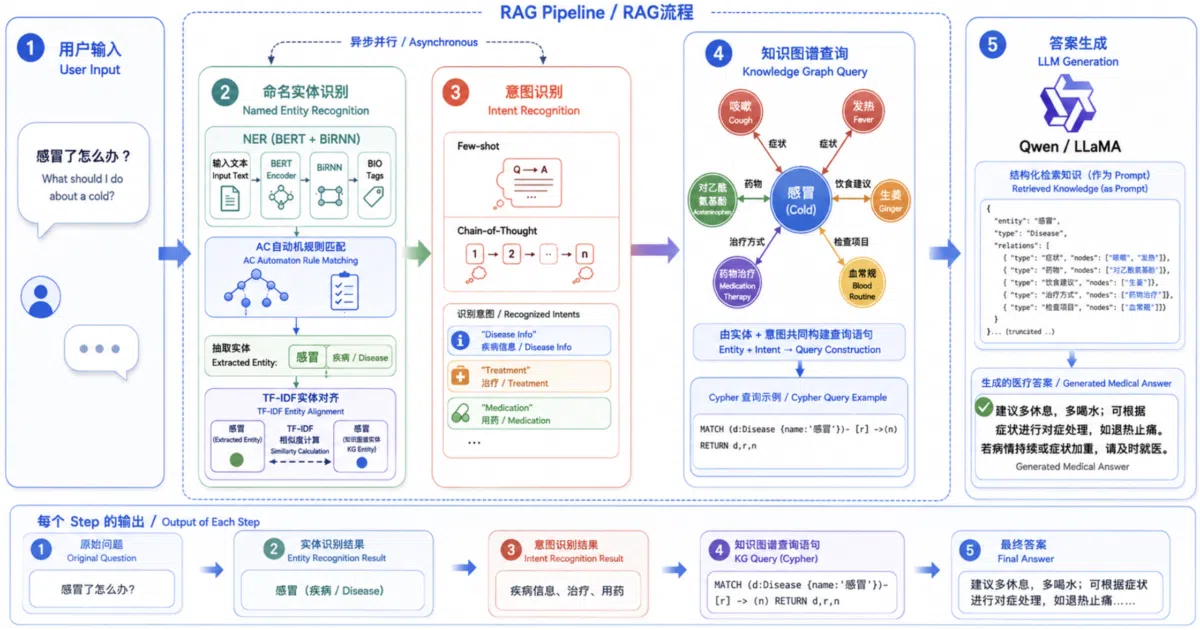
A Chinese medical Q&A stack that grounds large language model answers in a Neo4j knowledge graph. It extracts entities from user questions with a fine-tuned BERT+RNN model, classifies intent into one of 16 categories via a local ollama-hosted LLM, retrieves precise subgraphs with Cypher queries, and streams back a synthesized answer through a Streamlit interface.
The interesting bit Instead of dumping medical documents into a vector database, the project keeps roughly 44,656 entities and 312,159 relations in a structured graph, forcing the generative model to cite actual nodes and edges rather than hallucinate clinical advice. The intent router is table-driven, which keeps the 16-class taxonomy out of nested if-else hell.
Key highlights
- Graph-native RAG: Retrieves from a
Neo4jmedical graph (diseases, drugs, symptoms, foods, etc.) rather than using embedding similarity search. - Local-only operation: Runs on
ollamawithQwen(32B by default, 7B fallback) and a localNeo4jinstance—no external API calls required. - High reported NER accuracy: The
BERT+RNNentity recognizer claims 97.40% F1 after data augmentation. - Bootstrapped training pipeline: NER training data is generated via
ACautomaton using entity lists auto-extracted during the graph build. - Full-featured
StreamlitUI: Includes user login, multi-window sessions, LLM switching, and an admin panel.
Caveats
- The README explicitly warns that the system collapses if any of its three heavy dependencies—
Neo4j, NER model weights, orollama—are missing; there is no graceful degradation. - Default setup demands serious hardware: the recommended
Qwen32B model needs approximately 20 GB of VRAM, though a 7B fallback exists with unspecified accuracy trade-offs. - Pre-trained NER weights are distributed through Baidu Netdisk, which may complicate access for users outside mainland China.
Verdict Worth a look if you are building domain-specific Chinese Q&A systems and want to trade vector-database fuzziness for graph precision. Skip it if you need a lightweight, plug-and-play medical chatbot—this is a thesis-scale stack with infrastructure appetite.
Frequently asked
- What is honeyandme/RAGQnASystem?
- It forces a local Chinese LLM to cite a Neo4j medical graph instead of freelancing clinical advice.
- Is RAGQnASystem open source?
- Yes — honeyandme/RAGQnASystem is an open-source project tracked on heatdrop.
- What language is RAGQnASystem written in?
- honeyandme/RAGQnASystem is primarily written in Jupyter Notebook.
- How popular is RAGQnASystem?
- honeyandme/RAGQnASystem has 1.3k stars on GitHub.
- Where can I find RAGQnASystem?
- honeyandme/RAGQnASystem is on GitHub at https://github.com/honeyandme/RAGQnASystem.