georgesung/ssd_tensorflow_traffic_sign_detection
A 2017 SSD port that admits its own overfitting
A TensorFlow implementation of the Single Shot MultiBox detector trained on stop signs and pedestrian crossings, with refreshingly honest notes about its limitations.
Not currently ranked — collecting fresh signals.
star history
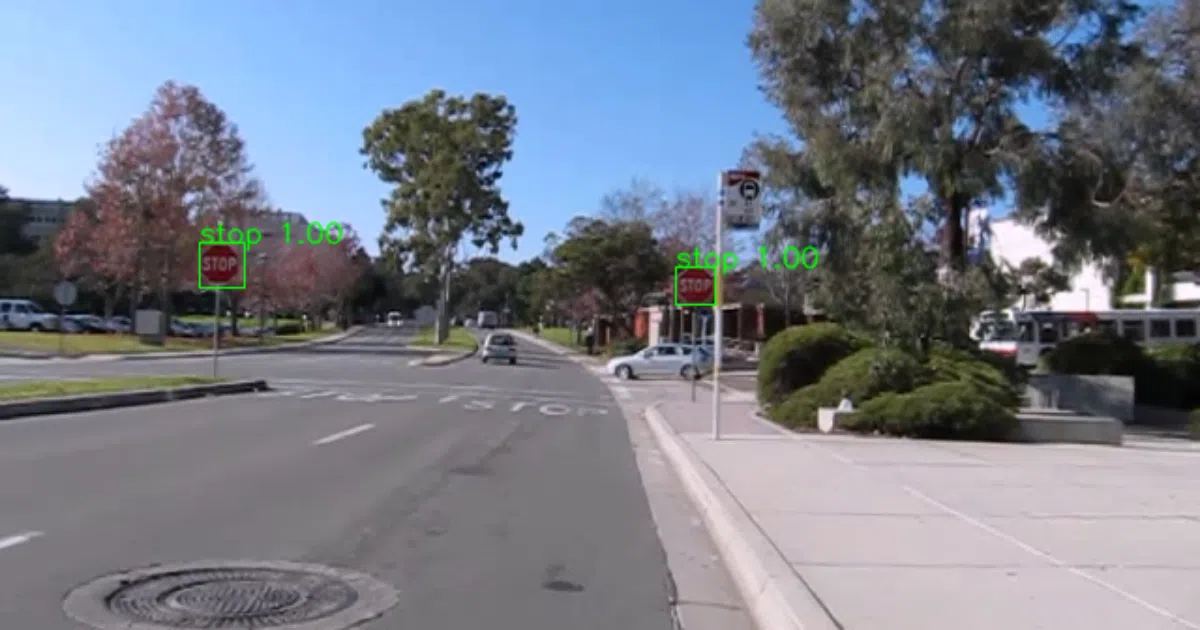
What it does This repo implements the SSD object detection architecture in TensorFlow, narrowed to detect just two traffic sign classes—stop signs and pedestrian crossings—from the LISA Traffic Sign Dataset. It runs inference at 40–45 fps on a GTX 1080, though the author notes that most of that time is actually CPU-bound Non-Maximum Suppression, not the neural network itself.
The interesting bit The author swaps VGG for AlexNet as the base network and uses a dynamic scaling factor tied to feature map dimensions rather than fixed scales. More striking is the candor: the README flags overfitting as the main issue, notes the model “severely overfits at this time,” and suggests pre-training on VOC2012 as a likely fix. This was written in the TensorFlow v0.12 era, which now feels archaeological.
Key highlights
- Achieves 7–8 ms neural network inference, but 15–16 ms unoptimized CPU-only NMS
- Uses AlexNet backbone with 400×260 input resolution instead of original SSD specs
- Trained on a heavily pruned subset of LISA dataset (only 2 of 47 classes, with samples discarded when no default box matches)
- 95/5 train/validation split due to tiny effective dataset size
- Adadelta optimizer, 200 epochs, batch size 32
Caveats
- Explicitly work-in-progress; model overfitting is the stated main problem
- Only detects stop signs and pedestrian crossings—nowhere near full traffic sign recognition
- TensorFlow v0.12.0 dependency means significant version archaeology required to run today
- No mAP metric reported; performance claims are inference speed only
Verdict Worth a look if you’re studying SSD evolution or need a case study in honest academic-style repo documentation. Skip it if you need production traffic sign detection—modern YOLO variants or current SSD implementations in PyTorch/TensorFlow 2.x will serve you better, and the dependency stack here is a time capsule.
Frequently asked
- What is georgesung/ssd_tensorflow_traffic_sign_detection?
- A TensorFlow implementation of the Single Shot MultiBox detector trained on stop signs and pedestrian crossings, with refreshingly honest notes about its limitations.
- Is ssd_tensorflow_traffic_sign_detection open source?
- Yes — georgesung/ssd_tensorflow_traffic_sign_detection is open source, released under the MIT license.
- What language is ssd_tensorflow_traffic_sign_detection written in?
- georgesung/ssd_tensorflow_traffic_sign_detection is primarily written in Python.
- How popular is ssd_tensorflow_traffic_sign_detection?
- georgesung/ssd_tensorflow_traffic_sign_detection has 532 stars on GitHub.
- Where can I find ssd_tensorflow_traffic_sign_detection?
- georgesung/ssd_tensorflow_traffic_sign_detection is on GitHub at https://github.com/georgesung/ssd_tensorflow_traffic_sign_detection.