fidler-lab/polyrnn-pp
Polygon-RNN++: When drawing boundaries is too tedious for humans alone
A 2018 CVPR model that turns image crops into polygonal object boundaries, designed to spare annotators from clicking hundreds of points by hand.
Not currently ranked — collecting fresh signals.
star history
What it does
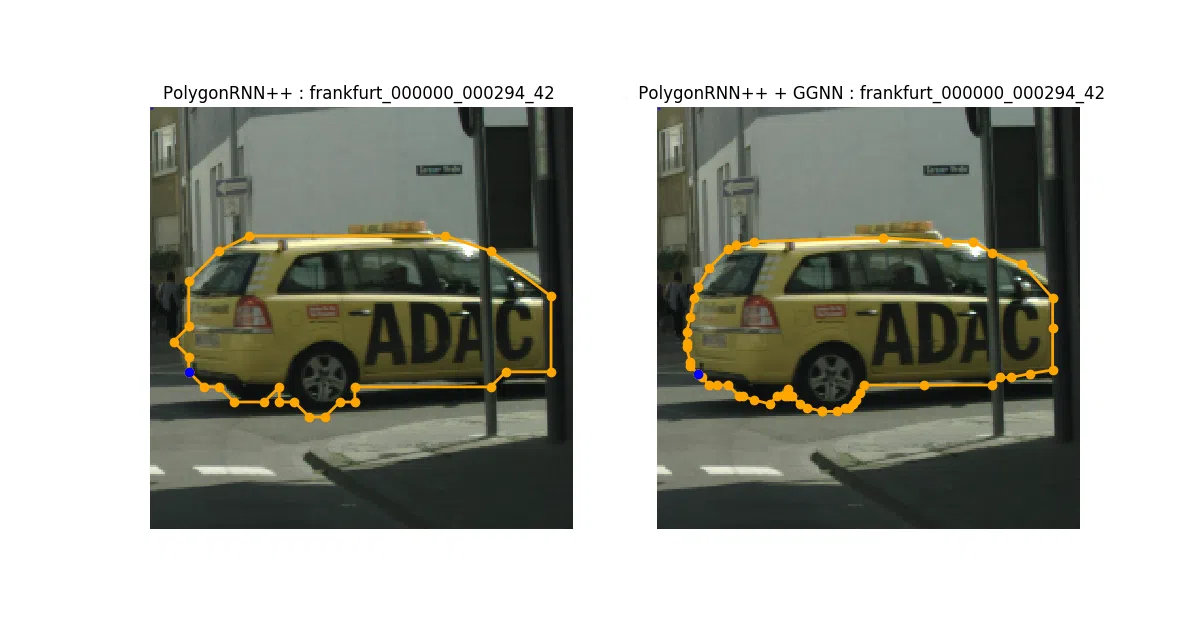
Polygon-RNN++ generates polygon outlines around objects in image crops. Feed it a crop and a starting vertex, and it predicts the sequence of points tracing the object’s boundary. The repo contains only inference code—run the Jupyter notebook or shell script, get polygons in the output/ folder. Models were trained on Cityscapes and weigh 448 MB.
The interesting bit
The real product isn’t full automation; it’s human-in-the-loop speedup. The model predicts most vertices, humans correct the mistakes, and the loop tightens. The authors also published a separate PyTorch repo with training code and annotation tools—this TensorFlow release is essentially the frozen demo.
Key highlights
- Pre-trained models available via shell script; CPU runs “albeit slowly”
- Interactive demo and video walkthrough linked from the README
- PyTorch reimplementation with full training/tooling exists elsewhere
- Citation includes both the 2018++ paper and the original 2017 Polygon-RNN
- Jupyter notebook provides step-by-step inference walkthrough
Caveats
- Only inference code here; training requires the PyTorch sibling repo
- Clone instructions still point to
davidjesusacu/polyrnn, a fork/redirect, rather than the canonicalfidler-labURL
Verdict
Worth a spin if you’re building annotation pipelines or researching interactive segmentation. Skip it if you need end-to-end training—head to the PyTorch repo instead.
Frequently asked
- What is fidler-lab/polyrnn-pp?
- A 2018 CVPR model that turns image crops into polygonal object boundaries, designed to spare annotators from clicking hundreds of points by hand.
- Is polyrnn-pp open source?
- Yes — fidler-lab/polyrnn-pp is open source, released under the GPL-3.0 license.
- What language is polyrnn-pp written in?
- fidler-lab/polyrnn-pp is primarily written in Jupyter Notebook.
- How popular is polyrnn-pp?
- fidler-lab/polyrnn-pp has 729 stars on GitHub.
- Where can I find polyrnn-pp?
- fidler-lab/polyrnn-pp is on GitHub at https://github.com/fidler-lab/polyrnn-pp.