fendouai/CodexSaver
Shrink Codex Bills by Routing Trivia to Cheaper Models
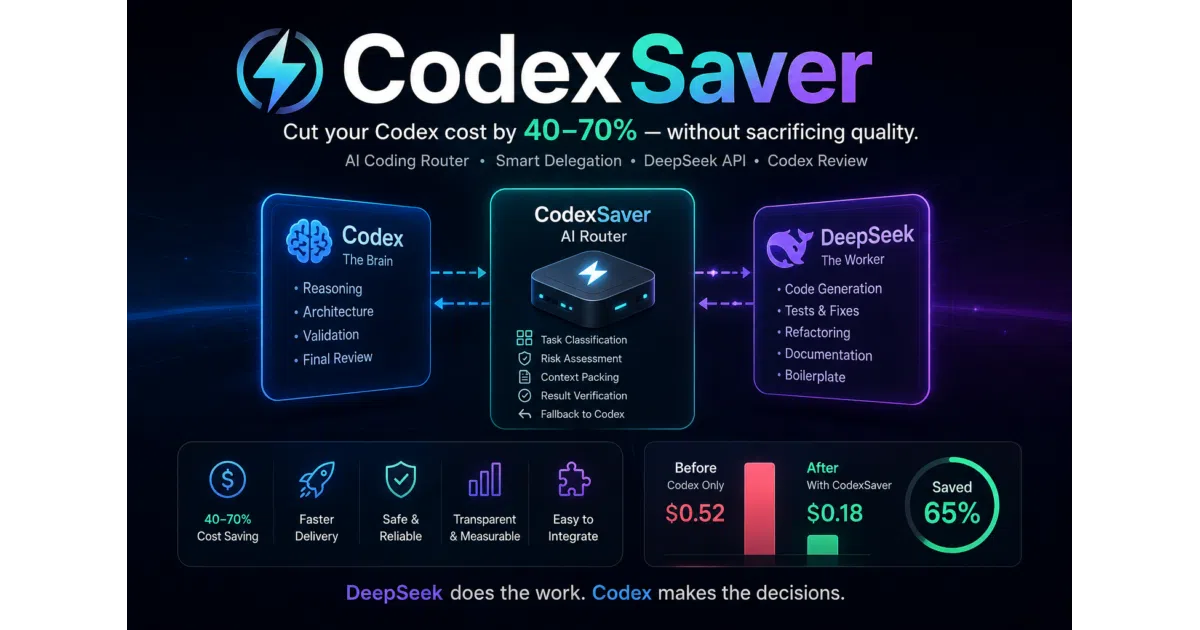
CodexSaver is an MCP tool that intercepts coding tasks and delegates low-risk busywork—like docs, tests, and code search—to cheaper workers while reserving OpenAI Codex for judgment calls.
Not currently ranked — collecting fresh signals.
star history
What it does
CodexSaver sits between you and Codex as an MCP router. It inspects incoming tasks and, if they look safe and bounded, hands them off to cheaper local or remote workers such as DeepSeek or Pi Agent. Anything involving architecture, security, or ambiguous judgment stays with Codex, which also reviews whatever the workers produce.
The interesting bit
The project treats model selection as a risk-routing problem, not just a cost-optimization problem. v2 locks delegated work into sandboxed “work packets” with strict file scopes and allowlisted commands, while v3 can spin up parallel readonly specialists—like an explainer and a performance reviewer—then verify and compress their output before Codex sees it.
Key highlights
- Claims 45% to 100% estimated savings on five bounded v2 tasks, with successful runs finishing between 0.03s and 14.95s.
- v3 readonly specialist swarm completed in 6.45s and produced 10 findings with a 0.75 quality score in repo benchmarks.
- Workers are sandboxed: patches apply in isolation, verifiers check diff size and policy, and the router falls back to Codex if tasks overlap protected paths or exceed risk thresholds.
- v3.6 introduces Agent Card discovery and weighted scoring (capability match, historical success, cost, load) to pick workers dynamically instead of hardcoding DeepSeek.
- Includes built-in output compression so Codex gets shorter, review-friendly delegated results rather than raw worker noise.
Caveats
- v3 is described as “real and testable, but still in an honest early stage” and may conservatively return
needs_codexfor implementation-and-test workflows. - The project explicitly avoids auth, security, payment, permissions, destructive migrations, and ambiguous architecture decisions—so the savings are limited to bounded, verifiable tasks.
- Benchmark data is repo-local and self-reported; the README notes v2 savings are “estimated” rather than independently verified.
Verdict
Worth a look if you are already paying for Codex and want to cut costs on routine code explanation, documentation, and bounded refactors. Skip it if you need a drop-in replacement for Codex across risky or open-ended engineering work.
Frequently asked
- What is fendouai/CodexSaver?
- CodexSaver is an MCP tool that intercepts coding tasks and delegates low-risk busywork—like docs, tests, and code search—to cheaper workers while reserving OpenAI Codex for judgment calls.
- Is CodexSaver open source?
- Yes — fendouai/CodexSaver is an open-source project tracked on heatdrop.
- What language is CodexSaver written in?
- fendouai/CodexSaver is primarily written in Python.
- How popular is CodexSaver?
- fendouai/CodexSaver has 605 stars on GitHub.
- Where can I find CodexSaver?
- fendouai/CodexSaver is on GitHub at https://github.com/fendouai/CodexSaver.