facebookresearch/sam2
SAM 2 treats images as single-frame videos
It provides the inference code, checkpoints, and training scripts for Meta’s foundation model that unifies promptable segmentation across images and video.
Not currently ranked — collecting fresh signals.
star history
What it does
SAM 2 is Meta’s sequel to Segment Anything, turning promptable segmentation from a static-image tool into a video tracker. You nudge it with a click or bounding box, and it either masks the object in a single frame or propagates that mask across an entire clip. The repo ships inference APIs, pretrained checkpoints ranging from 39 million to 224 million parameters, and—since late 2024—the full training code, a web demo, and Hugging Face loaders.
The interesting bit
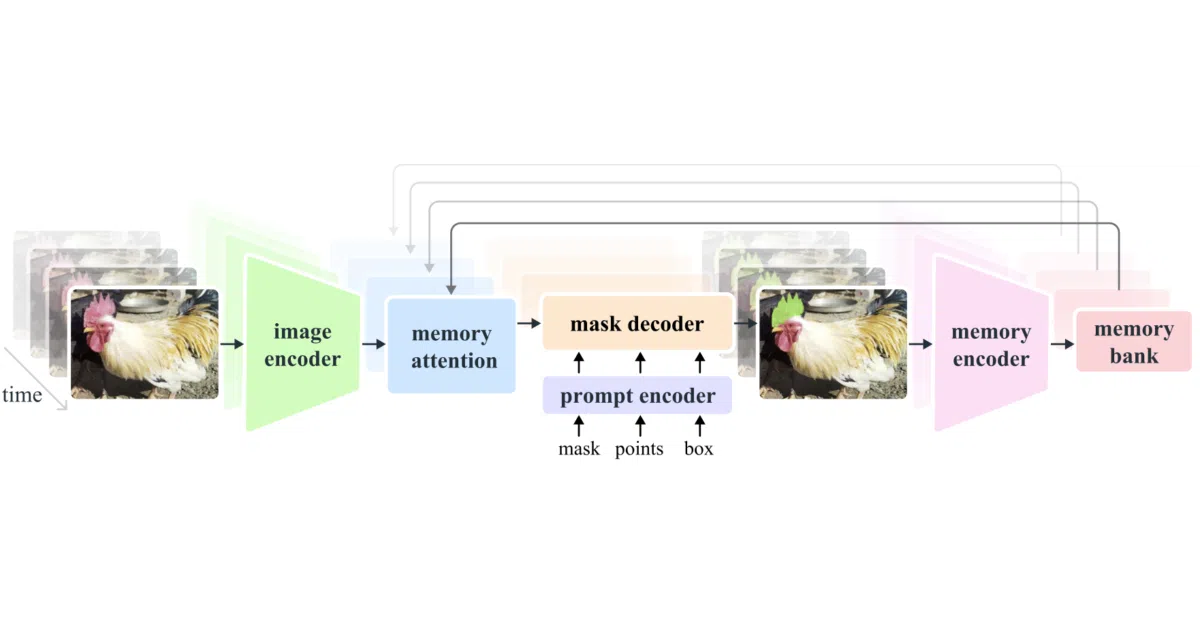
The model handles both domains with the same transformer backbone by processing a still image exactly like a one-frame video, using streaming memory to keep context as it processes footage in real time. A recent refactor of SAM2VideoPredictor also decouples per-object inference, so you can add new targets to an ongoing track instead of locking in every object at the start.
Key highlights
SAM2ImagePredictorandSAM2VideoPredictorprovide unified APIs for stills and clips, including automatic mask generation.- Four checkpoint sizes offer a direct speed-accuracy trade-off, with the smallest running at over 90 FPS and the largest at roughly 40 FPS on published benchmarks.
- The December 2024 update brings full-model
torch.compilesupport for faster video object segmentation and relaxes multi-object tracking constraints. - Training scripts, web demo source code, and Hugging Face
from_pretrainedintegration are all included.
Caveats
- Installation compiles a custom CUDA kernel, and the README warns that if
nvccis missing or the build fails, some post-processing features will be limited. - Native Windows installation is effectively unsupported; the maintainers strongly recommend WSL.
Verdict
Ideal for researchers and product engineers building interactive video annotation, editing, or tracking pipelines. If your workload is strictly static images and the original SAM already suffices, the video capabilities are the main reason to migrate.
Frequently asked
- What is facebookresearch/sam2?
- It provides the inference code, checkpoints, and training scripts for Meta’s foundation model that unifies promptable segmentation across images and video.
- Is sam2 open source?
- Yes — facebookresearch/sam2 is open source, released under the Apache-2.0 license.
- What language is sam2 written in?
- facebookresearch/sam2 is primarily written in Jupyter Notebook.
- How popular is sam2?
- facebookresearch/sam2 has 19.5k stars on GitHub.
- Where can I find sam2?
- facebookresearch/sam2 is on GitHub at https://github.com/facebookresearch/sam2.