facebookresearch/ijepa
Self-supervised vision that skips pixels and hand-crafted augmentations
A CVPR-23 architecture from FAIR that learns image semantics by predicting latent representations instead of reconstructing pixels.
Not currently ranked — collecting fresh signals.
star history
What it does
I-JEPA is a self-supervised pretraining method for images. It masks out regions of an image, encodes the visible parts, and trains a predictor to guess the latent representation of the hidden regions—not the pixels themselves. The approach is built around a joint-embedding predictive architecture, where context and target blocks are processed by separate encoders and a predictor sits in between.
The interesting bit
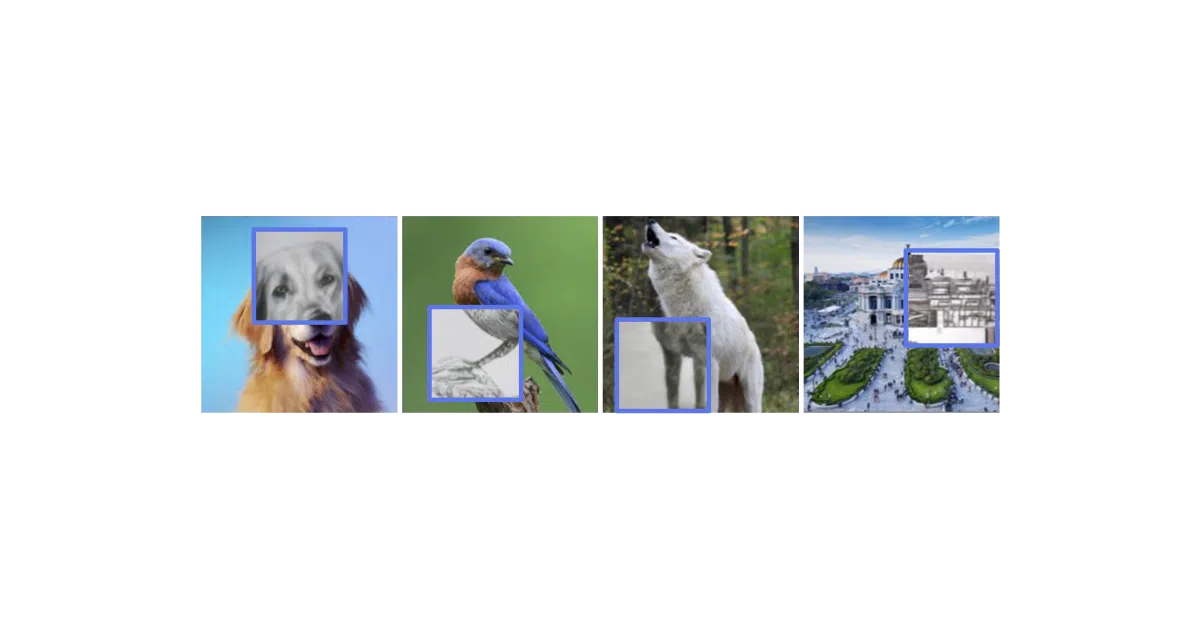
The predictor acts like a “primitive world-model” that reasons about spatial uncertainty in semantic space rather than pixel space. The authors visualize this by training a stochastic decoder to sketch what the predicted representations imply—showing the model grasposes and object parts (a dog’s head, a wolf’s legs) without ever being trained to draw. It also sidesteps the usual parade of hand-crafted augmentations (random crops, color jitters, etc.) that self-supervised methods typically rely on.
Key highlights
- Predicts in representation space, not pixel space, which the authors argue yields more semantically meaningful features
- Avoids data-augmentation overhead: only one view of the image is processed by the target encoder
- Released pretrained checkpoints for ViT-H and ViT-g on both ImageNet-1K and ImageNet-22K
- Official PyTorch implementation with SLURM-distributed and local-single-machine entrypoints
- Published at CVPR 2023; associated with Yann LeCun’s broader JEPA research direction
Caveats
- Reproducing the main ViT-H/14 result requires 16 A100 80G GPUs and a batch size of 2048—not a casual workstation project
- The codebase is training infrastructure only; no fine-tuning or downstream task scripts are visible in the README
- Config-driven (YAML) rather than CLI-driven, which is a design choice but may feel rigid
Verdict
Worth studying if you’re in self-supervised vision research or curious about LeCun’s JEPA line of work. Skip it if you need a plug-and-play feature extractor for downstream tasks—this repo is for pretraining from scratch.
Frequently asked
- What is facebookresearch/ijepa?
- A CVPR-23 architecture from FAIR that learns image semantics by predicting latent representations instead of reconstructing pixels.
- Is ijepa open source?
- Yes — facebookresearch/ijepa is an open-source project tracked on heatdrop.
- What language is ijepa written in?
- facebookresearch/ijepa is primarily written in Python.
- How popular is ijepa?
- facebookresearch/ijepa has 3.5k stars on GitHub.
- Where can I find ijepa?
- facebookresearch/ijepa is on GitHub at https://github.com/facebookresearch/ijepa.