exo-explore/exo
Mesh your Macs into a local AI cluster
exo auto-discovers Apple devices on your network and shards frontier models across them, turning a pile of Macs into a single inference engine.
Velocity · 7d
+14
★ / day
Trend
↘cooling
star history
What it does
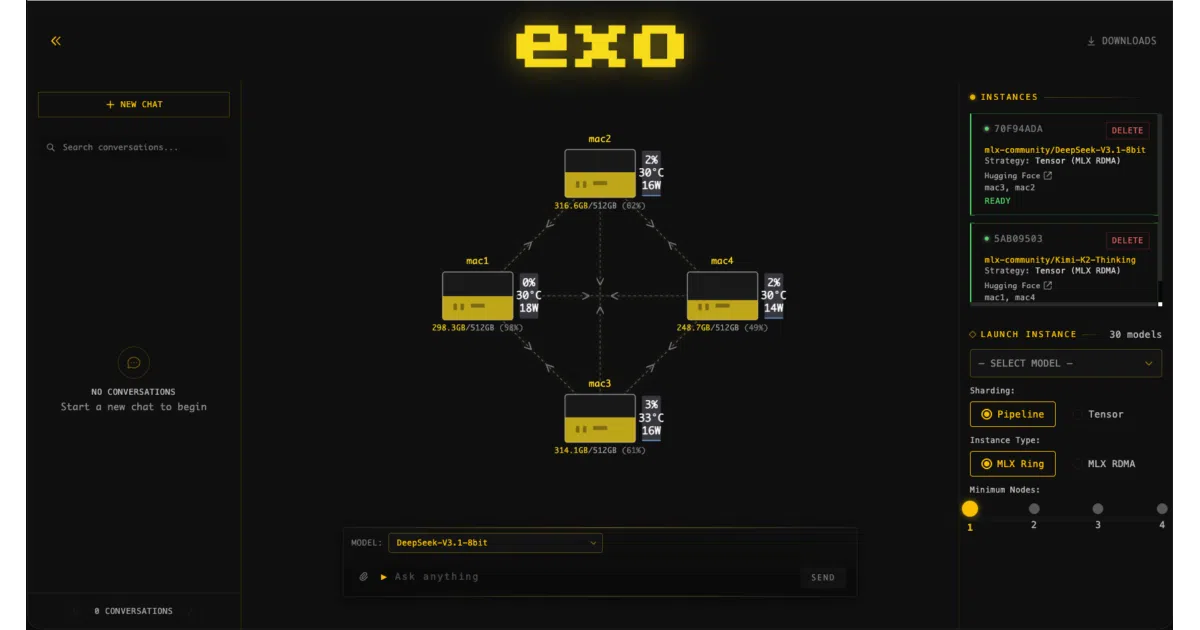
exo is a distributed inference engine that pools your local devices into a single cluster. It auto-discovers peers, shards large models across them using tensor parallelism, and serves results through OpenAI-, Claude-, and Ollama-compatible APIs. A built-in dashboard handles cluster management and chat without extra tooling.
The interesting bit
The project treats Thunderbolt 5 like a datacenter interconnect by shipping day-zero support for RDMA over Thunderbolt, which the team claims reduces inter-device latency by 99%. A topology-aware scheduler then splits models based on realtime link bandwidth and per-node resources rather than assuming a uniform grid.
Key highlights
- Zero-config mesh: devices find each other automatically with no manual cluster setup.
- RDMA over Thunderbolt 5 on macOS 26.2+, targeting sub-millisecond latency between Macs.
- Tensor parallelism with reported speedups up to 1.8× on two devices and 3.2× on four.
- Drop-in API compatibility with OpenAI Chat Completions, Claude Messages, and Ollama endpoints.
- Built-in web dashboard for cluster monitoring and inference.
Caveats
- Linux support is currently CPU-only; GPU acceleration is marked as under development.
- RDMA requires macOS Tahoe 26.2 or later and Thunderbolt 5 hardware (M4 Pro/Max, M3 Ultra).
- The packaged macOS app also requires macOS Tahoe 26.2, and enabling RDMA demands a trip to Recovery mode.
Verdict
Worth a look if you have a stack of Apple Silicon Macs and want to run 400B+ parameter models locally without cloud GPUs. Skip it for now if you are on Linux and need GPU performance, or if your idea of a cluster is a single laptop.
Frequently asked
- What is exo-explore/exo?
- exo auto-discovers Apple devices on your network and shards frontier models across them, turning a pile of Macs into a single inference engine.
- Is exo open source?
- Yes — exo-explore/exo is open source, released under the Apache-2.0 license.
- What language is exo written in?
- exo-explore/exo is primarily written in Python.
- How popular is exo?
- exo-explore/exo has 48k stars on GitHub and is currently cooling off.
- Where can I find exo?
- exo-explore/exo is on GitHub at https://github.com/exo-explore/exo.