eugeniughelbur/obsidian-second-brain
Your Obsidian vault, but it actually remembers things
A cross-CLI skill that turns your static notes into a self-updating knowledge base for Claude, Codex, Gemini, and OpenCode.
Velocity · 7d
+15
★ / day
Trend
→steady
star history
What it does
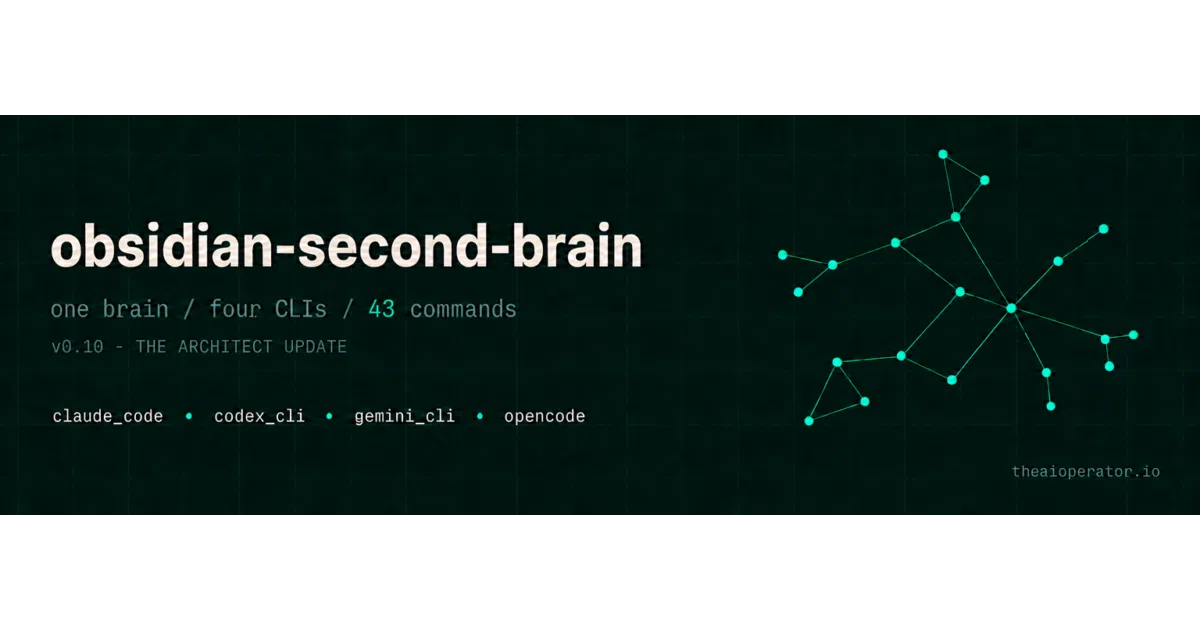
obsidian-second-brain is a Python skill that plugs into four AI CLI tools—Claude Code, Codex, Gemini CLI, and OpenCode—and gives them 43 commands to read, write, and reason about your Obsidian vault. Instead of treating notes as a dump, it treats them as a living database: ingest a meeting transcript and it extracts decisions, people, and tasks into the right pages; feed it a YouTube URL and it updates existing notes rather than appending yet another file.
The interesting bit
The core twist is rewrite, don’t append. The README explicitly frames this as an evolution of Karpathy’s LLM Wiki pattern: new information updates existing pages, contradictions get auto-reconciled via /obsidian-reconcile, and /obsidian-synthesize writes new synthesis pages without being asked. The notes themselves are structured for LLM retrieval—## For future Claude preambles and frontmatter—making the vault machine-readable first, human-readable second. Four scheduled agents (nightly close, weekly review, contradiction sweep, vault-health check) run while you sleep.
Key highlights
- 43 slash commands covering ingestion (
/obsidian-ingestfor audio, images, URLs), research (/research,/research-deep,/x-read,/x-pulse), reflection (/obsidian-challengesearches your own vault for past failures to push back on decisions), and visualization (/obsidian-visualizegenerates canvas maps) - Dual-track research: open-web via Perplexity/Grok and source-grounded via Gemini File Search API (
/notebooklm), with explicit encouragement to run both and chase contradictions - v0.10 adds
/obsidian-architect: scans a codebase and writes maintained architecture notes into your vault, refreshable without clobbering your edits - Key-less web research and Google Calendar integration in the latest release
- Self-rewriting notes with anti-hallucination guards and a write-time AI-first validator
Caveats
- The README is heavy on promise and light on implementation detail: no visible architecture diagram, no explanation of how scheduled agents actually run (cron? daemon? CLI trigger?), and the “43 commands” are listed but not documented in the excerpt provided
- Requires multiple external API keys (Perplexity, Grok, Gemini, YouTube Data API v3) for full functionality; “key-less” appears to refer to a subset of research features, not the whole system
- The “AI-first” note format means your vault becomes increasingly opaque to human browsing without the CLI layer
Verdict
Worth a look if you’re already living in Claude Code or Codex and your Obsidian vault has become a graveyard of orphaned daily notes. Skip it if you want your notes to remain hand-curated or if the idea of an LLM rewriting your past decisions while you sleep sounds more alarming than helpful.
Frequently asked
- What is eugeniughelbur/obsidian-second-brain?
- A cross-CLI skill that turns your static notes into a self-updating knowledge base for Claude, Codex, Gemini, and OpenCode.
- Is obsidian-second-brain open source?
- Yes — eugeniughelbur/obsidian-second-brain is open source, released under the MIT license.
- What language is obsidian-second-brain written in?
- eugeniughelbur/obsidian-second-brain is primarily written in Python.
- How popular is obsidian-second-brain?
- eugeniughelbur/obsidian-second-brain has 4.9k stars on GitHub and is currently holding steady.
- Where can I find obsidian-second-brain?
- eugeniughelbur/obsidian-second-brain is on GitHub at https://github.com/eugeniughelbur/obsidian-second-brain.