ethanplusai/astra-flash-orchestrator
Astra decides, Flash builds, your bill shrinks
A Codex workflow that keeps GPT-6 Astra in charge of planning and review while offloading implementation and testing to DeepSeek V4.1 Flash to slash API-equivalent costs.
Collecting fresh signals — velocity needs a few days of history.
collecting data…
star history
What it does
Astra Flash Orchestrator is a Codex skill that installs a native subagent role called astra_flash_builder. It routes high-level planning, architecture, and final review to GPT-6 Astra, while delegating implementation, testing, debugging, and routine verification to DeepSeek V4.1 Flash. The goal is to preserve Astra’s judgment for decisions that matter without burning premium tokens on thousands of lines of boilerplate and tests. The README is explicit that this is workflow guidance, not a deterministic scheduler or security sandbox.
The interesting bit
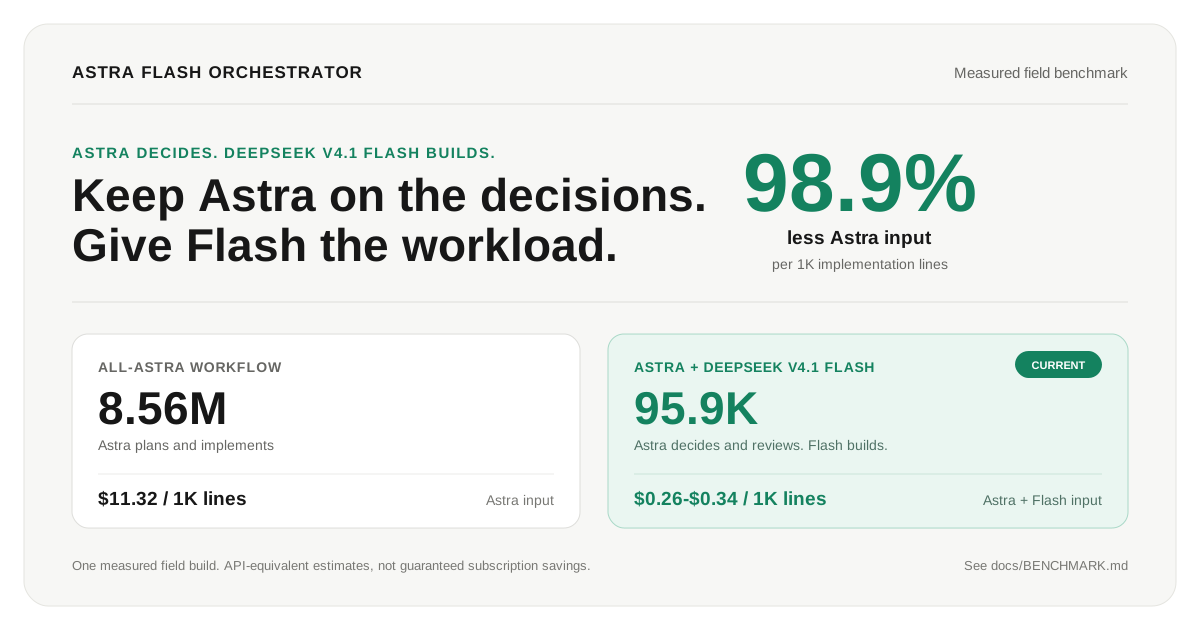
The README reports one substantial local field build where the workflow used 98.9% less Astra input per 1,000 implementation and test lines than an all-Astra baseline, with total API-equivalent compute dropping 97.0–97.7% while producing 39% more code. Those numbers come from a single measured run, not a guaranteed benchmark, but the cost table makes the logic obvious: Flash tokens are roughly 33× to 333× cheaper than Astra’s API-equivalent estimates. The installer itself is paranoid in a useful way—it runs dry-run preflights, backs up existing instructions, and prints a guarded undo receipt without ever asking for API keys or running paid inference.
Key highlights
- Pins a dedicated
astra_flash_buildersubagent role to a specific Flash route so unrelated subagents keep their defaults. - Claims a 98.9% reduction in Astra input per 1K lines and 97%+ lower compute cost in one measured build, though it notes these are not guaranteed savings.
- Installation is reversible: atomic apply, backups, and an undo receipt; it never touches root model, credentials, or provider config.
- Requires zero third-party Python dependencies beyond Python 3.11+.
- Explicitly independent of OpenAI, DeepSeek, and Codex Router.
Caveats
- Early release; the README warns that a new installation still needs runtime routing verification on its first authorized task.
- Requires a Codex client that supports native subagents, GPT-6 Astra as root, and an already-configured Codex Router advertising a DeepSeek V4.1 Flash route with
multi_agent_version: "v2". - The impressive efficiency numbers come from a single local field build, not a broad benchmark.
Verdict
Worth a look if you are already paying for Astra and want to stop using it as a glorified code monkey. Skip it if you do not use Codex with native subagent support or if your work is too small to justify the routing overhead.
Frequently asked
- What is ethanplusai/astra-flash-orchestrator?
- A Codex workflow that keeps GPT-6 Astra in charge of planning and review while offloading implementation and testing to DeepSeek V4.1 Flash to slash API-equivalent costs.
- Is astra-flash-orchestrator open source?
- Yes — ethanplusai/astra-flash-orchestrator is open source, released under the MIT license.
- What language is astra-flash-orchestrator written in?
- ethanplusai/astra-flash-orchestrator is primarily written in Python.
- How popular is astra-flash-orchestrator?
- ethanplusai/astra-flash-orchestrator has 599 stars on GitHub.
- Where can I find astra-flash-orchestrator?
- ethanplusai/astra-flash-orchestrator is on GitHub at https://github.com/ethanplusai/astra-flash-orchestrator.