erupts/erupt
Java admin UI from one annotation — now with an AI harness
Erupt generates full CRUD admin pages from JPA annotations, and its new AI layer adds 50+ LLM providers, MCP tools, and agent-to-agent protocols without extra boilerplate.
Not currently ranked — collecting fresh signals.
star history
What it does
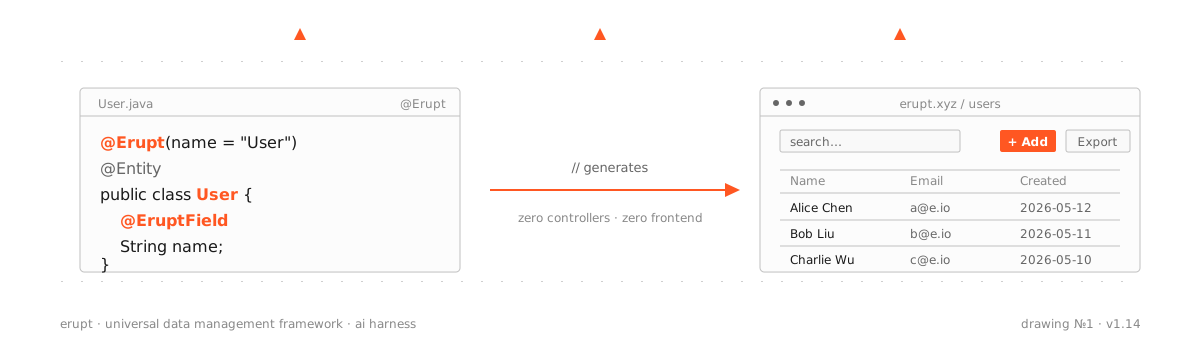
Erupt is a Spring Boot 3 library that turns a single annotated JPA entity into a complete admin interface — tables, forms, search, pagination, export, and RBAC — with zero front-end code or controllers. Add @Erupt to a class, run the app, and you have a working back-office at localhost:8080.
The interesting bit
The project has quietly bolted on a full AI infrastructure layer: 50+ LLM providers (hot-swappable in the admin UI), MCP-native tool servers, A2A agent-to-agent protocol, and role-gated tool security. You annotate a Spring bean with @AiToolbox and @Tool, and the LLM can call it — but only if the user’s role is whitelisted. It’s governance-first AI wiring, not just another chat wrapper.
Key highlights
- One Java class = one admin page with 20+ field types (sliders, maps, signatures, Markdown, etc.)
- Built-in RBAC, audit logs, Excel import/export, and OpenAPI endpoints for every entity
- AI Harness: streaming SSE chat, thinking-model support, per-user chat history with token tracking, long-term memory across sessions
- AI Claw: natural-language control of shell commands, file I/O, browser automation, and 700k+ skills from skills.sh
- Multi-database via JPA (MySQL, PostgreSQL, Oracle, SQL Server, DM) plus MongoDB module;
erupt-cloudfor distributed config
Caveats
- Several advanced modules (Chart, Flow, Tenant, Cube) are listed as commercial; the README doesn’t clarify licensing or pricing
- The “700k+ skills” claim comes from an external skills.sh integration, not native capabilities
- AI features are powerful on paper, but the README offers no benchmarks or latency numbers for production workloads
Verdict Worth a look if you maintain internal Spring Boot admin tools and want to add LLM features without rebuilding your stack. Skip it if you need deep custom UI logic or if vendor-lockin around the commercial modules worries you.
Frequently asked
- What is erupts/erupt?
- Erupt generates full CRUD admin pages from JPA annotations, and its new AI layer adds 50+ LLM providers, MCP tools, and agent-to-agent protocols without extra boilerplate.
- Is erupt open source?
- Yes — erupts/erupt is open source, released under the Apache-2.0 license.
- What language is erupt written in?
- erupts/erupt is primarily written in Java.
- How popular is erupt?
- erupts/erupt has 2.8k stars on GitHub.
- Where can I find erupt?
- erupts/erupt is on GitHub at https://github.com/erupts/erupt.