emrgnt-cmplxty/automata
A coding agent that dreams of replacing you, eventually
Automata is an LLM-powered system that reads, searches, and writes its own codebase in pursuit of full autonomy.
Not currently ranked — collecting fresh signals.
star history
What it does
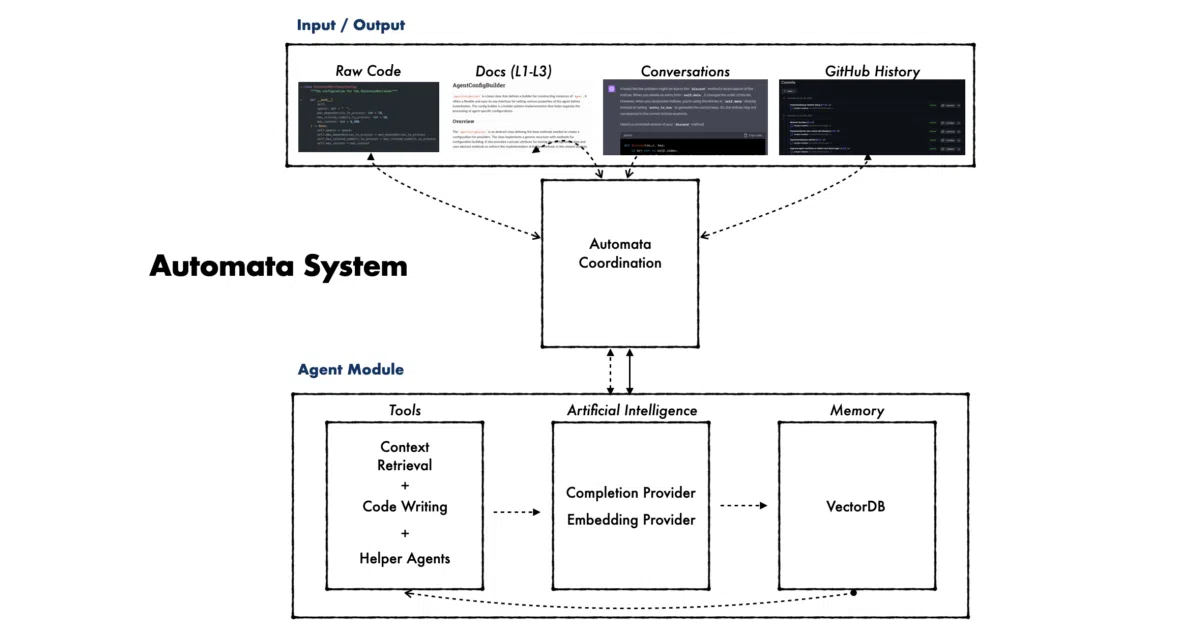
Automata wires GPT-4 to a vector database and SCIP code-graph indices so an agent can navigate, document, and modify a codebase. You give it an instruction in plain English; it plans, searches symbols, and emits or edits code. The project explicitly treats code as “memory” and aims to bootstrap itself toward full self-programming.
The interesting bit
The Greek etymology isn’t just window dressing. The architecture treats the codebase as a living graph—embeddings for code and docs, symbol dependencies resolved via SCIP—so the agent reasons about structure, not just text. It’s less “Copilot with ambition” and more “turtle stacking turtles,” where each improvement to tooling feeds back into the next iteration.
Key highlights
- Built on OpenAI function-calling agents with configurable toolkits (e.g.,
context-oracle) - Uses SCIP indices for cross-symbol dependency search across the codebase
- Maintains separate
SymbolCodeEmbeddingandSymbolDocEmbeddingvectors for retrieval - Docker and GitHub Codespaces support for quick setup
- Apache 2.0 licensed, with active docs on ReadTheDocs
Caveats
- Requires manual SCIP index generation for your own code; the pre-built indices only cover Automata itself
- Windows setup needs C++ build tools and potentially gcc-11/g++-11 shims
- The demo video and schematic are rough; actual capabilities vs. aspirations remain unclear from the README
Verdict
Worth a look if you’re experimenting with agentic code manipulation or recursive self-improvement as a research direction. Skip it if you need a production-ready coding assistant today—the 677 stars and heavy setup suggest this is still a lab project with AGI moonshot branding.
Frequently asked
- What is emrgnt-cmplxty/automata?
- Automata is an LLM-powered system that reads, searches, and writes its own codebase in pursuit of full autonomy.
- Is automata open source?
- Yes — emrgnt-cmplxty/automata is open source, released under the Apache-2.0 license.
- What language is automata written in?
- emrgnt-cmplxty/automata is primarily written in Python.
- How popular is automata?
- emrgnt-cmplxty/automata has 682 stars on GitHub.
- Where can I find automata?
- emrgnt-cmplxty/automata is on GitHub at https://github.com/emrgnt-cmplxty/automata.