dzhng/deep-seek
When you need a spreadsheet, not a summary
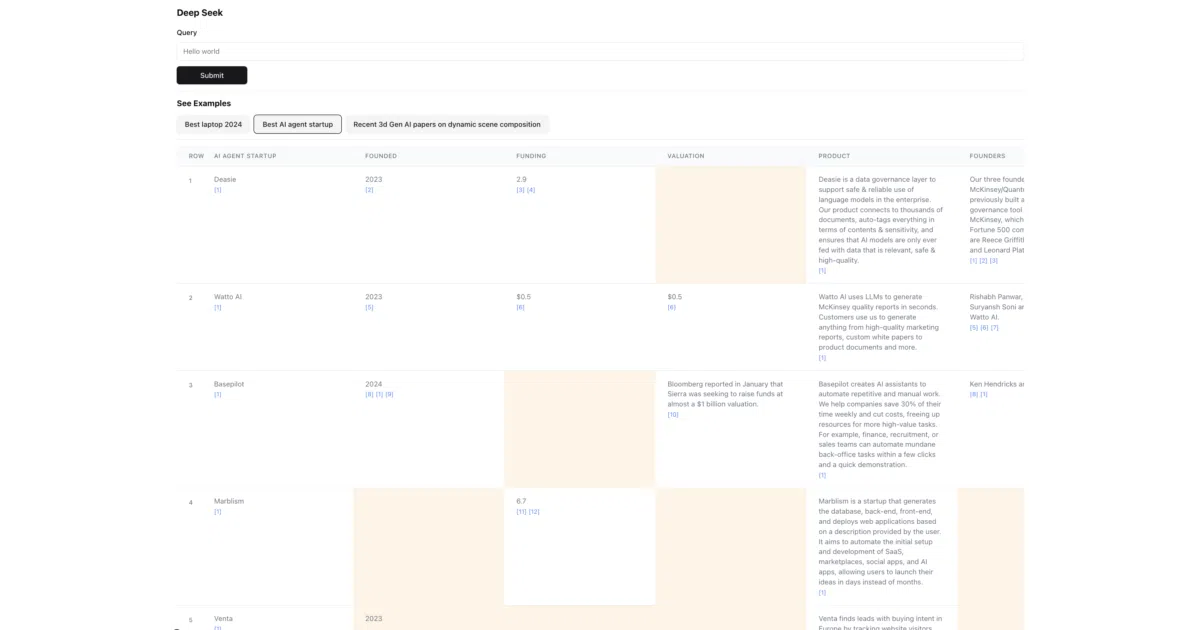
DeepSeek is an experimental retrieval engine that uses LLMs to scour hundreds of sources and compile comprehensive, enriched entity tables instead of writing research reports.
Not currently ranked — collecting fresh signals.
star history
What it does
A multi-step research agent that treats the web as a database to be harvested, not a textbook to be summarized. Given a query, it plans a schema, searches across hundreds of sources using Exa’s keyword and neural search, extracts entities with an LLM, and enriches each row into a structured table. One example run produced 94 entities after chewing through 356 sources, complete with per-cell confidence scores that flag uncertain data in yellow.
The interesting bit
The extraction step uses a clever token-saving trick: sentences are split with winkNLP, special tokens are inserted between them, and the LLM simply marks start and end tokens to define what content to pull. Inside the larger retrieval pipeline lives a smaller “answer agent” whose sole job is to fill in the table columns, making the system essentially an agent nested inside another agent.
Key highlights
- Designed as a retrieval engine (comprehensive entity tables) rather than an answer engine (single research report).
- Uses both keyword and neural search via Exa to find listicles, reviews, and specific entities.
- Claims to be “super fast & token efficient” during extraction by using special delimiter tokens instead of raw text chunking.
- Generates confidence scores (0–1) for every cell to surface conflicting or missing source data.
- Example run processed 356 sources and emitted 94 enriched records.
Caveats
- Runs are slow (~5 minutes) and not cheap; the author estimates $0.10–$3.00 in API credits per query.
- Entity resolution is still shaky—the README admits the agent can confuse things like M2 and M3 MacBooks.
- The live demo is read-only; actual queries require local setup with Anthropic and Exa API keys.
Verdict
Worth a look if your workflow involves competitive intelligence, market mapping, or any domain where “give me every X” beats “tell me about X”. Skip it if you just want a quick paragraph answer and don’t have a budget for agentic API bills.
Frequently asked
- What is dzhng/deep-seek?
- DeepSeek is an experimental retrieval engine that uses LLMs to scour hundreds of sources and compile comprehensive, enriched entity tables instead of writing research reports.
- Is deep-seek open source?
- Yes — dzhng/deep-seek is open source, released under the MIT license.
- What language is deep-seek written in?
- dzhng/deep-seek is primarily written in TypeScript.
- How popular is deep-seek?
- dzhng/deep-seek has 520 stars on GitHub.
- Where can I find deep-seek?
- dzhng/deep-seek is on GitHub at https://github.com/dzhng/deep-seek.