drprojects/superpoint_transformer
One repo, three papers: tiny models for giant point clouds
This repository exists to show that segmenting million-point 3D scenes doesn't require a massive model—just a clever way to group points into superpoints first.
Not currently ranked — collecting fresh signals.
star history
What it does
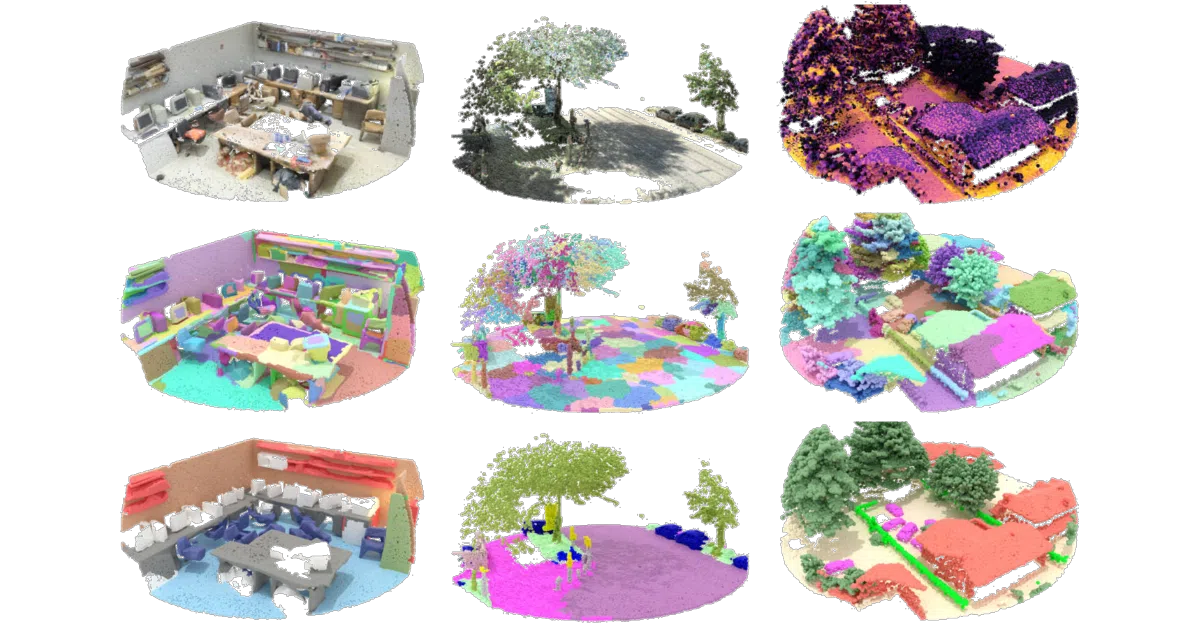
This is the official PyTorch implementation for three related methods: Superpoint Transformer (ICCV'23), SuperCluster (3DV'24 Oral), and EZ-SP (ICRA'26). All three tackle semantic or panoptic segmentation of large 3D point clouds by first compressing millions of raw points into a hierarchy of semantically coherent superpoints. Instead of brute-forcing attention across every single coordinate, the models run lightweight transformers or graph clustering on these condensed clusters.
The interesting bit
SuperCluster reframes panoptic segmentation as a graph optimization problem: the network predicts node and edge parameters, and a fast parallelized solver turns those into object instances at inference time, dodging the usual matching headaches during training. EZ-SP later replaces the original CPU-bound partitioning with a learnable GPU graph clustering pipeline that embeds points so different semantic classes naturally drift apart before clustering.
Key highlights
- Absurdly small footprints: SPT and SuperCluster weigh in at 212k parameters—roughly 1/200th the size of PointNeXt—while EZ-SP stays lean at 392k.
- Single-GPU scalability: SuperCluster digests an 18-million-point, 7.8 km² tile in 10.1 seconds; SPT trains on S3DIS in three hours on one GPU.
- EZ-SP claims a 72× end-to-end speedup over PTv3 and a 5.3× speedup over the original SPT by moving superpoint partitioning to the GPU.
- The codebase spans three tasks—semantic segmentation, panoptic segmentation, and fast learnable partitioning—under one Hydra-and-Lightning configuration roof.
- The core GPU graph algorithms are also available separately in the
torch-graph-componentslibrary.
Caveats
- The README is truncated mid-sentence in the EZ-SP update section, so the full details of the latest release are partially missing.
- The authors explicitly note that if you only need the fast graph connected components or partitioning algorithms, you should use the standalone
torch-graph-componentslibrary instead of this full segmentation framework. - Every benchmark number in the README is drawn from S3DIS, KITTI-360, DALES, or ScanNet; no other datasets are discussed.
Verdict
Computer vision researchers and robotics engineers working with large-scale LiDAR or indoor scans who need off-the-shelf semantic or panoptic segmentation should start here. If you are looking for a general-purpose point cloud utility or need support for arbitrary datasets without heavy reconfiguration, this is probably not your tool.
Frequently asked
- What is drprojects/superpoint_transformer?
- This repository exists to show that segmenting million-point 3D scenes doesn't require a massive model—just a clever way to group points into superpoints first.
- Is superpoint_transformer open source?
- Yes — drprojects/superpoint_transformer is open source, released under the MIT license.
- What language is superpoint_transformer written in?
- drprojects/superpoint_transformer is primarily written in Python.
- How popular is superpoint_transformer?
- drprojects/superpoint_transformer has 1.1k stars on GitHub.
- Where can I find superpoint_transformer?
- drprojects/superpoint_transformer is on GitHub at https://github.com/drprojects/superpoint_transformer.