deepspeedai/DeepSpeed-MII
Inference that auto-configures GPU optimizations per model and batch size
MII eliminates the manual tuning required to get high-throughput LLM inference by automatically applying system optimizations based on your model, batch size, and GPU.
Not currently ranked — collecting fresh signals.
star history
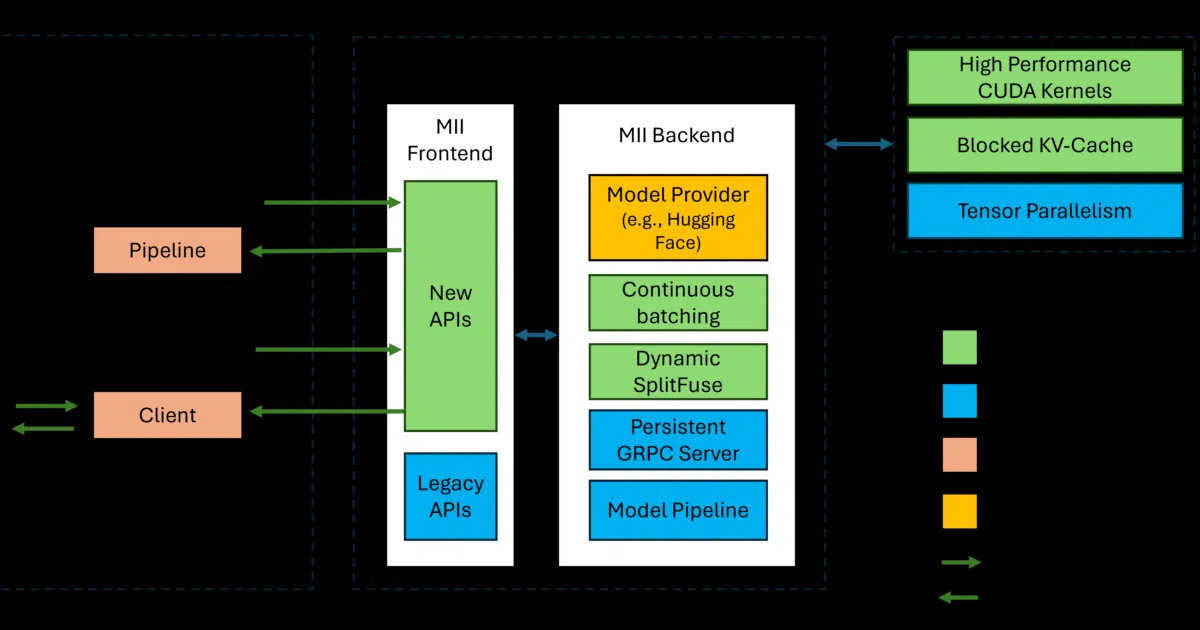
What it does MII is an inference engine built on top of DeepSpeed-Inference that takes Hugging Face models and automatically applies a set of GPU optimizations—blocked KV caching, continuous batching, tensor parallelism, and custom CUDA kernels—to minimize latency and maximize throughput. You hand it a model name and it handles the rest, offering both ephemeral pipelines for quick scripts and a persistent gRPC server for production traffic.
The interesting bit The README cites up to 2.5× the effective throughput of vLLM, though it defers the detailed benchmarks to the project’s own blog posts. The real convenience is the pre-compiled kernel wheels shipped via DeepSpeed-Kernels, which sidestep the usual compile-from-source ritual that makes many inference frameworks a pain to install.
Key highlights
- Supports over 37,000 models across eight architectures, including Llama, Mistral, Mixtral, and Qwen, pulling weights and tokenizers directly from Hugging Face.
- Automatically selects optimizations based on model architecture, size, batch size, and available hardware resources.
- Offers two deployment modes: a lightweight non-persistent pipeline for prototyping and a persistent gRPC service for multi-client production use.
- Legacy APIs extend support to over 50,000 additional models, including BERT, RoBERTa, and Stable Diffusion.
- Targets NVIDIA Ampere and newer (compute capability 8.0+), CUDA 11.6+, and Ubuntu 20+.
Caveats
- The 2.5× throughput claim over vLLM appears in the README but detailed performance data lives in the project’s own blog posts, not independent benchmarks in the repo.
- Modern NVIDIA hardware is effectively mandatory: Ampere or newer, CUDA 11.6+, and Ubuntu 20+.
- The README names
Dynamic SplitFuseas a key technology but does not explain how it works.
Verdict If you’re already in the DeepSpeed ecosystem and want a straightforward way to serve Hugging Face models at high throughput, MII is worth a look. If you’re running older GPUs or prefer to hand-tune your own inference stack, it probably won’t change your mind.
Frequently asked
- What is deepspeedai/DeepSpeed-MII?
- MII eliminates the manual tuning required to get high-throughput LLM inference by automatically applying system optimizations based on your model, batch size, and GPU.
- Is DeepSpeed-MII open source?
- Yes — deepspeedai/DeepSpeed-MII is open source, released under the Apache-2.0 license.
- What language is DeepSpeed-MII written in?
- deepspeedai/DeepSpeed-MII is primarily written in Python.
- How popular is DeepSpeed-MII?
- deepspeedai/DeepSpeed-MII has 2.1k stars on GitHub.
- Where can I find DeepSpeed-MII?
- deepspeedai/DeepSpeed-MII is on GitHub at https://github.com/deepspeedai/DeepSpeed-MII.