datawhalechina/easy-vibe
A 10-Language Field Guide to Building Apps by Chat
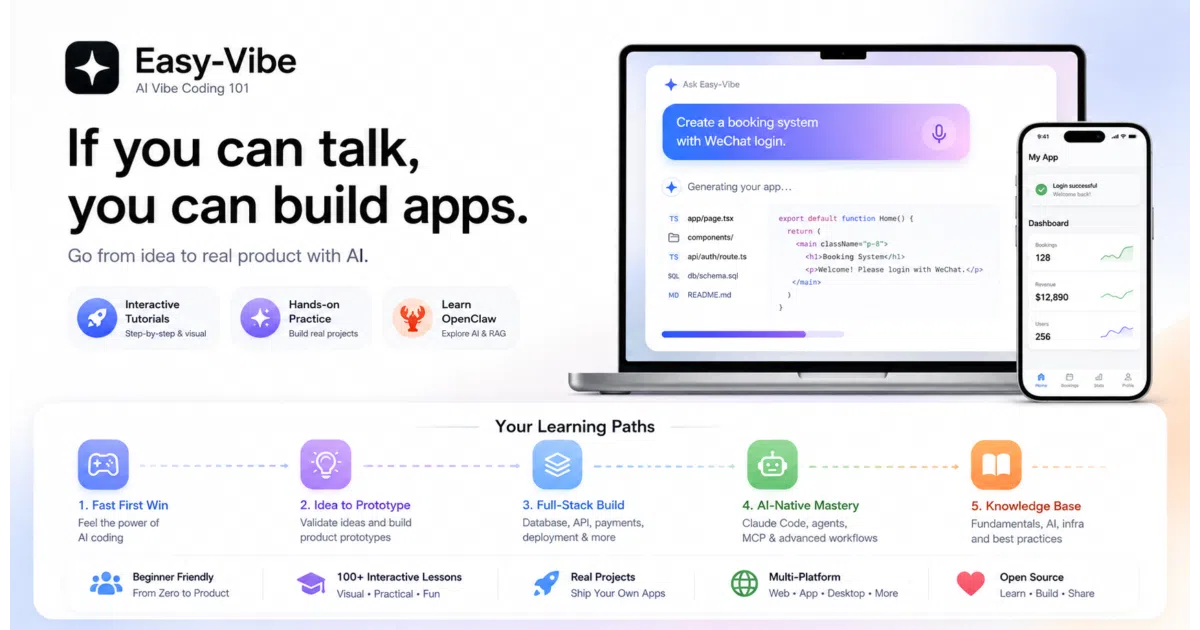
It is a free, multi-stage curriculum that teaches beginners how to turn conversational prompts into shipping products using AI IDEs and agents.
Velocity · 7d
+37
★ / day
Trend
↗accelerating
star history
What it does
Easy-Vibe is a free, multi-stage course—hosted as a documentation site—that teaches app development through “vibe coding,” the practice of describing features to an AI and refining the output. The curriculum runs from absolute beginner (building a first prototype) through junior full-stack topics such as Stripe payments and SaaS capstones, up to advanced workflows with Claude Code, MCP, and agent teams. All content is published under a CC BY-NC-SA 4.0 license and available in ten languages.
The interesting bit
Instead of static markdown walls, the course uses interactive animations to visualize dry concepts: a virtual mouse cursor walks you through IDE workflows, click-through diagrams explain RAG data flow, and terminal commands are illustrated with visual logic. It even includes llms.txt so AI agents like Claude and Cursor can read the syllabus themselves.
Key highlights
- Three-stage path: beginner prototyping, full-stack development (24 chapters), and advanced AI-agent workflows (25 chapters).
- 10-language localization including English, Chinese, Japanese, Korean, Arabic, and others.
- Interactive appendices covering 80+ topics—prompt engineering, Git internals, authentication design, and image-generation principles.
- Real-world “Vibe Stories” from a rural teacher, a truck driver, and a college student who shipped products.
- Course material is licensed CC BY-NC-SA 4.0 (non-commercial).
Verdict
Grab this if you are a beginner, product manager, or founder trying to bootstrap an MVP with Cursor or Claude and need a structured roadmap. Skip it if you are looking for a library or framework to import into your existing codebase—it is coursework, not code.
Frequently asked
- What is datawhalechina/easy-vibe?
- It is a free, multi-stage curriculum that teaches beginners how to turn conversational prompts into shipping products using AI IDEs and agents.
- Is easy-vibe open source?
- Yes — datawhalechina/easy-vibe is an open-source project tracked on heatdrop.
- What language is easy-vibe written in?
- datawhalechina/easy-vibe is primarily written in JavaScript.
- How popular is easy-vibe?
- datawhalechina/easy-vibe has 20.2k stars on GitHub and is currently accelerating.
- Where can I find easy-vibe?
- datawhalechina/easy-vibe is on GitHub at https://github.com/datawhalechina/easy-vibe.