datawhalechina/deepagents-in-action
A Chinese field guide to taming production LangChain agents
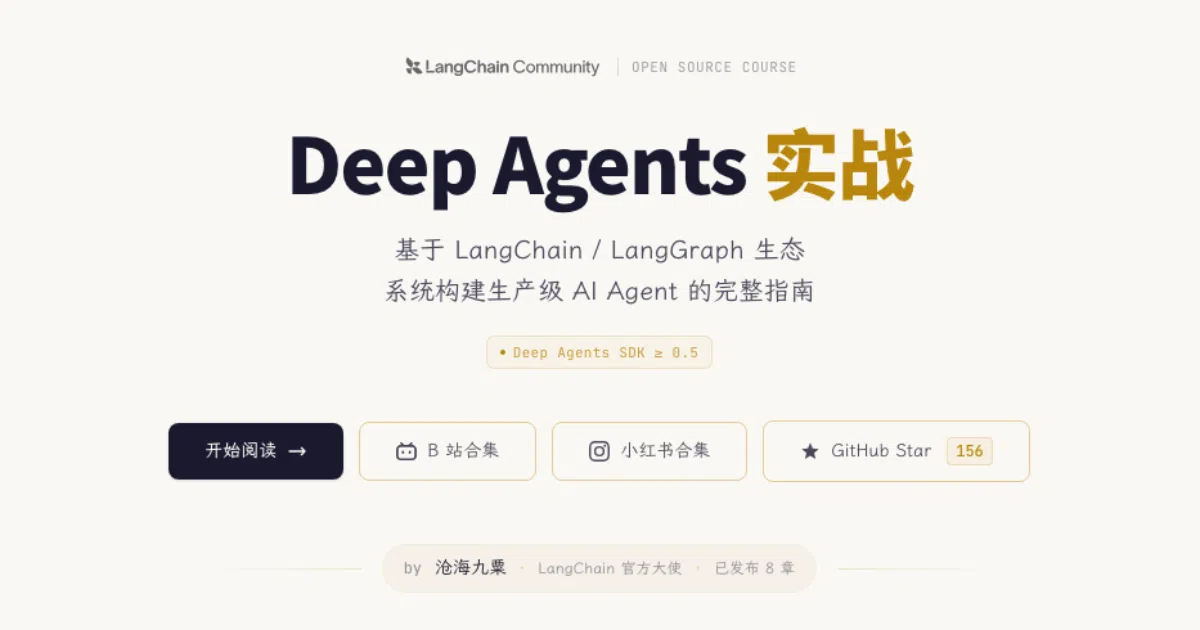
An open-source Chinese curriculum that tries to bridge the chasm between LangChain demos and production-grade agent systems.
Velocity · 7d
+66
★ / day
Trend
↗accelerating
star history
What it does
The repo hosts 《Deep Agents 实战》, an open-source course site built with Astro. It walks through the Deep Agents framework—built atop LangChain and LangGraph—to move from quickstarts to concepts like virtual filesystems, task planning, sub-agent delegation, and long-term memory. The material is delivered as a GitHub Pages site with linked Bilibili videos and Xiaohongshu posts.
The interesting bit
The author is a LangChain official ambassador, and the course doubles as advocacy for an opinionated stack: it pairs Deep Agents with the AgentSeek scaffolding tool, specific SiliconFlow model endpoints, and AI-coding-assistant “skills” that inject LangChain engineering lore directly into your editor.
Key highlights
- Covers context engineering via a “virtual filesystem” abstraction inside Deep Agents.
- Teaches agent decomposition: task planning, synchronous sub-agents, and async sub-agents.
- Includes advanced chapters on reusable Skills and long-term memory.
- Content is CC BY-NC-SA 4.0 licensed; videos and articles are hosted on Bilibili and Xiaohongshu.
- Explicitly warns that small models (e.g.,
Qwen/Qwen2.5-7B-Instruct) often fail on complex planning and recommends larger endpoints for serious tasks.
Caveats
- The course is entirely in Chinese; English speakers need translation tools.
- Several advanced topics (human-in-the-loop, sandbox execution, production deployment) are listed but marked as still in planning.
- Deep Agents itself is a rapidly moving target; the text warns that some features require versions as specific as
deepagents>=0.6.8.
Verdict
Worth bookmarking if you read Chinese and are trying to productionize LangChain agents. If you are looking for a language-agnostic reference or a finished software library, this is not it.
Frequently asked
- What is datawhalechina/deepagents-in-action?
- An open-source Chinese curriculum that tries to bridge the chasm between LangChain demos and production-grade agent systems.
- Is deepagents-in-action open source?
- Yes — datawhalechina/deepagents-in-action is an open-source project tracked on heatdrop.
- What language is deepagents-in-action written in?
- datawhalechina/deepagents-in-action is primarily written in Astro.
- How popular is deepagents-in-action?
- datawhalechina/deepagents-in-action has 2.5k stars on GitHub and is currently accelerating.
- Where can I find deepagents-in-action?
- datawhalechina/deepagents-in-action is on GitHub at https://github.com/datawhalechina/deepagents-in-action.