cvat-ai/cvat
The open-source label factory behind half the vision datasets you've seen
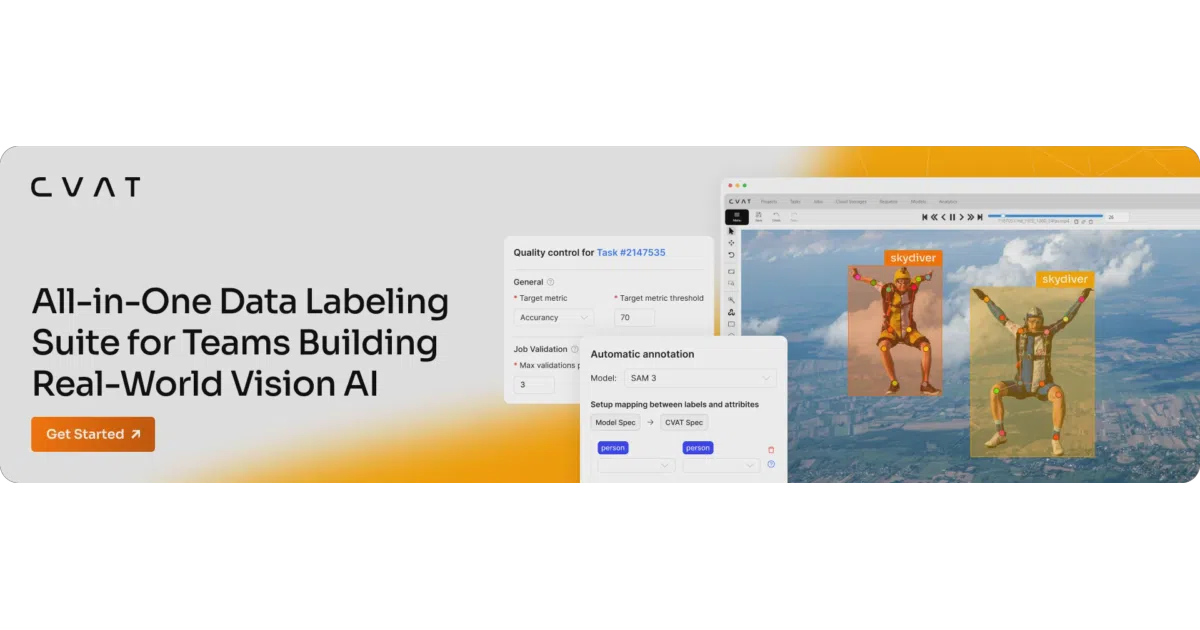
CVAT is the self-hosted annotation workbench that lets teams draw bounding boxes, polygons, and 3D cuboids on their own hardware while plugging in their own models to do the boring parts.
Velocity · 7d
+6.6
★ / day
Trend
→steady
star history
What it does
CVAT Community is a browser-based platform for labeling images, videos, and 3D point clouds. Teams create projects, assign annotation jobs, review each other’s work, and export to 20+ formats including COCO, YOLO, and KITTI. It runs entirely on your own infrastructure via Docker Compose, with a Python SDK and REST API for pipeline automation.
The interesting bit
The project treats your own ML models as first-class citizens: you can wire in detectors, segmenters, or trackers (SAM, YOLO, RetinaNet, etc.) through a serverless Nuclio layer to pre-label data before humans touch it. That’s a pragmatic inversion of the usual SaaS pattern where AI assistance is a premium upsell.
Key highlights
- MIT-licensed core with active maintenance since 2018
- Multi-organization support with role-based access and review workflows
- 20+ import/export formats plus direct S3/Azure/GCS storage hooks
- Pre-built serverless integrations for PyTorch, ONNX, OpenVINO, and TensorFlow models
- Grafana dashboards for tracking annotator activity and project progress
- Chromium-based browsers only; Firefox has caveats, Safari is unsupported
Caveats
- Advanced analytics, SSO, SAM 2/3, and AI agents are paywalled to CVAT Online or Enterprise tiers
- Some serverless model assets carry separate non-commercial licenses despite the MIT core
- FFmpeg dependencies pull in LGPL/GPL obligations you’ll need to track
Verdict
Worth evaluating if you need to keep data in-house and already have models to deploy against your labeling queue. Skip if you want turnkey SaaS convenience or need Safari support for your annotation team.
Frequently asked
- What is cvat-ai/cvat?
- CVAT is the self-hosted annotation workbench that lets teams draw bounding boxes, polygons, and 3D cuboids on their own hardware while plugging in their own models to do the boring parts.
- Is cvat open source?
- Yes — cvat-ai/cvat is open source, released under the MIT license.
- What language is cvat written in?
- cvat-ai/cvat is primarily written in Python.
- How popular is cvat?
- cvat-ai/cvat has 17k stars on GitHub and is currently holding steady.
- Where can I find cvat?
- cvat-ai/cvat is on GitHub at https://github.com/cvat-ai/cvat.