cocoindex-io/cocoindex
React-style reactivity for data pipelines feeding LLM agents
It exists to end the ritual of re-embedding your entire corpus every time someone edits a PDF.
Velocity · 7d
+6.4
★ / day
Trend
↘cooling
star history
What it does
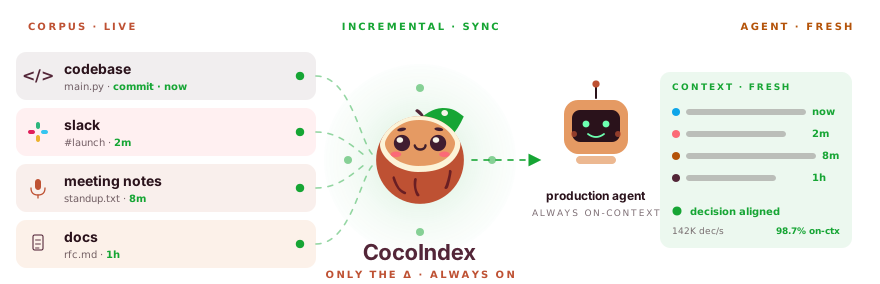
CocoIndex is a declarative data-pipeline framework that continuously syncs unstructured enterprise data—codebases, Slack, PDFs, meeting notes—into structured indices for LLM agents and RAG apps. You declare what the target index should look like in Python, and the Rust-backed engine keeps it in sync, recomputing only the delta when sources change. It targets the long-horizon agent problem: context that rots the moment your backfill job finishes.
The interesting bit
The team explicitly frames the project as “React — for data engineering”: you declare target state and the engine handles the diffing and recomputation. Functions can be memoized by a hash of their inputs plus a hash of their own code, so unchanged artifacts skip expensive steps like embedding generation. There is even a dedicated skill file to help AI coding agents write correct pipeline code—a neat bit of dogfooding.
Key highlights
- Incremental by default: only changed files and their downstream dependencies are reprocessed
- Declarative Python API over a Rust core; parallel execution is the default
- Ships with a flagship MCP server,
CocoIndex-code, that provides AST-aware semantic code indexing for tools like Claude Code and Cursor - Supports vector indices and knowledge-graph targets via connectors such as Postgres and local filesystem walkers
- Memoization via
@coco.fn(memo=True)caches results by content hash, not just timestamps
Caveats
- The README is heavy on animated badges and hero images; deep technical documentation on consistency models, failure handling, or connector maturity is not visible in the provided excerpts
- The “React for data engineering” analogy is presented as a heading but the detailed explanation is truncated in the sources
Verdict
Evaluate it if you are building production RAG or long-running agents that need to reason over live, messy enterprise data. Skip it if your context is small and static enough that a nightly batch job does the trick.
Frequently asked
- What is cocoindex-io/cocoindex?
- It exists to end the ritual of re-embedding your entire corpus every time someone edits a PDF.
- Is cocoindex open source?
- Yes — cocoindex-io/cocoindex is open source, released under the Apache-2.0 license.
- What language is cocoindex written in?
- cocoindex-io/cocoindex is primarily written in Rust.
- How popular is cocoindex?
- cocoindex-io/cocoindex has 11.8k stars on GitHub and is currently cooling off.
- Where can I find cocoindex?
- cocoindex-io/cocoindex is on GitHub at https://github.com/cocoindex-io/cocoindex.