city96/ComfyUI-GGUF
Run FLUX on a GPU that has no business running FLUX
A ComfyUI plugin that borrows llama.cpp's GGUF quantization to squeeze diffusion transformers into low-VRAM territory.
Not currently ranked — collecting fresh signals.
star history
What it does
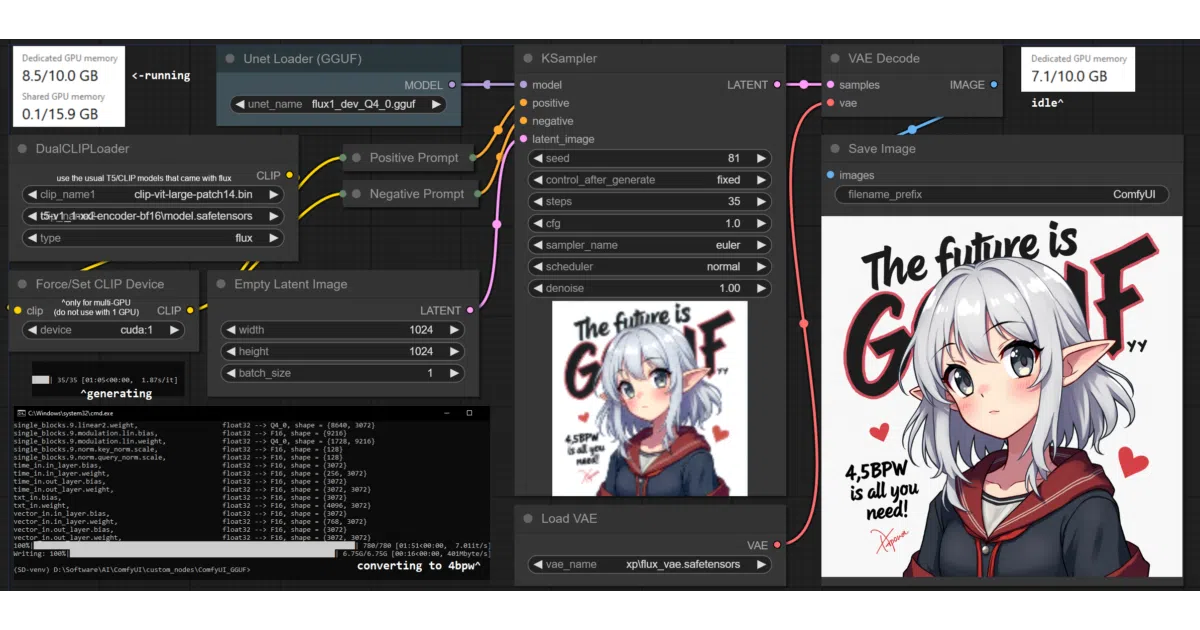
ComfyUI-GGUF adds custom nodes that load diffusion models in GGUF format — the same variable-bitrate quantization scheme that made large language models runnable on consumer hardware. It replaces the standard model loader with a Unet Loader (GGUF) node and includes a quantized T5 text encoder loader for extra VRAM savings.
The interesting bit
The author notes that old-school UNet models (with their conv2d layers) fell apart under quantization, but transformer-based diffusion models like FLUX and SD3.5 tolerate aggressive bit-crushing far better. This is a rare case where a format migration from an entirely different domain — LLM inference — actually ports over cleanly.
Key highlights
- Supports FLUX.1 [dev], FLUX.1 [schnell], SD3.5 Large, and SD3.5 Large Turbo in pre-quantized GGUF variants
- T5 text encoder quantization available via
*CLIPLoader (gguf)nodes; loaders accept bothggufand standardsafetensors/binfiles - Experimental LoRA loading via built-in ComfyUI nodes
- Includes tooling for creating custom quantizations in the
tools/directory - Ships with a single runtime dependency: the
ggufPython package
Caveats
- Explicitly marked “very much WIP” by the author
- macOS Sequoia users hit a torch 2.6.x nightly regression causing “M1 buffer is not large enough” errors; torch 2.4.1 appears to be the workaround
- LoRA loading is experimental
- Requires a recent ComfyUI build with custom ops support for UNET-only loading
Verdict
Worth a look if you’re running ComfyUI on hardware that can’t fit full-precision FLUX in VRAM. Skip if you’re on a 48GB workstation and value stability over novelty — this is still shaking out edge cases.
Frequently asked
- What is city96/ComfyUI-GGUF?
- A ComfyUI plugin that borrows llama.cpp's GGUF quantization to squeeze diffusion transformers into low-VRAM territory.
- Is ComfyUI-GGUF open source?
- Yes — city96/ComfyUI-GGUF is open source, released under the Apache-2.0 license.
- What language is ComfyUI-GGUF written in?
- city96/ComfyUI-GGUF is primarily written in Python.
- How popular is ComfyUI-GGUF?
- city96/ComfyUI-GGUF has 3.8k stars on GitHub.
- Where can I find ComfyUI-GGUF?
- city96/ComfyUI-GGUF is on GitHub at https://github.com/city96/ComfyUI-GGUF.