chorus-codes/chorus
Your AI Wrote the Code. Now Make Different AI Review It.
Chorus exists because the model that wrote your code shares its blind spots, so it drafts two to four rival AIs to review your diffs using subscriptions you already pay for.
Not currently ranked — collecting fresh signals.
star history
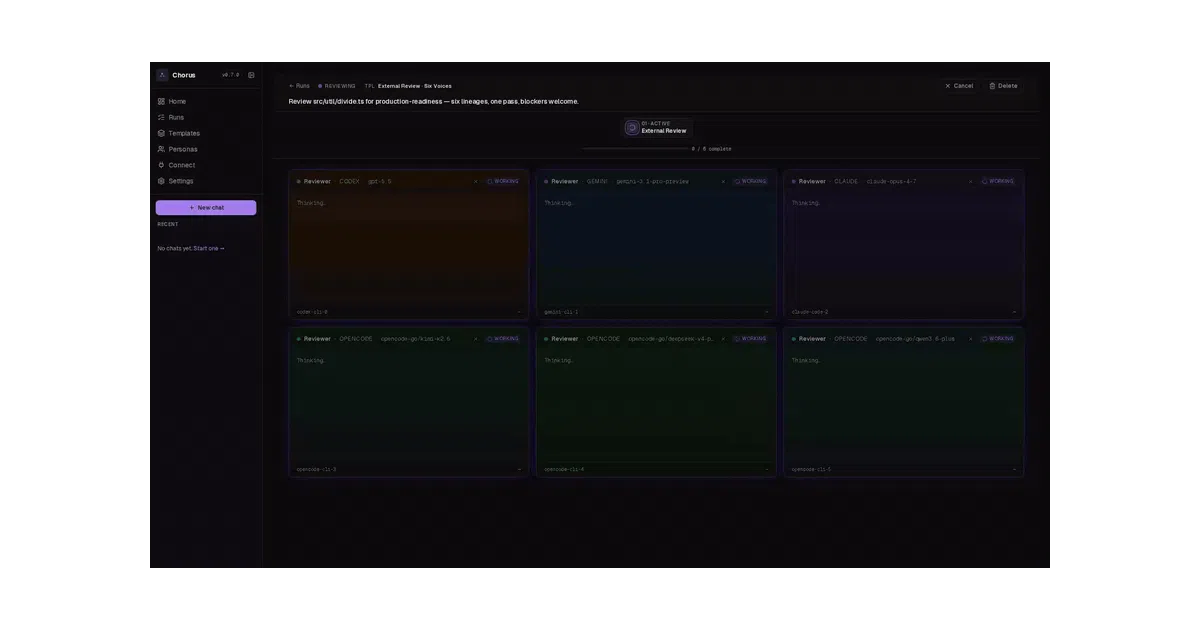
What it does Chorus acts as a local peer-review panel for AI-written code. It sends a given diff or task to two-to-four different LLM reviewers—Claude, GPT, Gemini, or others—through the CLI tools you already own, and surfaces a verdict only when they agree. The whole thing runs on your laptop and counts against the subscription quotas you already pay for, so a typical review costs nothing out of pocket.
The interesting bit Instead of burning pay-per-token API keys, Chorus drives the headless CLIs of your existing AI subscriptions to generate reviews. By forcing different vendors to cross-examine each other, it turns your existing monthly quotas into a multi-model safety net that costs nothing extra per review.
Key highlights
- Local-first: your code stays on your laptop; Chorus routes to the AI CLIs you already trust rather than a new vendor cloud.
- Template-driven reviews: built-in YAML patterns like
code-review,bug-diagnose, andred-greendefine reviewer count, vendor mix, and consensus rules. - Persona “hats”: assign reviewers roles like Sentinel (security), Cartographer (cross-platform), or Accountant (cost regressions) to target specific blind spots.
- MCP-native: plugs into Claude Code, Codex, Cursor, and others as an MCP server, letting you summon a multi-AI panel without leaving your editor.
- Subscription-first economics: leans on existing Claude Pro / ChatGPT Plus / Gemini Advanced quotas so typical reviews cost $0 out of pocket; API-key fallback averages $0.30–$1.50 per run.
Caveats
- Codex CLI headless mode currently blocks MCP tool calls under any approval policy; scripted or CI usage requires a dangerous bypass flag until a fix lands (see issue #16).
Verdict Worth a look if you already use AI coding assistants and want a structured way to catch their blind spots before merging. Skip it if you don’t generate code with AI, or if you’re hoping for a fully managed cloud service—this is strictly local tooling.
Frequently asked
- What is chorus-codes/chorus?
- Chorus exists because the model that wrote your code shares its blind spots, so it drafts two to four rival AIs to review your diffs using subscriptions you already pay for.
- Is chorus open source?
- Yes — chorus-codes/chorus is open source, released under the Apache-2.0 license.
- What language is chorus written in?
- chorus-codes/chorus is primarily written in TypeScript.
- How popular is chorus?
- chorus-codes/chorus has 526 stars on GitHub.
- Where can I find chorus?
- chorus-codes/chorus is on GitHub at https://github.com/chorus-codes/chorus.