chihming/awesome-network-embedding
A field guide to turning graphs into vectors
A curated index of 100+ network embedding papers with links to code, because nobody reads the references section.
Not currently ranked — collecting fresh signals.
star history
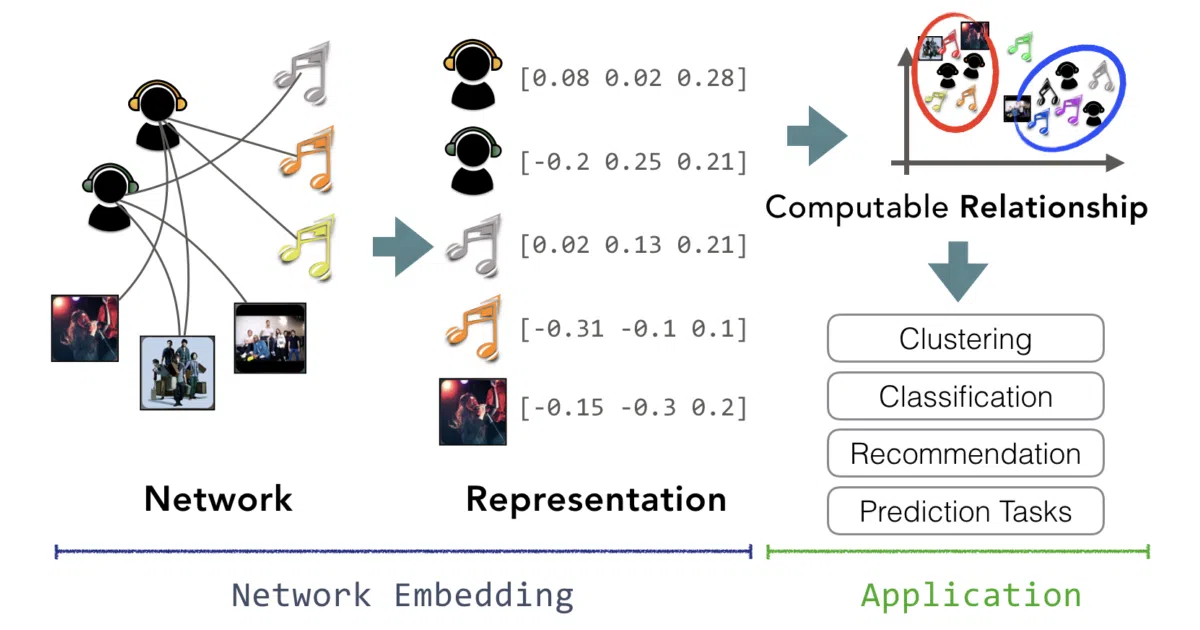
What it does This repo catalogs techniques for learning vector representations of network nodes—also called graph embedding, network representation learning, or knowledge embedding. Each entry links to the paper and, crucially, to available implementations in Python, PyTorch, TensorFlow, or occasionally C++ and Matlab.
The interesting bit The curation reveals how the field splintered and reconverged. You’ll find matrix factorization methods (NetMF, SymmNMF), random-walk approaches (Walklets, AttentionWalk), GNN layers (GAT, MixHop, GWNN), and specialized variants for signed networks (SGCN, SIDE), bipartite graphs (BiNE), temporal graphs (JODIE), and knowledge graphs (TuckER, HypER). The maintainer also flags when multiple papers share a single codebase—KarateClub appears so often it practically deserves co-authorship.
Key highlights
- Covers 2012–2020 with heavy concentration in 2018–2019, when the field exploded
- Includes both academic papers and practical libraries (PyTorch Geometric, PyTorch-BigGraph, AmpliGraph)
- Tracks implementation availability across frameworks, not just paper titles
- Spans specialized problem settings: incomplete networks, attributed graphs, directed graphs, signed edges, dynamic graphs
- Open call for contributions to reorganize with a clearer classification index
Caveats
- The list is chronological/alphabetical, not taxonomic; finding methods for your specific problem requires scanning
- README notes the maintainer is “planning to re-organize” but that call for help has been open for some time
- No comparative benchmarks or guidance on which method to choose when
Verdict Worth bookmarking if you’re starting graph ML research and need to map the territory, or if you need a quick implementation pointer. Skip it if you want principled comparisons or a tutorial—this is a bibliography with hyperlinks, not a textbook.
Frequently asked
- What is chihming/awesome-network-embedding?
- A curated index of 100+ network embedding papers with links to code, because nobody reads the references section.
- Is awesome-network-embedding open source?
- Yes — chihming/awesome-network-embedding is an open-source project tracked on heatdrop.
- How popular is awesome-network-embedding?
- chihming/awesome-network-embedding has 2.6k stars on GitHub.
- Where can I find awesome-network-embedding?
- chihming/awesome-network-embedding is on GitHub at https://github.com/chihming/awesome-network-embedding.