charent/ChatLM-mini-Chinese
How to train a 0.2B Chinese chatbot in your spare room
It exposes every step of building a 0.2B-parameter Chinese chatbot—from raw text cleaning to DPO—so you can train one on a GPU with just 4GB of VRAM.
Not currently ranked — collecting fresh signals.
star history
What it does
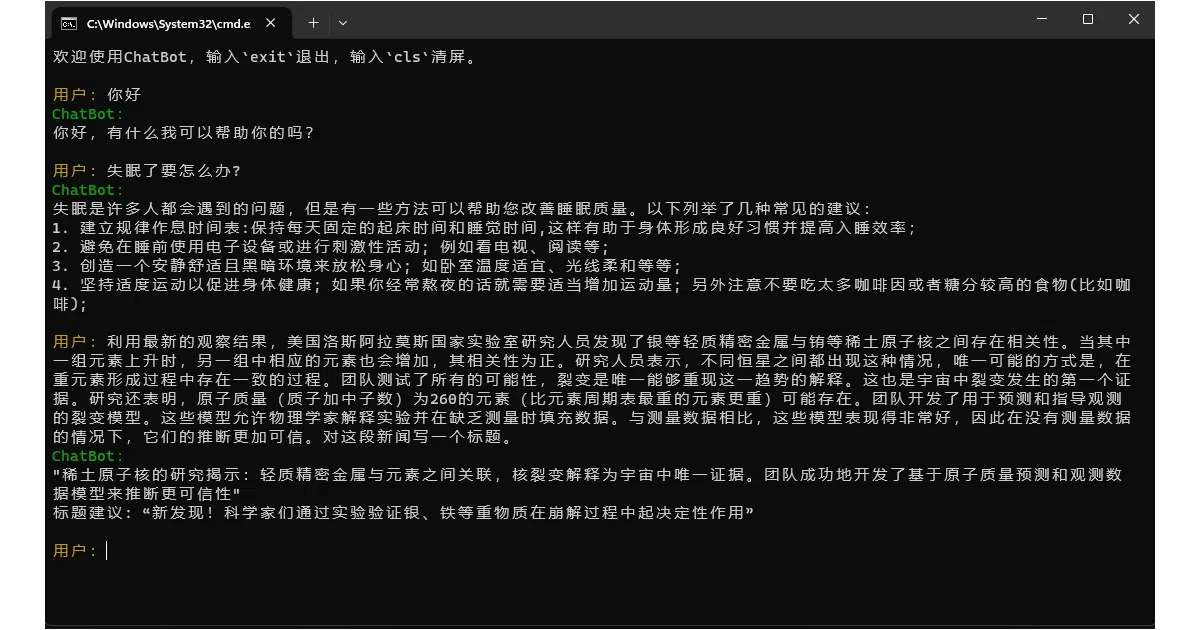
ChatLM-mini-Chinese is a 0.2B-parameter Chinese dialogue model built on a slimmed-down T5 backbone: ten encoder and decoder layers instead of T5-base’s twelve, plus a 29,298-token vocabulary weighted toward Chinese. The repository treats the model as a side effect of its real product, which is a complete, reproducible training pipeline. It ships the data sources, cleaning scripts, tokenizer training logic, text-to-text pre-training code, SFT trainer, and DPO preference optimization—enough to go from raw crawls to a chatbot that loads in 512MB of VRAM.
The interesting bit
The author built a custom trainer that streams gigabyte-scale datasets with buffer shuffling and mini-hash deduplication, deliberately avoiding memory and disk caches so the whole pre-training circus fits on a machine with 16GB of RAM and a 4GB GPU. There is also a working downstream example that fine-tunes the model for triplet information extraction without turning it into a single-task amnesiac, which is a neat trick for something this small.
Key highlights
- Full pipeline transparency: data provenance (webtext2019zh, BELLE, Zhihu-KOL, etc.), cleaning, tokenizer training, pre-training, SFT, and DPO are all included and documented.
- Consumer-grade feasibility: pre-trains at
batch_size=1on a 4GB GPU; inference infloat16needs only 512MB of VRAM. - Resilient training: custom trainer supports single-machine multi-GPU setups, arbitrary breakpoint resumption, and dynamic per-batch maximum length to squeeze into limited memory.
- Preference optimization: supports both full-model DPO and LoRA-based DPO, with adapter merging back into the base model.
- Downstream versatility: includes a triplet information extraction fine-tuning example that preserves the base dialogue capability.
Caveats
- The README candidly warns that 0.2B parameters and a 9.3-million-sample corpus are insufficient for broad coverage, so the model can wander off-topic or ramble.
- Streaming chat is hard-coded to greedy search; if you want beam sampling, you must disable the streamer.
- The tokenizer and data pipeline are narrowly tuned for Chinese text with minimal English support, and the author explicitly dropped datasets containing complex tables or translation tasks.
Verdict
This is a teaching specimen for developers who want to see how a language model is actually born, not just how to prompt one. If you need a reliable, general-purpose Chinese conversationalist for production, look elsewhere—the author admits this is homework, not a finished oracle.
Frequently asked
- What is charent/ChatLM-mini-Chinese?
- It exposes every step of building a 0.2B-parameter Chinese chatbot—from raw text cleaning to DPO—so you can train one on a GPU with just 4GB of VRAM.
- Is ChatLM-mini-Chinese open source?
- Yes — charent/ChatLM-mini-Chinese is open source, released under the Apache-2.0 license.
- What language is ChatLM-mini-Chinese written in?
- charent/ChatLM-mini-Chinese is primarily written in Python.
- How popular is ChatLM-mini-Chinese?
- charent/ChatLM-mini-Chinese has 1.7k stars on GitHub.
- Where can I find ChatLM-mini-Chinese?
- charent/ChatLM-mini-Chinese is on GitHub at https://github.com/charent/ChatLM-mini-Chinese.