c2g-dev/city2graph
Your city, but as a graph your GNN can actually read
A Python bridge that turns messy geospatial data—streets, transit feeds, building footprints—into PyTorch Geometric tensors without the usual hand-rolled pain.
Not currently ranked — collecting fresh signals.
star history
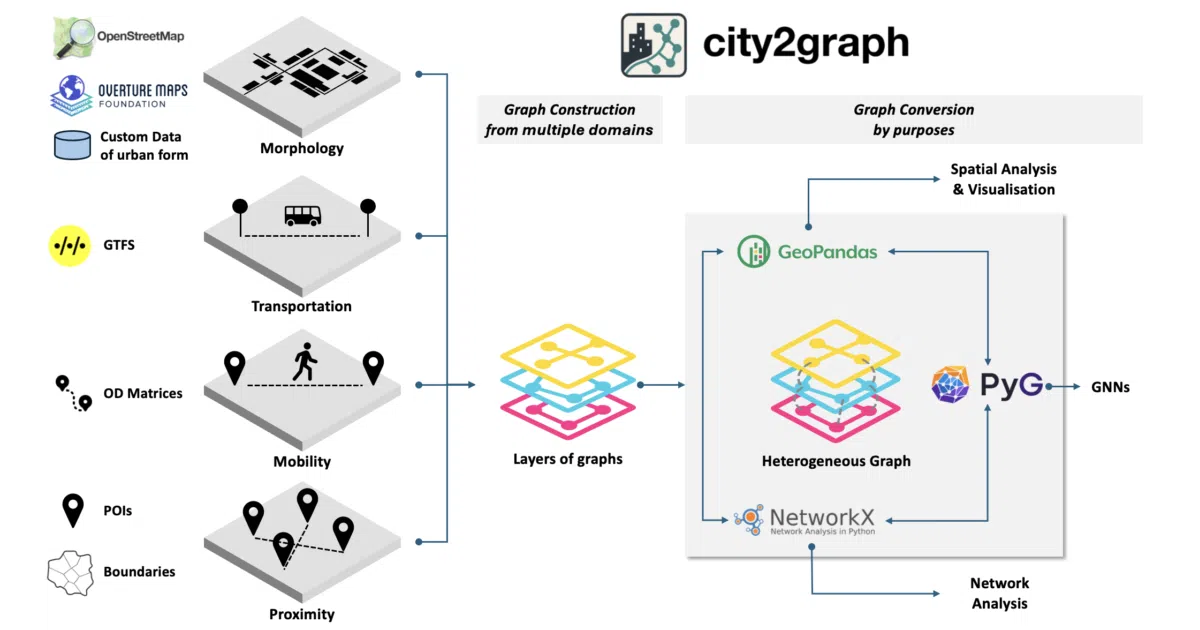
What it does City2Graph converts urban geospatial datasets into graph representations for network analysis and Graph Neural Networks. It wraps GeoPandas, NetworkX, and PyTorch Geometric into a single interface, handling streets, transit networks, POI proximities, mobility flows, and land-use adjacency.
The interesting bit The GTFS integration is the quiet standout: it queries transit feeds through DuckDB and builds detailed accessibility graphs, which is the kind of plumbing most people rebuild badly. The library also handles multi-center distance filtering and layered isochrones—spatial operations that sound routine until you try to implement them yourself.
Key highlights
- Builds graphs from buildings, streets, land use, and OD matrices
- Queries GTFS feeds via DuckDB for transit network modeling
- Supports proximity, contiguity, and mobility flow analysis (bike-sharing, migration, pedestrian)
- Converts geospatial data directly to PyTorch Geometric tensors
- Available on PyPI and conda-forge with optional CPU/GPU PyTorch extras
- BSD-3-Clause license with a Zenodo DOI for citation
Caveats
- The README warns that conda is “not officially supported by PyTorch and PyTorch Geometric anymore” and recommends pip or uv instead
- Documentation is split across two systems: MkDocs for v0.2.0+, Sphinx for legacy v0.1.x releases
- One Docker Compose example still points to
yu-ta-sato/city2graphrather than thec2g-devorg, suggesting a minor migration cleanup gap
Verdict Worth a look if you’re doing urban GNN research or spatial network analysis and tired of writing conversion glue. Skip it if your graphs don’t have a geographic component—this is purpose-built for cities, not general graph construction.
Frequently asked
- What is c2g-dev/city2graph?
- A Python bridge that turns messy geospatial data—streets, transit feeds, building footprints—into PyTorch Geometric tensors without the usual hand-rolled pain.
- Is city2graph open source?
- Yes — c2g-dev/city2graph is open source, released under the BSD-3-Clause license.
- What language is city2graph written in?
- c2g-dev/city2graph is primarily written in Python.
- How popular is city2graph?
- c2g-dev/city2graph has 1.9k stars on GitHub.
- Where can I find city2graph?
- c2g-dev/city2graph is on GitHub at https://github.com/c2g-dev/city2graph.