borawong/AiMaMi
A control panel for the mess Codex leaves in ~/.codex
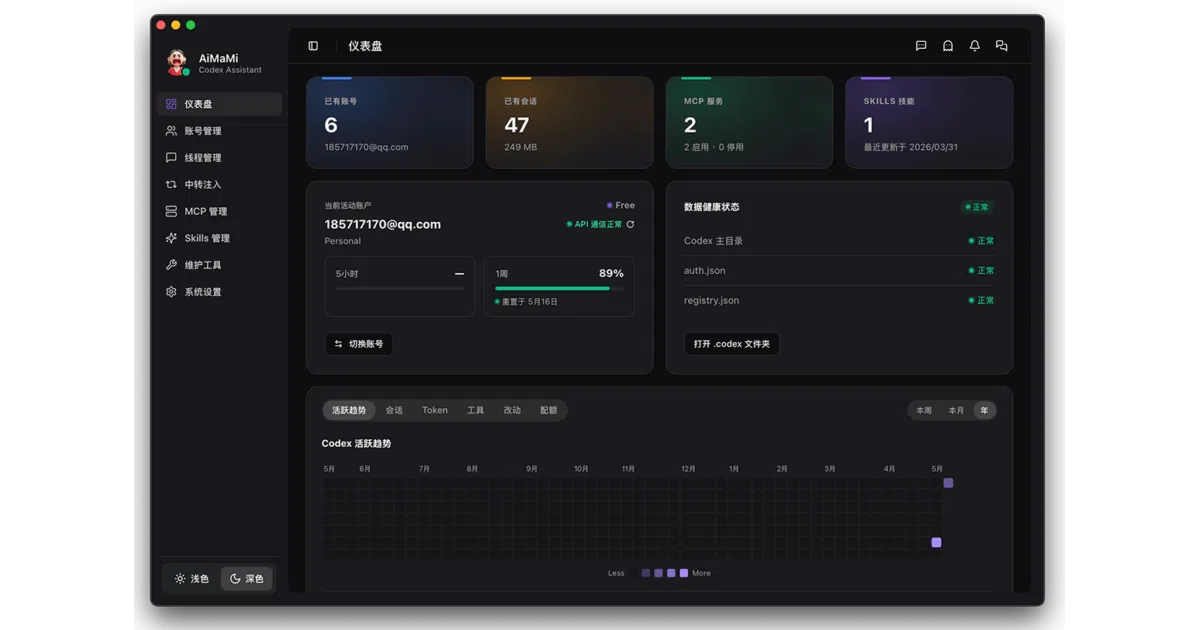
AiMaMi wraps OpenAI Codex's scattered config files, accounts, and sessions into one Tauri desktop app so you stop hand-editing TOML and SQLite.
Velocity · 7d
+0.7
★ / day
Trend
→steady
star history
What it does
Codex keeps accounts, sessions, MCP entries, Skills, and router settings spread across TOML, JSON, and SQLite files under ~/.codex. AiMaMi is a native desktop app (Tauri 2, React, Rust) that reads and writes all of that locally: account switching, quota monitoring with automatic fallback when the 5-hour or weekly limit hits, session inspection and bulk cleanup, MCP/Skills management, and config repair.
The interesting bit
The smart router forwards relay/third-party models through AiMaMi’s own local proxy, so you can use them inside Codex Desktop while keeping historical threads resumable. The catch: AiMaMi has to keep running for relay models to work. It also touches only its own managed block in AGENTS.md, with preview and rollback — a nice bit of restraint for a tool that edits your files.
Key highlights
- Auto-switch accounts on quota exhaustion, with Codex restart
- Session management against the real local index, including bulk cleaning
- Relay provider setup, connectivity tests, and router diagnostics
- System maintenance: diagnose, rebuild registry, force-quit Codex, fix common config issues
- macOS notch and tray quota display; English and Chinese UIs
Caveats
- Linux support is explicitly “best-effort” for some workflows only
- Relay traffic depends on a third-party proxy staying alive — a new moving part in your setup
- Not affiliated with OpenAI; relay usage is at your own risk per the disclaimer
Verdict
Worth a look if you juggle multiple Codex accounts or relay providers and are tired of editing auth.json by hand. If you’re a single-account, straight-from-OpenAI user, most of this is solving problems you don’t have.
Frequently asked
- What is borawong/AiMaMi?
- AiMaMi wraps OpenAI Codex's scattered config files, accounts, and sessions into one Tauri desktop app so you stop hand-editing TOML and SQLite.
- Is AiMaMi open source?
- Yes — borawong/AiMaMi is open source, released under the Apache-2.0 license.
- What language is AiMaMi written in?
- borawong/AiMaMi is primarily written in TypeScript.
- How popular is AiMaMi?
- borawong/AiMaMi has 1.5k stars on GitHub and is currently holding steady.
- Where can I find AiMaMi?
- borawong/AiMaMi is on GitHub at https://github.com/borawong/AiMaMi.