baidu-baige/LoongForge
Baidu's internal trainer chases every modality at once
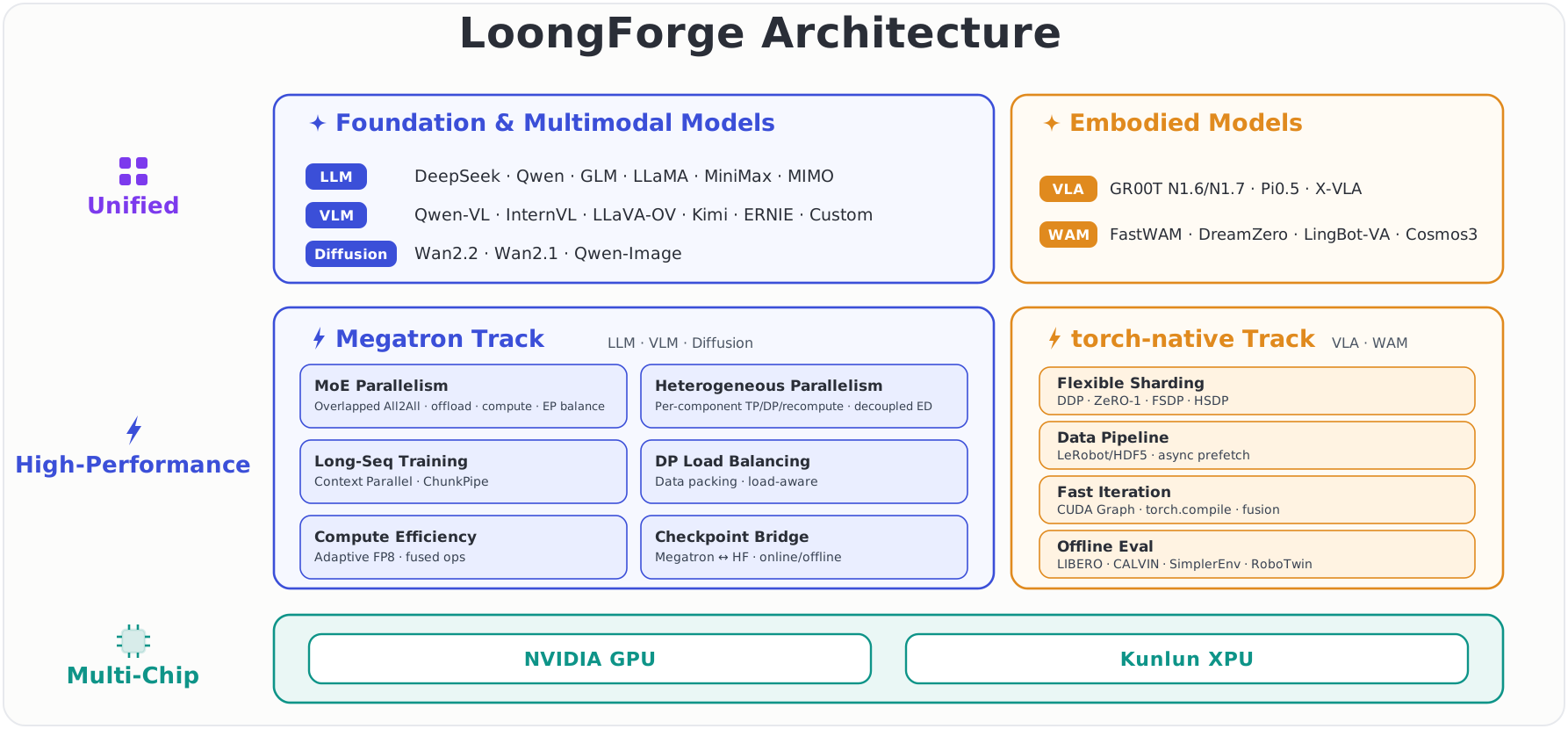
LoongForge is Baidu's unified training stack for language, vision, diffusion, and embodied models, open-sourced after serving production runs on thousands of XPUs and GPUs.
Not currently ranked — collecting fresh signals.
star history
What it does
LoongForge is a training framework that wraps Megatron-LM for language, vision, and diffusion models, and a separate torch-native DDP/FSDP stack for embodied AI. It targets pre-training, continued pre-training, and supervised fine-tuning across both NVIDIA GPUs and Kunlun XPUs. Before it was open-sourced as LoongForge, it ran inside Baidu as AIAK-Training-LLM, reportedly delivering 30%–50% speedups over customer baselines on production runs scaling past 5,000 XPUs.
The interesting bit
The framework treats heterogeneity as a first-class feature: you can assign independent tensor-parallel, data-parallel, and recomputation strategies to different components of a VLM—say, the ViT encoder versus the LLM backbone—rather than forcing one global strategy. For MoE models, it even implements topology-aware dynamic expert replica placement (TAOT) to fix Expert Parallel load imbalance, which is the kind of optimization usually locked inside proprietary clouds.
Key highlights
- Dual-backend architecture:
Megatron-LMfor LLM/VLM/diffusion, torch-nativeDDP/FSDPfor VLA and world-action models, each heavily optimized rather than abstracted into a least-common-denominator API. - Heterogeneous parallelism: Independent parallelization and memory strategies per model component, plus decoupled encoder-decoder training to kill pipeline bubbles.
- MoE-native optimizations: Overlapped
All2All, activation offload, and adaptiveFP8training with per-operator precision selection; the TAOT paper claims low-communication expert rebalancing. - Hardware coverage: Native support for NVIDIA GPUs and Kunlun XPUs via a plugin design, with pre-built Docker images and dedicated XPU tutorials.
- Checkpoint diplomacy: Offline bidirectional conversion between
MegatronandHuggingFaceformats, plus native online HF load/save.
Caveats
- The headline 5× speedup for
DeepSeek-V3.2was measured on a reduced-layer “Lite” configuration because the test bed lacked the scale to run the full model. - The highest-performance fused DSA kernels are only available on the Baidu Baige platform; the open-source release provides a
TileLangversion. - Embodied training is explicitly decoupled from the
Megatroncore, so “unified” here means coexistence under one umbrella rather than a single execution engine.
Verdict
Worth a look if you are training large open-source models at scale and want Baidu’s collection of memory and parallelism tricks without writing your own kernels. Skip it if you need a lightweight, single-GPU fine-tuning script; this is a heavy industrial stack.
Frequently asked
- What is baidu-baige/LoongForge?
- LoongForge is Baidu's unified training stack for language, vision, diffusion, and embodied models, open-sourced after serving production runs on thousands of XPUs and GPUs.
- Is LoongForge open source?
- Yes — baidu-baige/LoongForge is open source, released under the Apache-2.0 license.
- What language is LoongForge written in?
- baidu-baige/LoongForge is primarily written in Python.
- How popular is LoongForge?
- baidu-baige/LoongForge has 666 stars on GitHub.
- Where can I find LoongForge?
- baidu-baige/LoongForge is on GitHub at https://github.com/baidu-baige/LoongForge.