arcelien/pba
AutoML for image augmentation that won't melt your GPU
PBA learns when and how strongly to distort training images, trading the brute-force search of AutoAugment for a population-based approach that runs on a single workstation.
Not currently ranked — collecting fresh signals.
star history
What it does
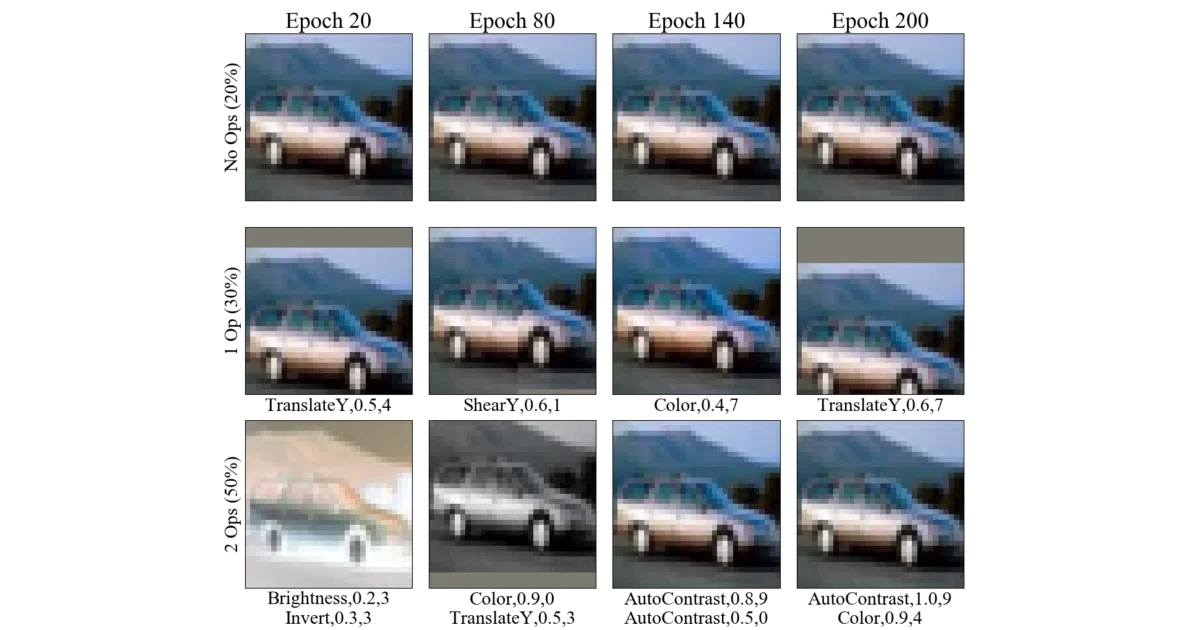
Population Based Augmentation (PBA) automatically learns schedules for data augmentation—deciding not just which transforms to apply, but how strongly and when during training. It targets the same problem as Google’s AutoAugment, but with a fraction of the compute budget. The repo includes pre-baked schedules for CIFAR-10/100 and SVHN, plus code to discover new ones.
The interesting bit
The cleverness is in the search: instead of training thousands of models to completion, PBA maintains a population of small models that periodically copy weights from better performers and mutate their augmentation policies. Reduced SVHN search finishes in about an hour on a Titan XP; reduced CIFAR-10 in five hours. The full CIFAR-10 PyramidNet result still takes 9 days on a V100, but that’s training, not search.
Key highlights
- Matches reported AutoAugment results on CIFAR with “one thousand times less compute” (per the README)
- Pre-computed schedules available for Wide-ResNet, Shake-Shake, and PyramidNet variants
- Includes a Jupyter notebook (
pba.ipynb) to visualize policies and applied augmentations - Search scripts support reduced datasets for quick iteration; full reproduction scripts included
- Python 2 and 3 compatible
Caveats
- TensorFlow-only; no PyTorch implementation in repo
- The “1000x less compute” claim compares search cost, not total training cost—full model training is still expensive
- Code appears to be research-grade: functional but not packaged as a library
Verdict
Worth a look if you’re doing image classification on CIFAR-scale datasets and want augmentation policies without burning a TPU pod. Skip if you need plug-and-play PyTorch or are working far outside the tested model/dataset combinations.
Frequently asked
- What is arcelien/pba?
- PBA learns when and how strongly to distort training images, trading the brute-force search of AutoAugment for a population-based approach that runs on a single workstation.
- Is pba open source?
- Yes — arcelien/pba is open source, released under the Apache-2.0 license.
- What language is pba written in?
- arcelien/pba is primarily written in Jupyter Notebook.
- How popular is pba?
- arcelien/pba has 509 stars on GitHub.
- Where can I find pba?
- arcelien/pba is on GitHub at https://github.com/arcelien/pba.