angel291592/Intent-Router
Compiling 'add caching' into a contract before the agent writes code
Routers and typed-decision models assume the request arriving is already clear; this skill is the upstream layer that converges a vague one-liner into a typed, evidence-backed contract.
Too new to rank. Velocity needs a few days of history.
not enough history yet
star history
What it does
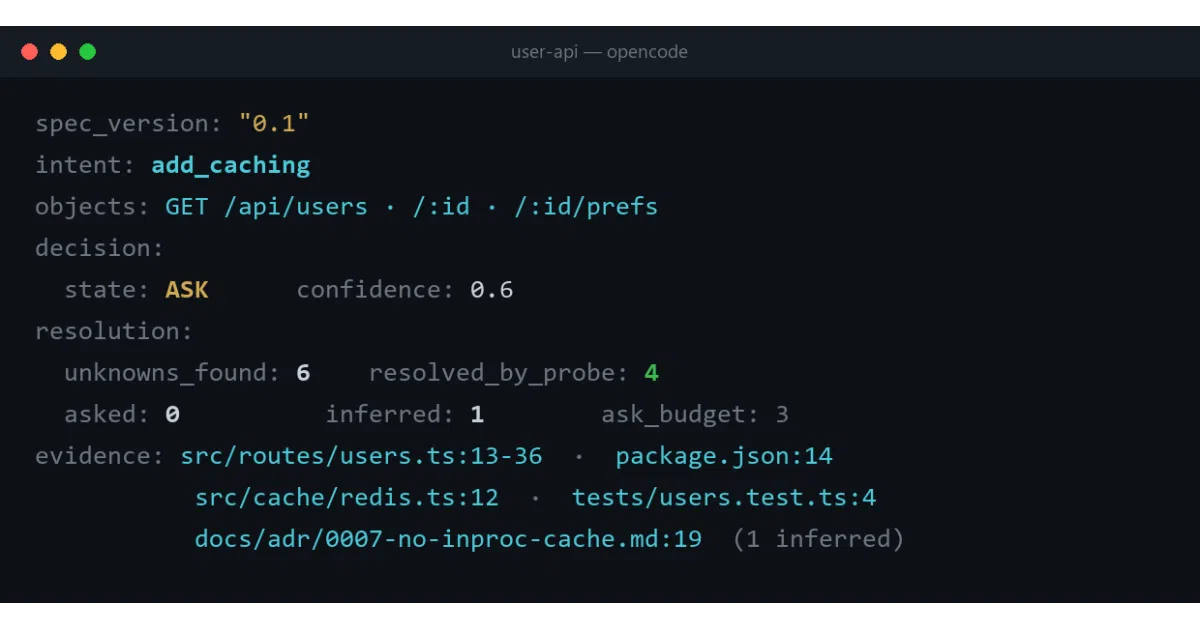
Intent-Router is a prompt-only skill that sits between a human’s one-liner and the agent that executes it. Given something like ‘add caching to the user API,’ it runs three passes — parse, resolve, typecheck, emit — probing your dependencies, routes, git history, and ADRs before interrupting you, then asking only the question no file can answer. Requests that contradict themselves, admit two readings, or rest on a premise your repo already disproves get called out rather than guessed past, and anything irreversible and underspecified triggers a halt instead of an emit. The result is a machine-readable IntentSpec saved to .intent/<intent>.intent.yaml, and once work is delivered it gets checked against that spec one constraint at a time — not a vibe check.
The interesting bit The spec is a persistent artifact, not chat ephemera: it records its own state (awaiting an answer, settled, carried out), every probed field carries an evidence pointer, and a later session reads the file before probing anything — an answered question is never asked twice. That’s the piece a conversation can’t hold, and it’s what separates this from stateless grill-me-style skills. Credit where due: the comparison table openly notes that all five bare runs in its own eval read the relevant ADR without help — a rarer kind of honesty than most positioning tables manage.
Key highlights
- Probe before ask: deps, routes, git history, ADRs, ticket logs, and docs get read before you get interrupted.
- Decision states of
PROBE,ASK, andHALTbefore emitting, withambiguous,conflict, andpremisefindings checked against repo evidence. - The artifact outlives the session:
.intent/<intent>.intent.yamlcarries state and evidence pointers, and intent-check verdicts are written back into the same file. - In its delivery comparison (N=3 skill vs N=5 bare), every skill run asked exactly one question and all three shipped caches with an explicit failure policy; none of the bare deliveries stated one.
- The pitch is ‘prompt equity’: say it like you’d say it to a capable teammate, and the skill writes the briefing a senior engineer would have written first.
Caveats
- The eval samples are tiny — three runs versus five — and the README, to its credit, prints the N everywhere.
- ‘Compiler’ is a metaphor: at the L0 backend it’s a prompt, so the typecheck and halt behavior are model discipline, not anything code enforces.
- The comparison table leans on ’not documented’ gaps in competitors’ docs, which is absence of evidence rather than evidence of absence.
Verdict Worth a look if vague human requests feed your agent pipeline — especially if you run typed-decision models like Jev or Laya and lack the upstream layer that produces their assumed input. Skip it if you want enforced guarantees rather than model discipline, or if spec-kit or Kiro’s spec workflow already fits your team.
Frequently asked
- What is angel291592/Intent-Router?
- Routers and typed-decision models assume the request arriving is already clear; this skill is the upstream layer that converges a vague one-liner into a typed, evidence-backed contract.
- Is Intent-Router open source?
- Yes — angel291592/Intent-Router is open source, released under the MIT license.
- What language is Intent-Router written in?
- angel291592/Intent-Router is primarily written in Python.
- How popular is Intent-Router?
- angel291592/Intent-Router has 718 stars on GitHub.
- Where can I find Intent-Router?
- angel291592/Intent-Router is on GitHub at https://github.com/angel291592/Intent-Router.