amplifthq/opentag
Slack mentions that run Codex on your laptop
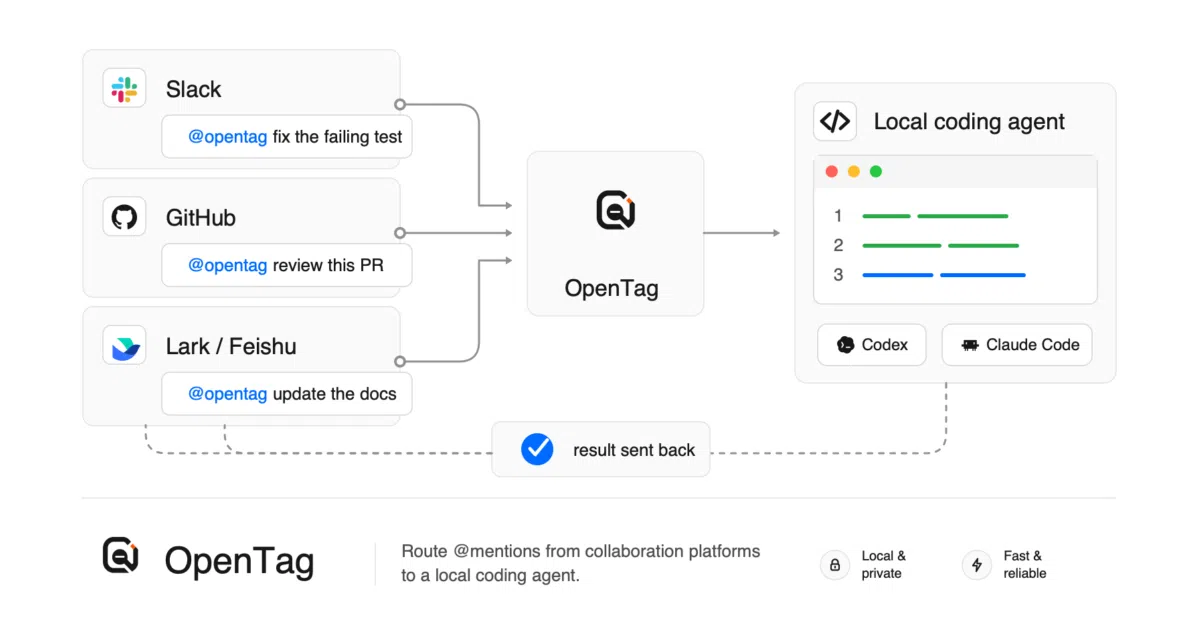
OpenTag lets teams summon local coding agents from Slack or GitHub without shipping code or credentials off the machine.
Not currently ranked — collecting fresh signals.
star history
What it does
OpenTag is a local relay that listens for @agent mentions on Slack, GitHub, or Lark and hands them off to Codex or Claude Code running on your own computer. It returns the agent’s output in the same thread, effectively turning a chat message into a local compute job. A built-in dispatcher keeps platform credentials, config, and runtime state on the machine.
The interesting bit
The project treats the source thread as an approval surface for system-of-record mutations. When an agent proposes a change, OpenTag renders a compact receipt showing exactly what will change and whether the action is safe to apply; Apply only appears once the dispatcher confirms a configured adapter can execute it. That keeps the loop tight: conversation, computation, and consent all happen in one place.
Key highlights
- Runs fully offline in the local CLI flow: no OpenTag cloud service, credentials stay on disk with restricted permissions, and agents execute against your local checkout.
- Supports Slack (Socket Mode), GitHub (webhooks), and Lark / Feishu; an experimental Telegram adapter exists but lacks CLI setup.
- Background service mode via LaunchAgent on macOS and
systemd --useron Linux; terminal mode elsewhere. - Ships as a scoped npm monorepo (
@opentag/cli,@opentag/local-runtime, etc.) under an MIT license.
Caveats
- The Telegram adapter is experimental and not yet wired into the CLI setup flow.
- Background service mode is limited to macOS and Linux; other platforms require keeping a terminal open.
Verdict
Worth a look if your team lives in Slack or GitHub issues and wants local agents to act on their behalf without standing up cloud infrastructure. Skip it if you need a managed SaaS or background service support outside macOS and Linux today.
Frequently asked
- What is amplifthq/opentag?
- OpenTag lets teams summon local coding agents from Slack or GitHub without shipping code or credentials off the machine.
- Is opentag open source?
- Yes — amplifthq/opentag is open source, released under the MIT license.
- What language is opentag written in?
- amplifthq/opentag is primarily written in TypeScript.
- How popular is opentag?
- amplifthq/opentag has 1.4k stars on GitHub.
- Where can I find opentag?
- amplifthq/opentag is on GitHub at https://github.com/amplifthq/opentag.