alibaba/graph-learn
Alibaba's GNN engine: training graphs that mutate in production
A battle-tested framework that closes the loop between offline graph training and real-time streaming inference at Alibaba scale.
Not currently ranked — collecting fresh signals.
star history
What it does
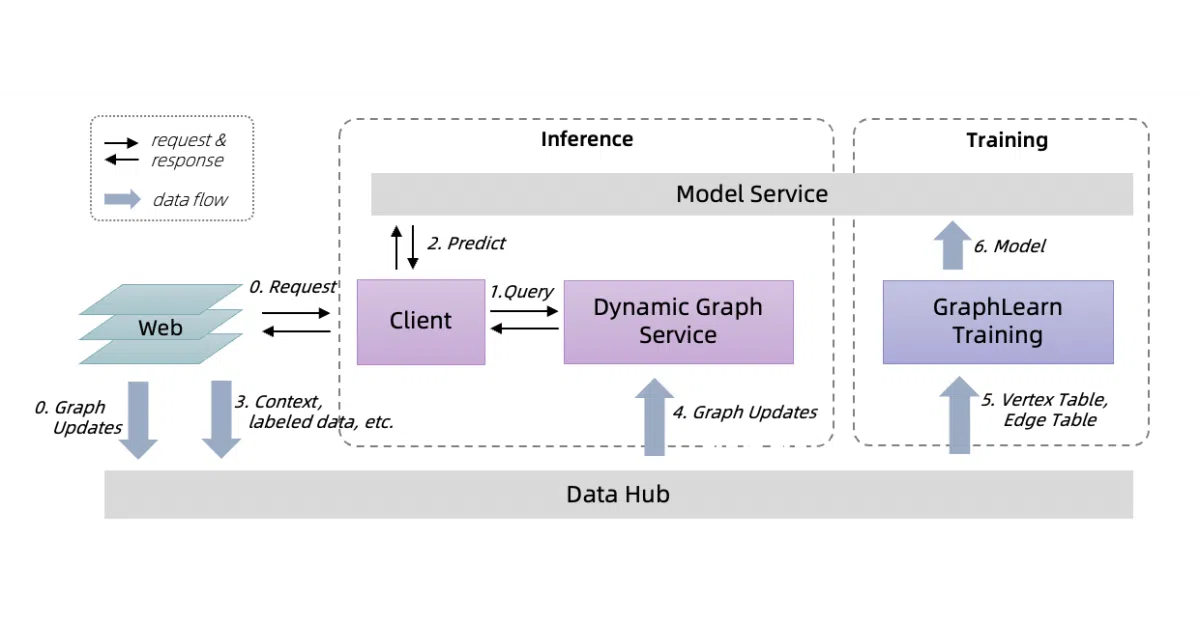
Graph-Learn (formerly AliGraph) is a distributed C++ framework for building and deploying large-scale graph neural networks. It has two main parts: GraphLearn-Training for offline or incremental model training, and Dynamic-Graph-Service for online inference with real-time graph updates. Both speak a Gremlin-like Graph Sampling Language (GSL), and the training side supports TensorFlow and PyTorch.
The interesting bit
Most GNN frameworks stop at batch training. Graph-Learn keeps going: it runs a streaming loop where user requests trigger real-time sampling on a dynamic graph, predictions feed back into a data hub, and those updates stream back into the graph service. Training reloads hourly, retrains incrementally, and pushes new models to the inference service. The claimed P99 sampling latency is 20ms on large dynamic graphs — fast enough for live search and recommendation traffic.
Key highlights
- Dual runtime support: TensorFlow and PyTorch backends for model development
- Gremlin-inspired GSL for graph sampling, with both Python and C++ APIs
- Java client SDK for online inference, plus TensorFlow Model Predict integration
- Incremental training on sliding graph windows, not just full retraining
- Proven production load at Alibaba: search, security, and knowledge graph use cases
Caveats
- The 20ms P99 latency claim lacks reproducible benchmark details in the README
- Documentation and examples are referenced but not included in-repo; you are sent to ReadTheDocs
- The PyTorch acceleration library is now a separate repo, suggesting the core may be TF-first
Verdict
Worth a look if you need GNNs in a live production loop, not just research batch jobs. Skip it if you want a lightweight, single-node library or a batteries-included Python package with everything in one install.
Frequently asked
- What is alibaba/graph-learn?
- A battle-tested framework that closes the loop between offline graph training and real-time streaming inference at Alibaba scale.
- Is graph-learn open source?
- Yes — alibaba/graph-learn is open source, released under the Apache-2.0 license.
- What language is graph-learn written in?
- alibaba/graph-learn is primarily written in C++.
- How popular is graph-learn?
- alibaba/graph-learn has 1.3k stars on GitHub.
- Where can I find graph-learn?
- alibaba/graph-learn is on GitHub at https://github.com/alibaba/graph-learn.