agentscope-ai/agentscope
AgentScope bets on smarter models, not smarter prompts
A Python framework for building production multi-agent systems that leans on LLM reasoning instead of rigid prompt choreography.
Velocity · 7d
+106
★ / day
Trend
↗accelerating
star history
What it does
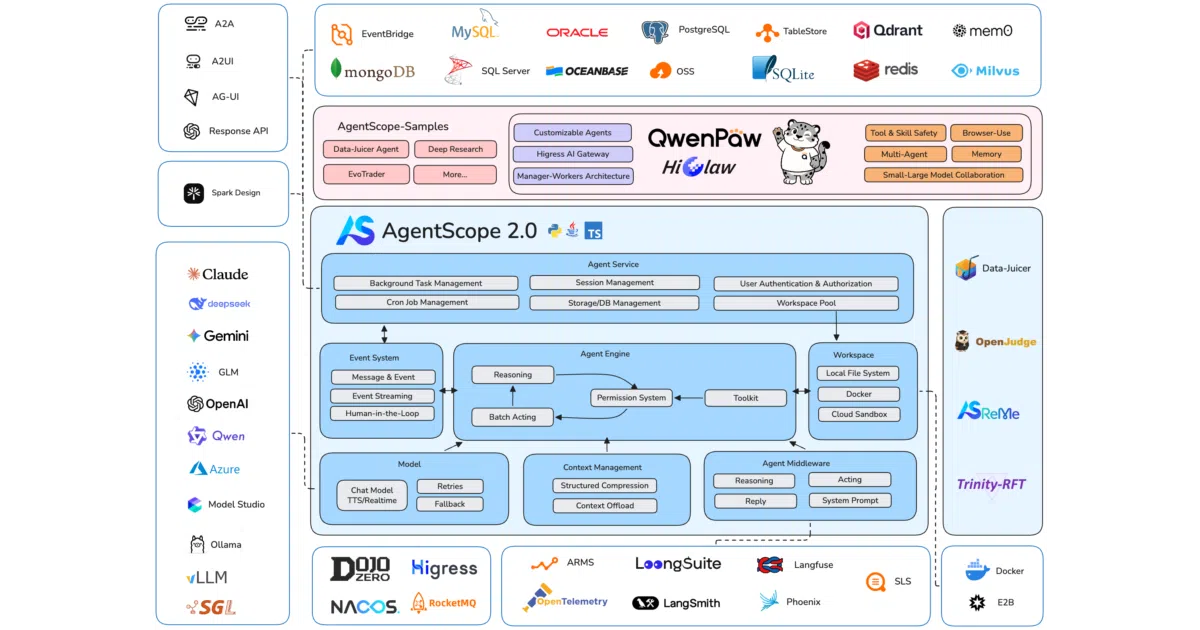
AgentScope 2.0 is a Python framework for building, running, and deploying LLM agents. It bundles ReAct agents, toolkits, memory, planning, realtime voice, evaluation, and model finetuning into one toolkit, and ships with a FastAPI-based service that supports multi-tenancy, multi-session chat, and a pre-built Web UI.
The interesting bit
Instead of forcing developers into prompt-engineering gymnastics, AgentScope treats the model as the orchestrator—leveraging native reasoning and tool-use capabilities. It also supports MCP and A2A protocols, so your agents can plug into broader tool and agent ecosystems without bespoke adapters.
Key highlights
- Streaming event architecture with
EventTypedeltas for real-time agent feedback - Deploys locally, serverless, or on Kubernetes with built-in OTel support
- MCP and A2A protocol support for tool and agent interoperability
- Includes model finetuning support and evaluation utilities out of the box
- Pre-built Web UI and multi-session FastAPI service for immediate prototyping
Caveats
- The README examples center on DashScope/Qwen models; broader model provider support is implied but not demonstrated in the provided source
- Requires Python 3.11+, which may sideline older environments
Verdict
Worth evaluating if you want a batteries-included path from prototype to production without writing a custom orchestration DSL. Skip it if you need a minimal agent library or are pinned to an older Python stack.
Frequently asked
- What is agentscope-ai/agentscope?
- A Python framework for building production multi-agent systems that leans on LLM reasoning instead of rigid prompt choreography.
- Is agentscope open source?
- Yes — agentscope-ai/agentscope is open source, released under the Apache-2.0 license.
- What language is agentscope written in?
- agentscope-ai/agentscope is primarily written in Python.
- How popular is agentscope?
- agentscope-ai/agentscope has 34.3k stars on GitHub and is currently accelerating.
- Where can I find agentscope?
- agentscope-ai/agentscope is on GitHub at https://github.com/agentscope-ai/agentscope.